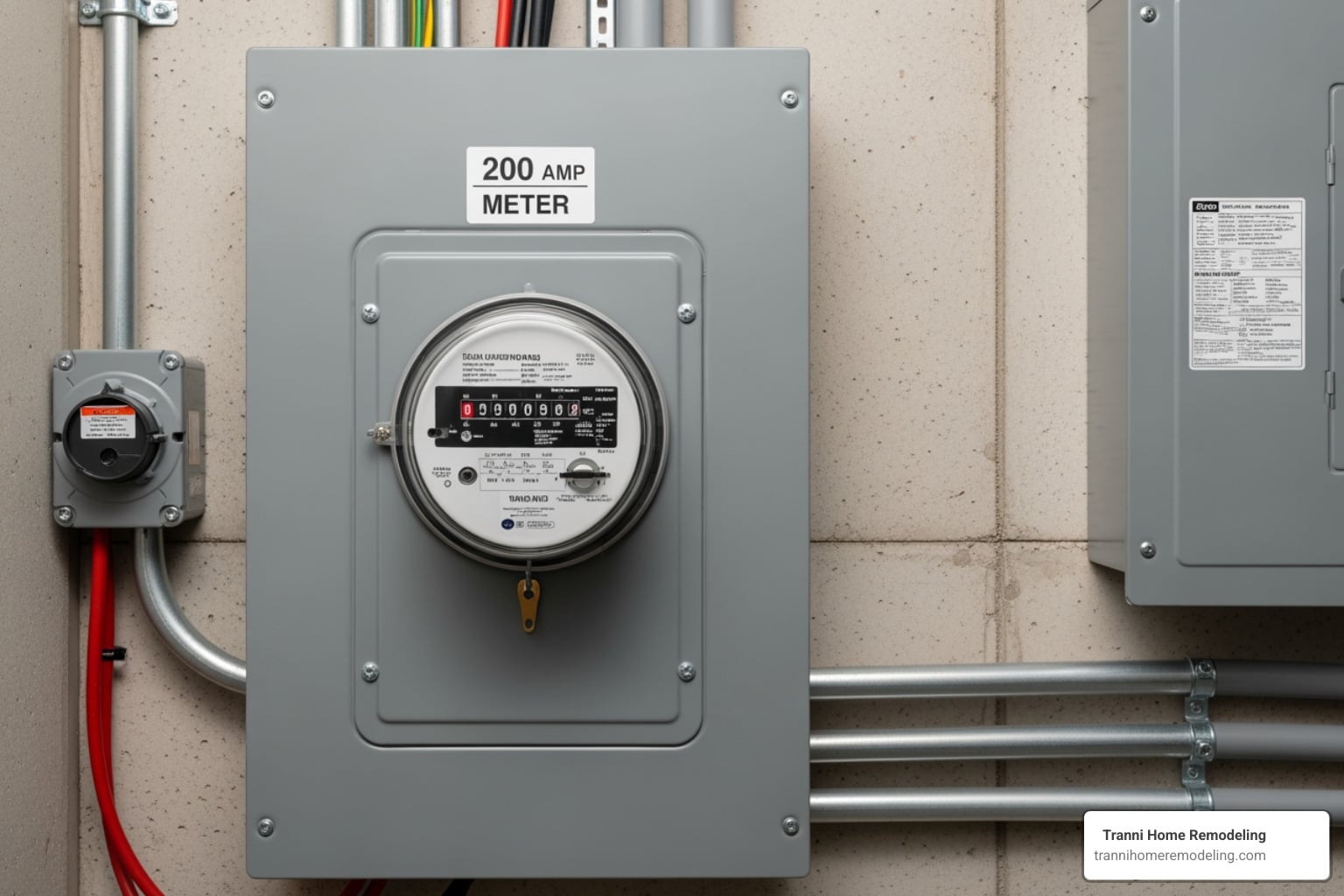





What Is a 200 Amp Panel with Meter — and Do You Need One?
A 200 amp panel with meter is an all-in-one electrical service unit that combines your utility meter socket and your main breaker panel into a single enclosure mounted on the outside of your home.
Here’s a quick overview of what to know before you dive in:
| Feature | Details |
|---|---|
| What it is | Meter socket + main breaker + load center in one unit |
| Typical use | New residential service entrances and service upgrades |
| Common brands | Siemens, Square D, Eaton, Leviton, Midwest |
| Circuit range | 4-space/8-circuit up to 30-space/42-circuit |
| Price range (materials only) | ~$150 to $720+ depending on brand and configuration |
| Key benefit | Saves space, simplifies wiring, and reduces installation time |
| Solar ready? | Yes — many modern models include dedicated solar input |
Whether you’re upgrading an aging electrical system, adding a detached shop, or building new, choosing the right 200 amp meter combo panel can save you time, money, and headaches down the road.
Homeowners in Billerica, MA and surrounding towns face a real challenge here: the market has over 160 different meter-panel combo products across major brands, with specs and code requirements that can feel overwhelming fast.
This guide breaks it all down — clearly and without the jargon.
I’m Tyler Tranni, owner of Tranni Home Remodeling, and I’ve worked on countless residential electrical upgrades — including 200 amp panel with meter installations — across Billerica and nearby communities. I’ll walk you through everything you need to know to make a confident, code-compliant decision for your home.
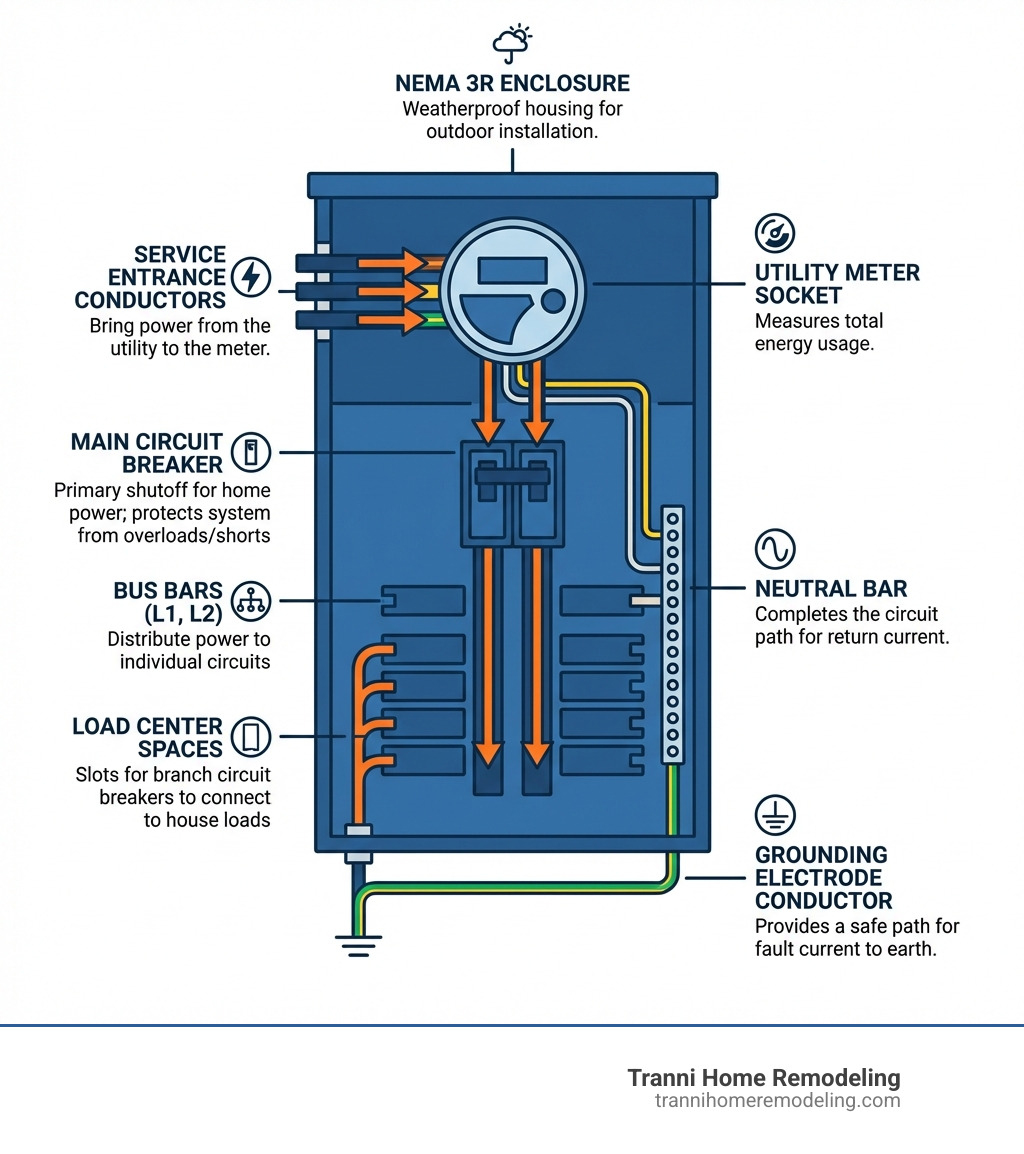
Easy 200 amp panel with meter glossary:
Understanding the 200 amp panel with meter
When we talk about a 200 amp panel with meter, we are usually referring to a Combination Service Entrance Device (CSED). In the electrical world, these are the “Swiss Army Knives” of service equipment. Instead of having a meter box on the outside of your house and a separate breaker panel tucked away in the basement or garage, the CSED puts them both in one weatherproof box.
Because these units are mounted outdoors, they must carry a NEMA 3R rating. This means the enclosure is designed to protect the internal components against rain, sleet, and snow—something we see plenty of here in Middlesex County! These units are the primary point of entry for your home’s power, acting as the bridge between the utility company’s lines and your home’s interior wiring.
If you are currently dealing with an outdated system, you might want to read more about electrical panel upgrades to see how a modern integrated disconnect can improve your home’s safety.
Meter Main Combo vs. Standard Panels
The biggest difference between a combo unit and a standard setup is the physical footprint. In a traditional setup, the meter base is one piece of equipment, and the main panel is another. This requires a conduit run between the two and often takes up more wall space.
A 200 amp panel with meter combo is a major space-saver. By integrating the two, we eliminate the need for extra wiring between the meter and the main breaker. This leads to better wiring efficiency and significantly faster installation speeds. For many of our projects in towns like Tewksbury and Wilmington, using a combo unit allows us to keep the exterior of the home looking much cleaner.
Benefits of a 200 Amp Meter Main Combo
Why go with a combo? Beyond the sleek look, there are several practical advantages:
- Solar Readiness: Many modern units, like those from Square D and Siemens, are “solar-ready.” They feature a dedicated bus bar section that allows you to connect solar inputs without having to “de-rate” your main breaker.
- Plug-on Neutral: This is a game-changer for clean wiring. It allows AFCI and GFCI breakers to snap directly onto the neutral bar, eliminating the messy “pigtail” wires that used to clutter up panels.
- Simplified Grounding: Since the main disconnect and the meter are in the same enclosure, the grounding electrode conductor (GEC) is much easier to land and inspect.
- Easier Upgrades: If you are looking to change a 100 amp panel to 200 amp, a combo unit is often the most cost-effective way to get the job done in one shot.
Technical Requirements and NEC Code Compliance
Installing a 200 amp panel with meter isn’t just about mounting a box; it’s about following the National Electrical Code (NEC). Recent updates to the NEC (specifically sections 230.71 and 230.85) have changed how we handle residential services.
One major requirement is the “Emergency Disconnect.” The code now requires an outdoor main disconnect for one- and two-family dwellings so that first responders can safely shut off power in an emergency without entering the building. A meter-main combo satisfies this requirement perfectly.
We also have to follow the “six-disconnect rule,” which limits the number of switches needed to kill all power to the building. Most residential combos use a single main breaker, which makes compliance easy. For those looking for specific details, you can review technical specifications for solar-ready meter combos to see how modern engineering meets these strict safety standards.
Sizing Service Entrance Conductors
You can’t just use any wire for a 200 amp service. The material and size of the conductors are critical to prevent overheating and voltage drop.
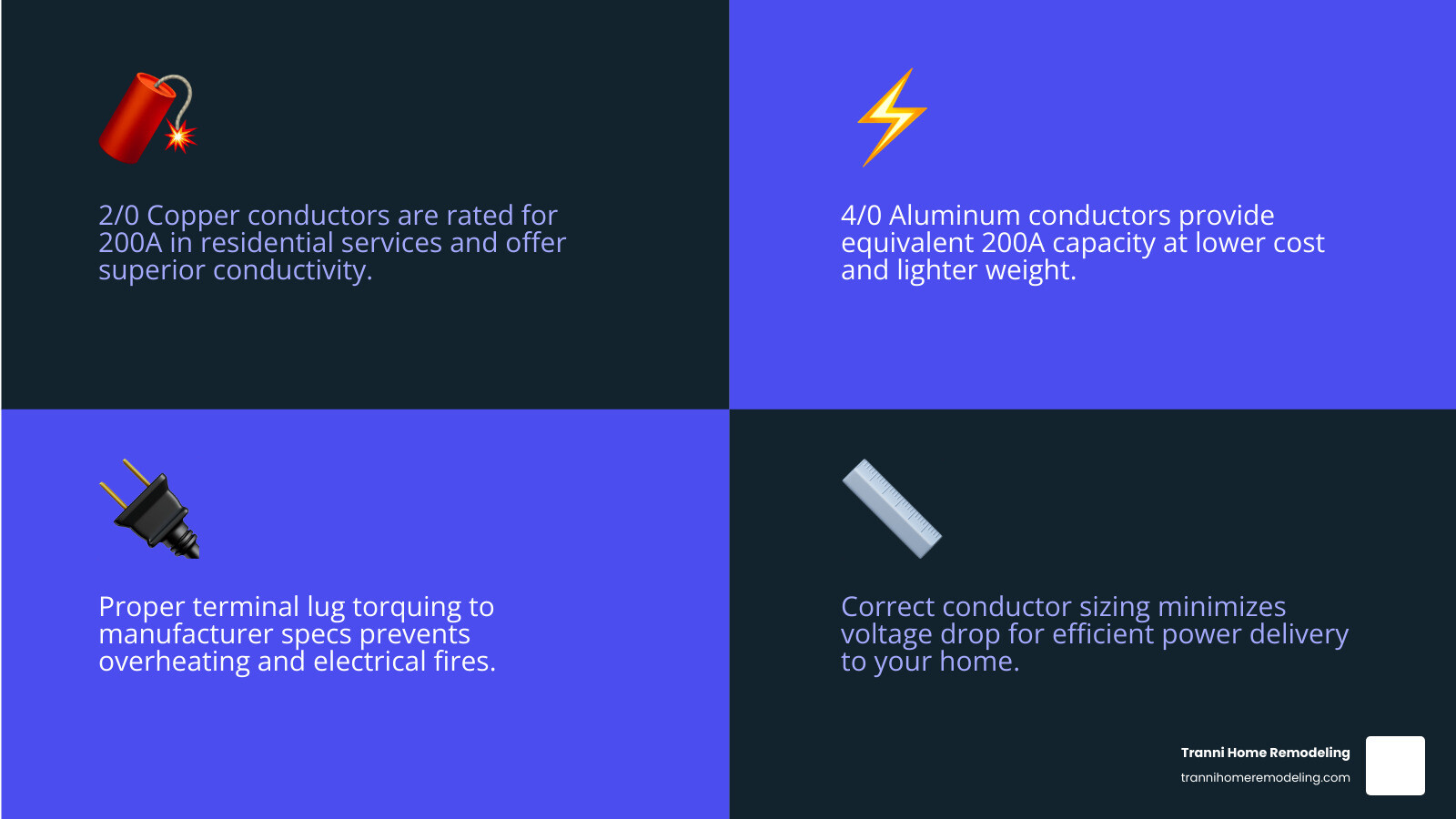
In Billerica and surrounding areas, we typically see:
- 2/0 Copper: The gold standard for conductivity, though more expensive.
- 4/0 Aluminum: Very common for residential service due to its lower cost and lighter weight.
When we install these, we ensure the terminal lugs are properly torqued to the manufacturer’s specifications—a step that is often missed in DIY attempts but is vital for preventing electrical fires.
Load Calculations for a 200 Amp Panel with Meter
Before we even pull a permit in Concord or Lexington, we have to perform a load calculation based on NEC Article 220. We don’t just add up the numbers on the breakers; we use a “demand factor.”
For example, your lights and outlets aren’t all on at 100% capacity all the time. The code allows us to take the first 10,000 volt-amps (VA) at 100% and the remainder at 40%. This calculation accounts for your square footage, fixed appliances (like your oven and dryer), and any “taps” for outbuildings. If you’re curious about the internal guts of the system, check out more info about 200 amp breaker box wiring.
Installation Considerations for Modern Homes
The way power gets to your 200 amp panel with meter depends on your neighborhood’s infrastructure.
- Overhead Feed: The utility wires come from a pole to a “weatherhead” on your roof. The wires then drop down into the top of the meter combo.
- Underground Service: This is becoming the standard in newer subdivisions in North Andover and Reading. The wires come up from the ground through a “lateral” into the bottom of the enclosure.
Bypass Options and Cover Types
When choosing a panel, you’ll see terms like “Lever Bypass” or “Horn Bypass.” These are features that allow the utility company to work on the meter without cutting power to your house.
- Lever Bypass: Usually required for commercial or heavy residential use; it uses a physical lever to bridge the connection.
- Horn Bypass: More common in residential units; it uses small “horns” that the utility company can jump across.
- Ringless vs. Ring-Type: This refers to how the meter is secured. “Ringless” covers are often preferred because the enclosure lid itself holds the meter in place, making it more tamper-resistant.
Solar Compatibility and Future-Proofing
If you’re planning on adding solar panels, you need to be careful with your panel choice. Under rules like California’s Title 24 (which has influenced many national standards), new panels should have a bus bar rating that can handle the extra current from solar inverters.
Siemens and Square D offer models with a dedicated “alternative energy input” that feeds in ahead of the main disconnect. This allows you to add a full solar array without having to de-rate your 200 amp main breaker to something smaller like 150 or 175 amps. If you’re starting from scratch, you can find more info about installing a new 200 amp service panel here.
Accessories for a 200 Amp Panel with Meter
A standard combo box often needs a few add-ons depending on your specific needs:
- Lug Kits: If you are feeding a sub-panel in a basement, you may need “feed-through lugs.”
- 5th Jaw: Required for certain 120/208V network services.
- Generator Interlock Kits: These are essential for safety. They ensure your main breaker is OFF before your generator breaker can be turned ON, preventing you from accidentally back-feeding the utility lines. You can check manufacturer documentation for generator interlock kit compatibility for common Siemens or Murray panels.
Cost and Professional Installation Factors
Let’s talk numbers. Installing a 200 amp panel with meter is a significant investment in your home’s infrastructure. The total cost is influenced by labor rates, the complexity of the wiring, and the cost of the permit in your specific town—whether that’s Billerica, Burlington, or Bedford.
When we handle these installations, we don’t just “swap the box.” We coordinate with the utility company (like National Grid or Eversource) to disconnect the power, install the new equipment, and coordinate with the local municipal inspector for the “cut-in” card that allows the utility to reconnect the power. You can find more info about the cost to change an electrical panel to help you budget.
Average Pricing for 200 Amp Service
Based on internet data averages, the cost for a professional 200 amp service upgrade typically ranges from $1,800 to $7,500.
Please note: These are average costs based on internet data and not actual costs for Tranni Home Remodeling. Every home is unique, and factors like the distance from the utility pole or the need for new grounding rods can affect the final price.
The wide range in pricing accounts for:
- Materials: A basic meter socket might cost $150, while a high-end, solar-ready, 42-circuit combo can exceed $720.
- Labor: Complex retrofits on older homes in towns like Lincoln or Carlisle often require more time to bring everything up to modern code.
- Permits: Local fees vary by town, with some requiring more extensive documentation than others.
Frequently Asked Questions
Can a 200 amp meter base feed a house and a detached shop?
Yes, it can! This is a very common request we get from homeowners in Dracut and Chelmsford. As long as your total calculated load (per NEC Article 220) does not exceed 200 amps, you can “tap” the meter base to feed both a 200 amp house panel and a 100 amp shop panel. However, you must ensure the meter lugs are rated for “double-lugging” or use a listed accessory like a lug conversion kit to make the connection safely.
What is the difference between a ring and ringless meter cover?
A “ring-type” cover uses a separate metal ring to lock the meter into the socket. A “ringless” cover has a top lid that slides over the meter, holding it in place securely. Many utility companies in our area are moving toward ringless designs because they are harder to tamper with and provide better weather protection.
When should I choose a lever bypass over a horn bypass?
You should check with your local utility company first. Generally, a lever bypass is required for any service where the power cannot be interrupted, or for larger residential loads. It allows the utility worker to physically move a lever that bypasses the meter completely. A horn bypass is a simpler, lighter-duty version often used for standard residential homes.
Conclusion
Upgrading to a 200 amp panel with meter is one of the smartest moves you can make for your home’s long-term value and safety. Whether you are prepping for a kitchen remodel in Billerica, adding an EV charger in Winchester, or finishing a basement in Woburn, having a robust 200 amp service ensures your home can handle the electrical demands of modern life.
At Tranni Home Remodeling, we take pride in providing high-quality craftsmanship to our neighbors in Andover, North Reading, Lynnfield, and across Middlesex County. We understand the local codes and the specific requirements of our regional utility providers.
If you are ready to upgrade your service or have questions about which panel is right for your home, we are here to help. You can find more info about our residential electrical services or contact us today to discuss your project!