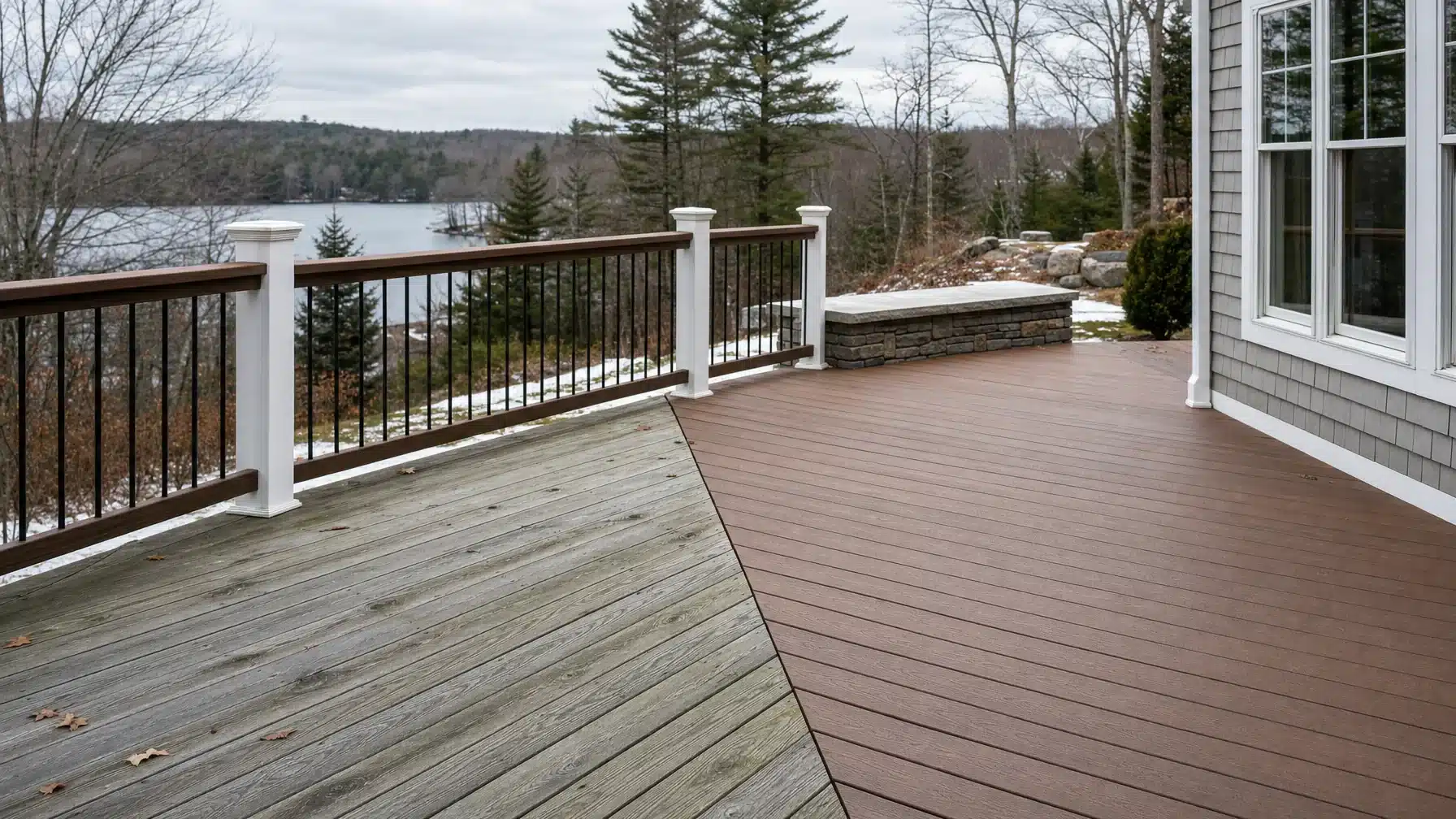





Wood vs. Composite Decking: What to Compare Before Choosing
Choosing between wood and composite decking starts with a more specific question: which exact surface fits the appearance you want, the way you use the deck and the upkeep you are willing to do? A material label alone does not answer those questions. Compare named products, their current care instructions and physical samples before approving a selection.
Keep the surface decision separate from the structure underneath it. Liking a decking board does not establish that existing framing can be reused or that the proposed installation is suitable. Those questions need professional assessment.
Start with the upkeep and appearance you will actually accept
Write down your priorities before looking at colors. Separate cleaning you are comfortable handling from finish work you would rather avoid or hire out. Then describe what you want the deck to look like after outdoor exposure—not only when it is newly installed.
- Appearance: Do you prefer visible natural variation, a more uniform look, a particular grain pattern or a specific sheen?
- Finish expectations: Is preserving the selected color essential, or would a documented change in appearance be acceptable?
- Upkeep tolerance: Are you willing to manage preparation and finish renewal if the selected wood-and-finish combination calls for it?
- Everyday use: Will people commonly walk barefoot, bring pets outside, eat on the deck or move chairs across it?
Use these answers as selection criteria. If avoiding finish renewal is important, ask each supplier to show whether the proposed product meets that requirement. If natural variation is the main attraction, review representative samples and ask what care is required to maintain the appearance you prefer.
Compare maintenance instructions, not “low-maintenance” labels
For a wood option, identify the species, treatment and proposed finish. For a composite option, identify the manufacturer, product line, board profile and color. Request current care and installation documents for each exact selection. For wood, include the finish manufacturer’s instructions as well as the decking supplier’s guidance.
Translate those documents into tasks: what needs cleaning, which products and tools are permitted, whether finish renewal is required and what conditions trigger further attention. Do not assign a maintenance schedule to all wood or all composite decking. Leave any unanswered task marked as unresolved.
- Cleaning: What method is specified for ordinary dirt, food spills and stubborn marks? What cleaners or equipment are prohibited?
- Finish care: Is a coating specified? How should its condition be evaluated, and what preparation is required before renewal?
- Accidental damage: What response is recommended for scratches, stains or surface damage? Do not assume sanding or recoating is permitted.
- Outdoor accessories: What guidance applies to rugs, mats, furniture feet, cooking equipment and snow-removal methods?
Note Treat “maintenance-free” as a claim to question, not a selection criterion. Ask for the written care requirements and compare the actual work involved.
Review physical samples in the intended setting
Place labeled samples beside the home’s siding, trim and proposed railing finish. View them in sun and shade, and look from the doorway as well as close up. For finished wood, request a sample of the proposed wood-and-finish combination rather than judging unfinished lumber.
Ask whether the sample represents the expected range of grain, knots, color variation or repeated surface patterns. Request product-specific information about appearance after exposure. Also review how board ends, fasteners, perimeter edges and stair surfaces would look; the face of a loose sample does not show the whole finished result.
Ask specific questions about barefoot comfort and traction
Do not assume that every product in a material category will feel the same underfoot. Describe the deck’s sun exposure and intended use, then ask what documentation is available for the selected color and surface texture.
- Surface temperature: What questions do you want the supplier to answer about barefoot use in direct sun?
- Traction: What questions do you have about using the selected surface when wet?
- Barefoot use: What inspection and care instructions can the supplier provide for the selected board?
- Documentation: Which answers are supported by documents for the exact product, and which questions remain unanswered?
A sample can help you judge texture and appearance, but it cannot establish all-day comfort or safe traction under every condition. Record gaps in the available evidence instead of treating a showroom impression as a performance guarantee.
Use a side-by-side decision worksheet
Copy this worksheet into your project notes and complete it for the actual options. Record the document name and revision or access date with each answer so the basis for the decision remains clear.
| Compare | Wood option: record | Composite option: record |
|---|---|---|
| Exact selection | Species, treatment, board profile and finish system | Manufacturer, line, profile, color and texture |
| Routine care | Cleaning instructions, finish-care tasks and prohibited methods | Cleaning instructions, stain treatment and prohibited methods |
| Appearance approval | Finished sample reviewed; acceptable variation and exposure changes | Color sample reviewed; acceptable pattern and exposure changes |
| Everyday use | Evidence and open questions about sun, wet use, barefoot use and furniture | Evidence and open questions about sun, wet use, barefoot use and furniture |
| Repair or replacement | Permitted repair methods; replacement board and finish-matching questions | Permitted repair methods; board-removal access and future matching questions |
| Project scope | Included surface, finishing, fasteners, edge details and related work | Included surface, fastening system, edge details and related work |
Separate the decking choice from the complete project scope
Ask the project professional to distinguish decking boards from framing, stairs, railings, fastening, perimeter trim, removal and disposal, and any finish application. Have them identify what requires assessment before the scope can be finalized. Do not interpret a surface-material comparison as approval to cover or reuse an existing structure.
Keep footprint decisions in a separate discussion. Use the deck layout guide for furniture, door access and walking routes to evaluate how the space will function without mixing layout approval with material approval.
Choose based on acceptable tradeoffs
Favor the option whose documented care tasks you will accept and whose sample meets your appearance preferences. If an essential requirement remains unresolved—such as barefoot comfort in direct sun or an acceptable repair method—keep the selection provisional. A clear list of unanswered questions is more useful than a general claim that wood or composite is always preferable.
Tranni Home Remodeling offers deck building exclusively in Middlesex County, Massachusetts, and Southern NH. Bring your completed comparison notes to a project discussion; the Porches / Decks service page is the place to learn about that service.