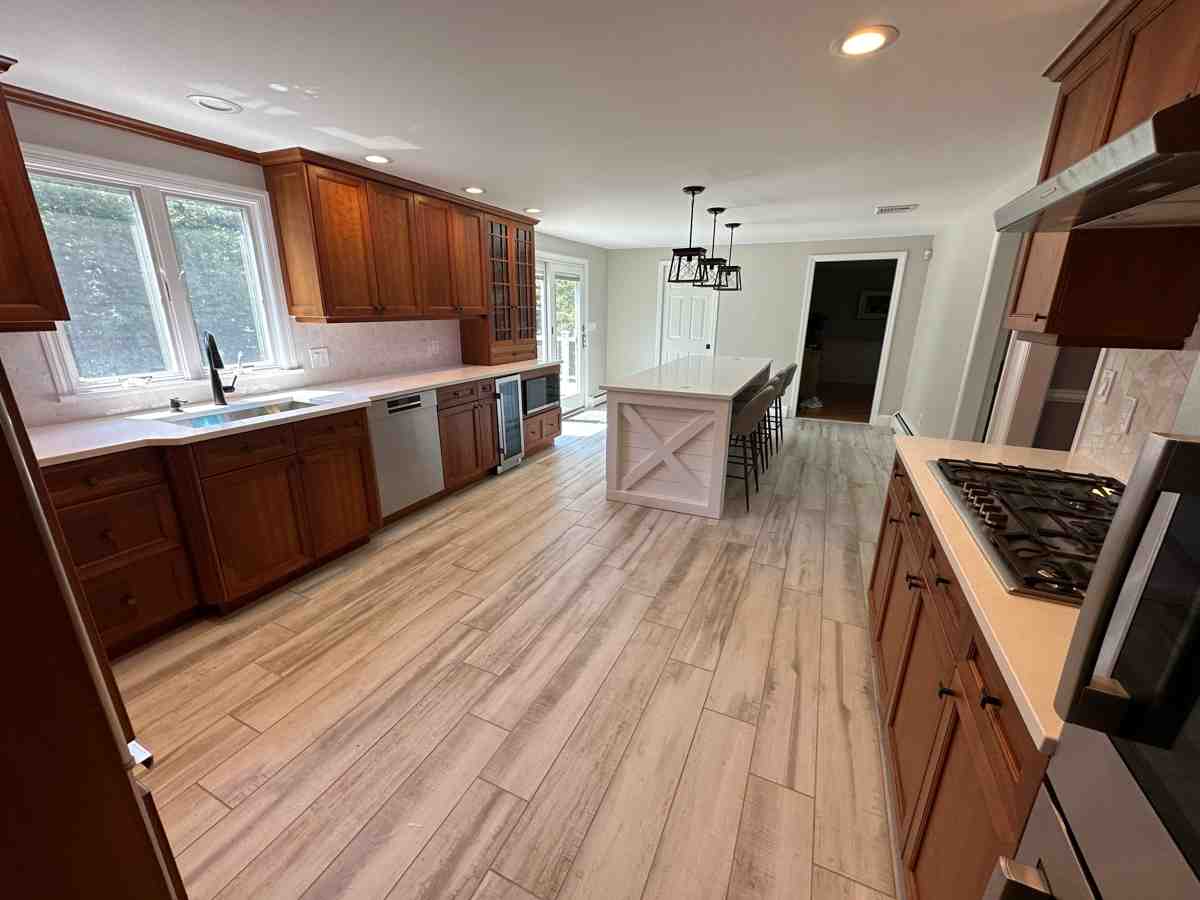





Why Choosing the Best Plywood for Cabinets Matters Before You Build
Choosing the best plywood for cabinets is one of the most important decisions you’ll make in any kitchen or bathroom renovation — and getting it wrong leads to sagging shelves, swelling edges, and stripped screws down the road.
Here’s a quick-reference guide to the best plywood for cabinets:
| Plywood Type | Best For | Grade to Buy |
|---|---|---|
| Baltic birch | Drawer boxes, cabinet boxes, CNC work | B/BB |
| Hardwood birch or maple | Kitchen cabinets, built-ins, stained finishes | A or A/B |
| MDF-core hardwood plywood | Painted cabinet doors and flat panels | A-face |
| Marine plywood | Sink bases, bathroom vanities, damp areas | A/B |
| Softwood sanded plywood | Utility cabinets, budget builds | B/C |
Quick thickness guide:
- 3/4 inch — cabinet sides, shelves, face frames, doors
- 1/2 inch — cabinet backs (when captured), drawer sides
- 1/4 inch — back panels, drawer bottoms (fully supported only)
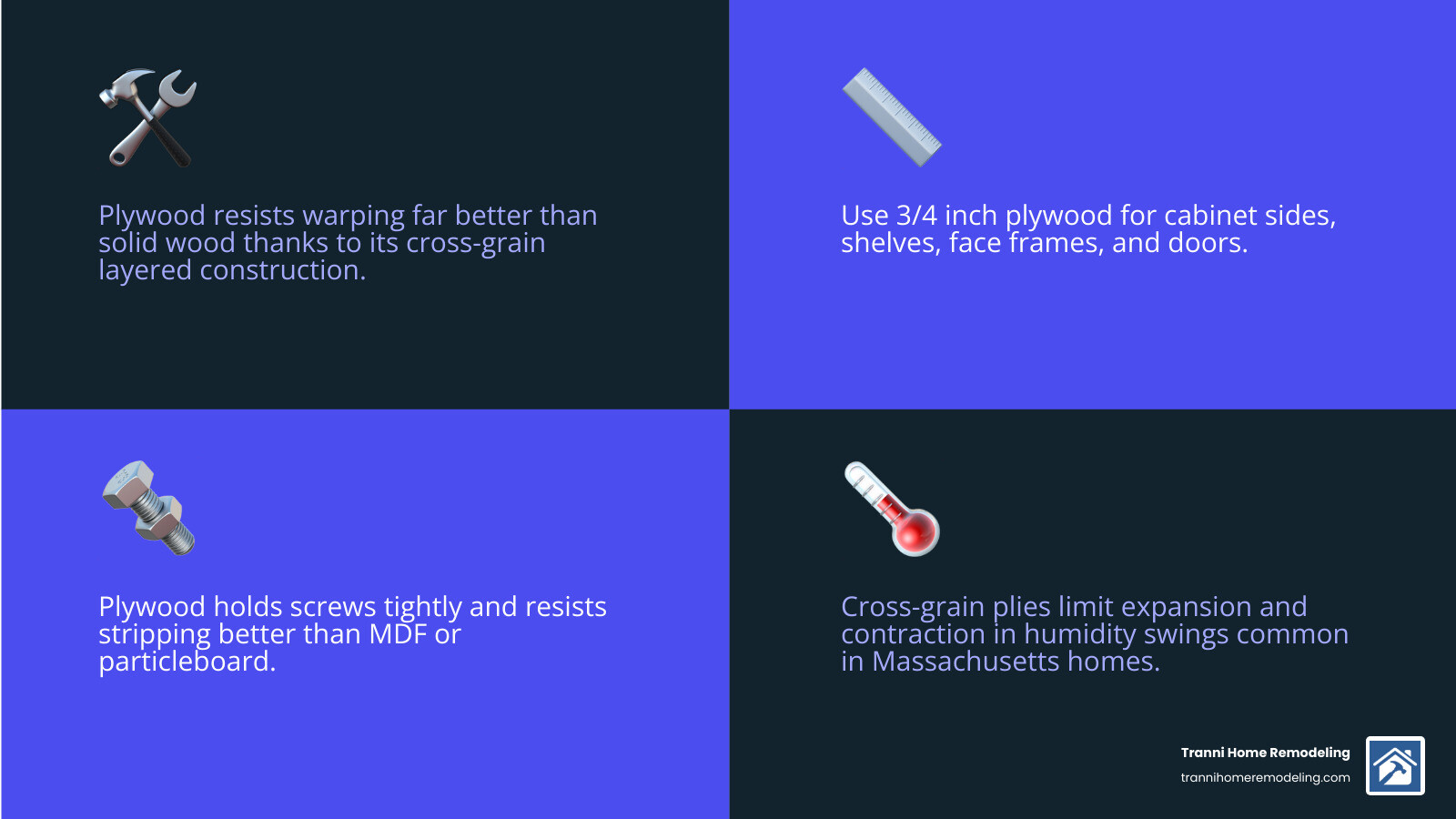
Most professional woodworkers and cabinet makers rely on plywood for nearly every project — and for good reason. Its layered construction resists warping and holds screws better than MDF or particleboard. But not all plywood is built the same. Two sheets labeled “birch plywood” can perform completely differently depending on core quality, ply count, and face veneer grade.
This guide breaks it all down so you can walk into any lumberyard or sheet-goods supplier with confidence.
I’m Tyler Tranni, owner of Tranni Home Remodeling in Billerica, MA, with years of hands-on experience selecting and building with the best plywood for cabinets across kitchen, bathroom, and built-in projects throughout the region. In everything that follows, I’ll share what actually works in the real world — not just on paper.
Why Plywood Is a Top Choice for Cabinets
When we sit down with homeowners to talk about Kitchen Cabinet Designs, the conversation almost always turns to materials. While solid wood sounds prestigious, it’s rarely the best choice for the “carcass” or box of the cabinet. Plywood is used in roughly 99% of professional cabinet and furniture projects for several very practical reasons.
Plywood is an engineered wood product made by gluing together thin layers of wood veneer, called plies, with the grain of each layer running perpendicular to the one below it. This cross-grain construction is the secret sauce. It provides incredible dimensional stability, meaning the wood won’t expand or contract nearly as much as solid wood when the humidity in your home spikes in July and drops in January.
Why the best plywood for cabinets outperforms solid wood and MDF in most builds
Solid wood is beautiful, but it is temperamental. It wants to cup, twist, and crack as it breathes. If you built a large cabinet box out of solid oak planks, the sides might expand enough to cause the joinery to fail or the doors to stop closing properly. The best plywood for cabinets solves this by balancing the internal stresses of the wood.
Compared to MDF (Medium Density Fiberboard) or particleboard—which are essentially sawdust and glue—plywood offers superior screw-holding power. When you attach a heavy spice rack to a plywood door or screw a hinge into a plywood side panel, those fibers “bite” the screw and hold on. In particleboard, the screw is basically sitting in compressed dust; one wrong move and it strips out, leaving you with a sagging door that’s nearly impossible to fix.
Plywood vs MDF for cabinet boxes, doors, and shelves
We often get asked if MDF is “cheaper” or “worse.” The truth is, both have their place, but plywood is the heavyweight champion for structural integrity.
- Sag Resistance: If you load up a 36-inch shelf with heavy ceramic plates, a 3/4-inch plywood shelf will hold firm. An MDF shelf of the same thickness is much more likely to develop a permanent “smile” or sag over time.
- Moisture Damage: In kitchens and bathrooms, water is the enemy. When MDF gets wet, it acts like a sponge, swelling at the edges and eventually disintegrating. Plywood, especially those with waterproof glues, handles occasional splashes much better.
- Surface Finish: MDF does have one advantage: it is perfectly flat and has no grain. This makes it a popular choice for painted cabinet doors where you want a “plastic-smooth” look. However, for the boxes themselves, we always recommend plywood.
| Feature | Plywood | MDF |
|---|---|---|
| Strength | High (Veneer core) | Moderate |
| Screw Holding | Excellent | Poor to Fair |
| Moisture Resistance | Good (especially Marine/Exterior) | Very Poor |
| Weight | Lighter | Very Heavy |
| Best Use | Boxes, Shelves, Structural | Painted Door Panels |
What Cabinet-Grade Plywood Really Means
You’ll hear the term “cabinet-grade” thrown around a lot at big-box stores, but it’s not just a marketing buzzword. It refers to plywood specifically manufactured for furniture and millwork rather than rough construction. Unlike the “CDX” plywood used for roofing—which is full of knots, splinters, and voids—cabinet-grade plywood features high-quality face veneers and a stable core.
Understanding veneer grades from A to D
Plywood is graded based on the appearance of its face and back veneers. The grading system typically uses letters:
- A Grade: The “prom queen” of plywood. It features a smooth, sanded surface with no knots and consistent grain. Any small defects are repaired with synthetic filler that blends in. This is what you want for visible, stained cabinets.
- B Grade: Very similar to A but might have minor tight knots or slight color variations. It’s still quite smooth and excellent for high-quality paint jobs.
- C & D Grades: These are structural grades. You’ll see knots, “football” patches, and rougher sanding. While fine for hidden supports, they shouldn’t be used for visible cabinet parts.
How to spot the best plywood for cabinets at the lumberyard
When you’re at a specialty supplier, don’t just grab the first sheet on the pile. We always perform a quick “physical” on every sheet:
- Sight the Edge: Look down the long edge of the sheet. Is it flat, or does it look like a potato chip? A warped sheet is a nightmare to cut accurately.
- Check for Voids: Look at the cut edges. Do you see gaps or holes between the layers? These are “voids.” If you drive a screw into a void, the screw won’t hold. The best plywood for cabinets (like Baltic birch) has virtually zero voids.
- Inspect the Face: Look for “telegraphing,” where the grain of the inner layers shows through the thin face veneer. Also, check for crushed corners or deep dents from forklift handling.
- Veneer Thickness: Some modern domestic plywood has a face veneer so thin you can practically see through it. If it’s too thin, you’ll sand right through it before you even get to the staining phase.
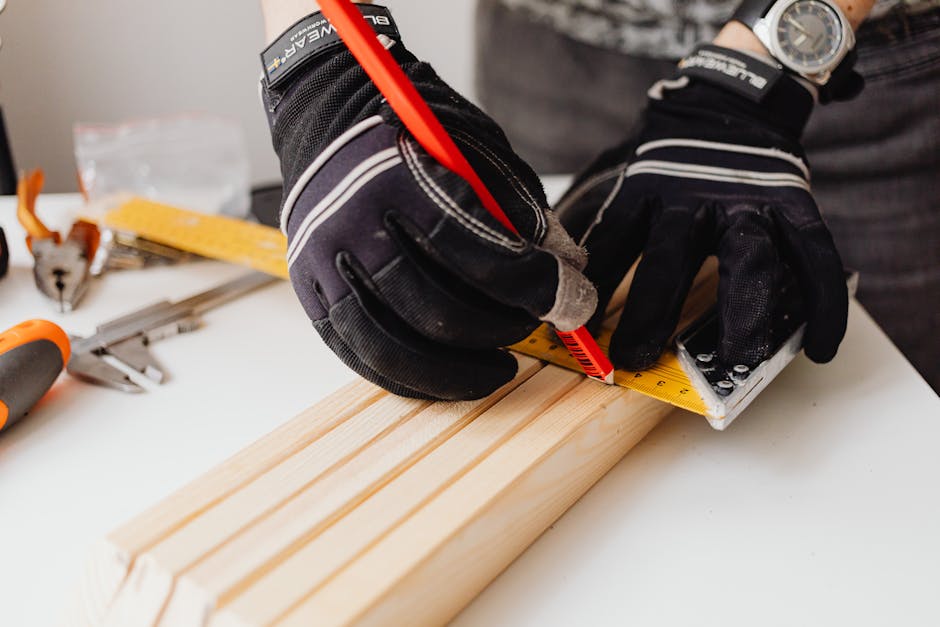
Best Plywood Types for Cabinets by Use Case
Not every cabinet needs the most expensive sheet of wood. Matching the material to the job is how we keep projects on budget for our clients.
Hardwood plywood for kitchen and built-in cabinets
For most high-end Shaker Style Cabinets or Contemporary Kitchen Cabinets, hardwood plywood is the gold standard. This usually means a plywood with a core made of softer woods (like poplar or fir) but faced with a beautiful hardwood veneer like maple, birch, cherry, or oak.
Maple and birch are our “go-to” choices. They are hard, durable, and have a relatively neutral grain that takes both stain and paint well. If you love a natural wood look, oak veneer offers that classic, open-grain texture that feels very traditional.
Baltic birch vs domestic birch plywood
This is where things get technical. “Birch plywood” from a big-box store is NOT the same as Baltic birch.
- Ply Count: A standard 3/4-inch domestic sheet has 5 to 7 plies. A 3/4-inch (18mm) sheet of Baltic birch has 13 plies. More plies mean more stability and strength.
- The Core: Baltic birch is birch all the way through. Domestic birch usually has a softer core (like pine) with just a thin birch skin.
- The Edge: Because Baltic birch is so dense and void-free, the edge itself is beautiful. Many modern designs actually leave the edges exposed and clear-coated rather than using edge banding.
- Price: Be prepared for the “premium” tag. Baltic birch typically costs 20-40% more per sheet than domestic birch.
When marine plywood or softwood plywood makes sense
If we are building Pantry Cabinet Ideas in a basement or utility room, we might use a high-quality softwood plywood to save on costs. However, for “wet” areas like a sink base or a bathroom vanity, marine plywood is a smart investment. It uses the same high-quality veneers as cabinet-grade wood but is bonded with 100% waterproof glue. It won’t delaminate even if a pipe leaks and the cabinet bottom sits in a puddle for a few hours.
Best Plywood for Cabinets in Kitchens, Bathrooms, and Painted Finishes
The environment and the final look dictate which sheet we pull from the rack.
Best plywood for cabinets in kitchens and other high-wear spaces
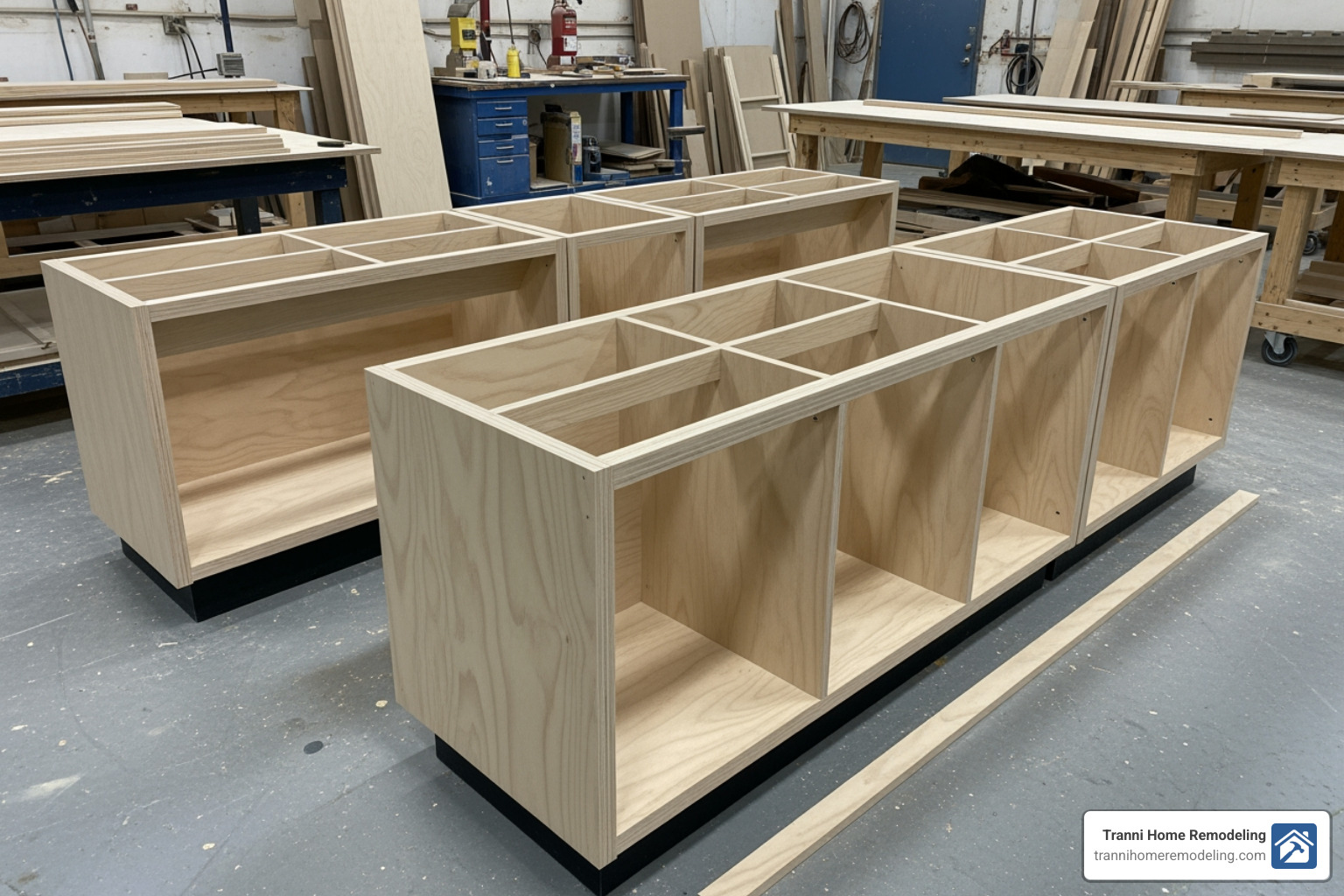
In a busy kitchen, cabinets take a beating. We recommend 3/4-inch hardwood plywood for the boxes (sides, tops, and bottoms). For the interiors, many of our clients prefer prefinished maple plywood. This comes with a factory-applied, UV-cured clear coat that is incredibly tough and easy to wipe clean. It saves hours of labor because the inside of your cabinets is “finished” the moment you build them.
The right plywood for bathroom cabinets and damp areas
Bathrooms are high-humidity zones. Every time someone takes a hot shower, your cabinets are exposed to steam. For these spaces, sealing is just as important as the material. We use Waterproofing Drainage Solutions for the room, but for the cabinets, we ensure every raw plywood edge is sealed with either edge banding or a specialized sealer. Gray Kitchen Cabinets are trending in bathrooms too, and using a moisture-resistant plywood base ensures that trendy paint job doesn’t peel.
Painted vs stained cabinets: which plywood face and finish to choose
- For Staining: You need an A-grade face. Any “patches” or knots will stand out like a sore thumb once the stain hits the wood. Maple and Oak are fantastic for staining.
- For Painting: You want a tight, closed-grain wood like birch or “paint-grade” maple. You can also use MDF-core plywood, which gives you the screw-holding power of a plywood core with the perfectly smooth painting surface of an MDF face. This prevents “grain telegraphing,” where the wood texture shows through your beautiful paint job.
Thickness Guide and Specialty Recommendations
Using the wrong thickness is a classic rookie mistake. Too thin, and the cabinet wobbles; too thick, and you’re wasting money and adding unnecessary weight.
Recommended plywood thickness for every cabinet component
- 3/4 inch (23/32″ actual): This is the workhorse. Use it for cabinet sides, tops, bottoms, and any adjustable shelves. It provides the structural “skeleton” of the unit.
- 1/2 inch: Perfect for drawer sides and for “captured” back panels (backs that slide into a groove).
- 1/4 inch: Only used for drawer bottoms and back panels that are fully supported by a wall or a sturdier frame. Never use 1/4 inch for a shelf!
Best plywood for drawer boxes, speaker enclosures, and CNC work
For drawer boxes, nothing beats 1/2-inch Baltic birch. The stability allows for tight joinery (like dovetails or dados), and the drawers will slide smoothly for decades. This same stability makes it the “undisputed heavyweight champion” for speaker enclosures and CNC routing. The high ply count prevents acoustic resonance in speakers and allows for incredibly clean, intricate cuts on a CNC machine without the wood splintering or “blowing out.”
Cost expectations and where to buy quality sheets
Note: The following are average internet price ranges and do not reflect the specific project pricing of Tranni Home Remodeling.
Prices for the best plywood for cabinets can vary wildly based on the species and the current market.
- Standard Hardwood Plywood (4×8 sheet): $65 to $195+
- Baltic Birch (5×5 sheet): $70 to $210+
- Pre-finished Maple (4×8 sheet): $95 to $285+
While you can find some plywood at big-box stores in Billerica, we recommend visiting a specialty lumberyard for cabinet projects. They tend to store their sheets flatter, offer a wider variety of grades, and the staff usually knows the difference between a “veneer core” and a “lumber core.”
Our Pre-Purchase Checklist:
- [ ] Is the sheet flat?
- [ ] Are the corners crisp and not “mushroomed”?
- [ ] Are there visible voids on the edges?
- [ ] Does the face veneer look thick enough to sand?
- [ ] Is it from the same “lot” or stack? (Grain patterns can change between shipments).
Frequently Asked Questions About the Best Plywood for Cabinets
What is the best plywood grade for painted cabinets?
For a professional painted finish, we recommend a B-grade or better Maple or Birch face. These are closed-grain woods, meaning you won’t see deep pores through the paint. If you want a flawlessly smooth, modern look, go with an MDF-core hardwood plywood.
Is Baltic birch always the best plywood for cabinets?
It is the strongest and most stable, but it has downsides. It is very heavy, expensive, and usually comes in 5×5 foot sheets, which can be awkward to transport and may result in more waste depending on your “cut list.” For standard kitchen boxes, domestic maple plywood is often a more practical choice.
Can you use 1/2-inch plywood for cabinets?
You can use it for the boxes of small, light-duty upper cabinets, but for base cabinets that support heavy granite or quartz countertops, 3/4-inch is mandatory. We occasionally use 1/2-inch for the “carcass” if weight is a major concern, but 3/4-inch is the industry standard for a reason.
Conclusion
Building or remodeling your cabinets is a significant investment in your home’s value and daily function. Whether you’re in Billerica, Concord, or Wilmington, choosing the best plywood for cabinets ensures that your kitchen or bathroom stands up to the test of time, kids, and New England weather.
At Tranni Home Remodeling, we believe in doing things right the first time. That means selecting the right grade, the right thickness, and the right species for every single component of your project. If you’re ready to transform your home with Fine Interior Carpentry or a full Kitchen Cabinet Installation, we’re here to help.
From kitchen remodeling services to custom built-ins, our team brings over a decade of high-quality craftsmanship to every job. Let’s build something beautiful together. Reach out to us today to start planning your next project!
Like us on Facebook!