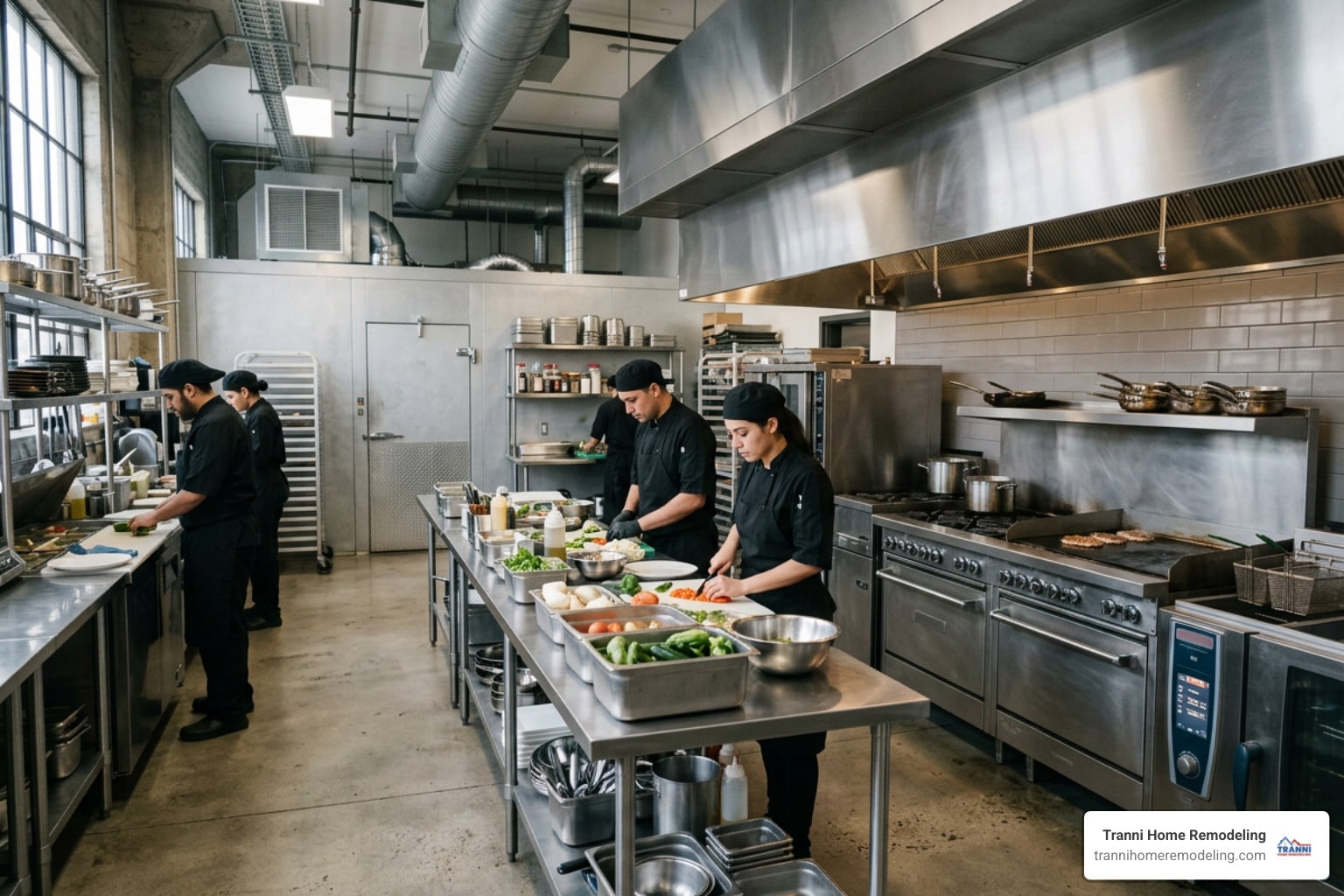





What to Know About Commercial Kitchen Renovations in MA
Commercial kitchen renovations in MA are one of the most complex and high-stakes remodeling projects a business can take on — and getting them right matters more than most people realize.
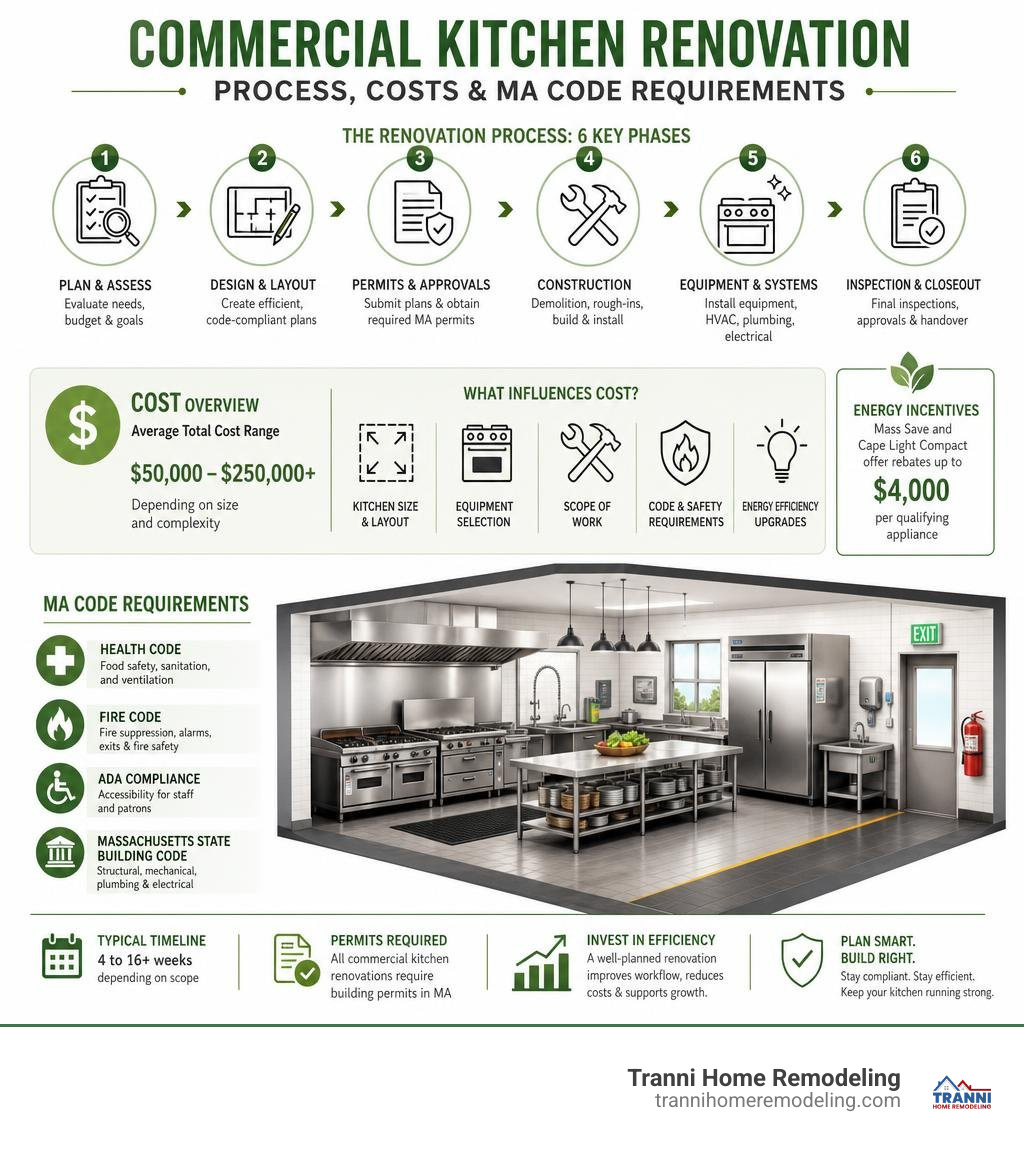
Here’s a quick snapshot of what’s involved:
| Topic | Key Point |
|---|---|
| Why renovate? | Compliance, efficiency, updated equipment, better workflow |
| Who needs permits? | All commercial kitchen renovations require building permits in MA |
| Typical timeline | 4 to 16+ weeks depending on scope |
| Average cost range | $50,000 to $250,000+ depending on size and complexity |
| Energy incentives | Mass Save and Cape Light Compact offer rebates up to $4,000 per qualifying appliance |
| Key codes | Health, fire, ADA, and Massachusetts State Building Code all apply |
Food service operations in the U.S. are nearly four times more energy-intensive than average commercial buildings — with cooking alone accounting for 40% of that energy use. That means an outdated commercial kitchen isn’t just inconvenient. It’s expensive.
Whether you’re running a restaurant, a cafeteria, or a shared-use food space, the pressure to stay code-compliant, energy-efficient, and operationally smooth is constant. A well-planned renovation can solve all three — but only if you go in prepared.
I’m Tyler Tranni, owner and operator of Tranni Home Remodeling based in Billerica, MA, with hands-on experience managing kitchen remodeling projects across the region, including commercial kitchen renovations in MA. In this guide, I’ll walk you through everything you need to know to plan your project with confidence.
Commercial Kitchen Renovations MA terms to remember:
- kitchen remodel near me
- kitchen renovation near me
- contractor cost for kitchen remodel
Why Plan Commercial Kitchen Renovations MA?

If your back-of-house staff is constantly bumping elbows, or your energy bills are eating into your profit margins, it is likely time to consider updating your workspace. Running a commercial food service operation in Billerica, MA means matching high culinary standards with exceptional speed. An outdated, cramped layout is more than an eyesore—it is a direct bottleneck to your business growth.
Key Drivers for Foodservice Upgrades
Why do local businesses make the leap into a full commercial remodel? The reasons usually boil down to survival and growth:
- Menu Evolution: If you are transitioning from a simple sandwich shop to a hot-plate bistro, your utility demands change overnight. You will need different hood systems, extra gas lines, and specialized cooking equipment.
- Regulatory Pressure: Code requirements do not stand still. What was perfectly acceptable ten years ago might fail a local health inspection today.
- Aesthetic and Operational Modernization: Updating your kitchen improves employee retention by creating a cleaner, safer work environment.
- Energy Overhead: Older refrigeration and cooking units are massive energy hogs. Modernizing these systems directly impacts your monthly bottom line.
If you are planning an upgrade that blends back-of-house utility with front-of-house style, exploring a comprehensive Kitchen Remodeling plan is the best place to start.
Improving Workflow and Employee Ergonomics
A kitchen remodel can create a better work environment for staff and visitors alike by expanding kitchen space, creating ergonomic work conditions, adding extra lighting, and placing storage in more accessible locations.
When we design a commercial kitchen, we look at the path of a single plate. From storage (refrigeration/pantry) to prep, cooking, plating, and eventually the dishwashing station, every step should flow in a logical, continuous loop. Minimizing the physical steps your line cooks must take reduces fatigue, speeds up ticket times, and dramatically decreases the risk of workplace accidents like spills and burns.
Commercial vs. Residential Kitchen Remodeling in Massachusetts
While a residential kitchen focuses on comfort, personal style, and family gathering, a commercial kitchen is an industrial production facility. The materials, equipment, and structural requirements could not be more different. For instance, if you are looking for shared commercial spaces or commercial-grade inspiration, you might look at specialized regional facilities like Kitchens in Billerica, MA to see how high-throughput layouts are structured.
Codes, Permits, and Heavy-Duty Equipment
Residential remodels are relatively straightforward. Commercial jobs, however, require navigating strict commercial zoning laws, commercial gas line installations, and heavy-duty electrical connections.
In a commercial setting, you cannot simply buy a high-end residential range. You need certified commercial appliances that can withstand constant 12-to-18-hour daily use. These units require specialized gas pressure regulators, dedicated high-voltage circuits, and robust fire suppression hoods. Navigating these differences requires a clear understanding of Kitchen and Bath Remodeling MA standards to avoid costly permitting delays.
Material Selection for High-Traffic Kitchens
In a home, you might opt for warm hardwood floors and custom wooden cabinetry. In a commercial kitchen, those materials would fail health codes within a week. Commercial spaces require non-porous, highly durable, and easily sanitizable surfaces:
- Flooring: Slip-resistant epoxy coatings or commercial-grade luxury vinyl plank (LVP) are standard. Epoxy is seamless, preventing water and food particles from seeping into subfloors.
- Walls: Fiberglass Reinforced Panels (FRP) are highly recommended. They resist impact, moisture, and chemical cleaners, making them easy to spray down at the end of a shift.
- Countertops: Stainless steel is the undisputed king of the commercial kitchen. It does not harbor bacteria, resists heat, and can take a beating from heavy pots and knives.
Navigating Regulations and Energy Incentives

Operating a food service business in Billerica, MA means adhering to some of the strictest health, building, and safety codes in the country.
Compliance During Commercial Kitchen Renovations MA
To pass inspections and protect your business, your renovation must satisfy multiple regulatory bodies simultaneously:
- ADA Accessibility: Your kitchen must accommodate workers of all physical abilities. This includes specific aisle widths, counter heights, and turning clearances.
- Grease Interceptors (Traps): Massachusetts plumbing codes require properly sized grease traps to prevent fats, oils, and grease (FOG) from entering municipal sewer systems.
- Ventilation and Fire Suppression: Any commercial cooking equipment that produces grease-laden vapors must have a Type I hood equipped with an Ansul fire suppression system, integrated directly into the building’s main fire alarm system.
Working with The Complete Kitchen Renovation Company ensures that these strict local health, fire, and plumbing codes are integrated into your design from day one, preventing failed inspections down the line.
Mass Save and Cape Light Compact Rebates
Because food service operations are so energy-intensive (with cooking accounting for 40% and refrigeration for 15% of total energy consumption), Massachusetts energy initiatives offer massive financial relief.
Through programs like Mass Save and regional compacts, businesses can access incredible incentives on energy-efficient commercial kitchen equipment:
- Up to $4,000 for high-efficiency combination ovens.
- Up to $2,000 for commercial deck ovens.
- Up to $2,000 for multiple-tank conveyor dishwashers.
- Substantial rebates on commercial refrigeration, walk-in coolers, and LED lighting retrofits.
Installing Energy Star-rated appliances not only lowers your monthly utility bills but also secures these upfront rebates to offset your renovation costs.
Timelines, Disruption, and Budgeting for Your Remodel
A commercial remodel is a race against the clock. Every day your kitchen is closed is a day you are losing revenue.
| Renovation Phase | Typical Duration | Focus Areas |
|---|---|---|
| Phase 1: Design & Permitting | 4 to 8 weeks | Stamped architectural plans, MEP engineering, town permits |
| Phase 2: Demolition & Prep | 1 to 2 weeks | Gutting old fixtures, floor removal, wall prep |
| Phase 3: Rough-In Utilities | 2 to 3 weeks | Gas lines, commercial plumbing, high-voltage electrical |
| Phase 4: Finishes & Walls | 1 to 2 weeks | FRP panels, epoxy flooring, ceiling tiles |
| Phase 5: Equipment & Hoods | 1 to 2 weeks | Hood hanging, walk-in installation, line equipment |
| Phase 6: Inspections & Testing | 1 week | Health, fire, plumbing, and building sign-offs |
Managing Timelines and Minimizing Disruption During Commercial Kitchen Renovations MA
To keep your business afloat during a major remodel, you have a few options:
- Phased Construction: Sectioning off parts of the kitchen so limited cold-prep or baking can continue while heavy construction occurs in another zone.
- Off-Hours Labor: Having your Kitchen Remodeling Contractors work overnight or during your typically closed days to minimize daytime disruptions.
- Temporary Kitchens: Setting up a temporary mobile kitchen trailer on-site to maintain a basic menu and keep your staff employed.
Average Costs and Wide Pricing Ranges
Commercial kitchen renovation costs vary wildly based on the size of your facility and the condition of your existing utilities.
Note: The following cost ranges are averages based on regional internet data and do not represent actual quotes for Tranni Home Remodeling.
- Minor Refresh / Cosmetic Upgrade: $35,000 – $65,000 (re-facing surfaces, minor equipment swaps, basic flooring repairs).
- Mid-Range Commercial Remodel: $75,000 – $150,000 (partial layout changes, updated hood systems, some new energy-efficient appliances, plumbing updates).
- High-End / Full Gut Renovation: $200,000 – $600,000+ (complete utility overhaul, structural wall removals, high-capacity walk-ins, premium cooking lines, custom stainless steel fabrication).
Because the high end of commercial work easily exceeds $600,000 depending on the scale of the plumbing and HVAC work, working with experienced professionals is vital to help dial in your design before construction begins.
Frequently Asked Questions
When should a business renovate its commercial kitchen?
A business should renovate when its current layout causes bottlenecked ticket times, when energy bills become unsustainable due to aging equipment, when changing the menu requires new cooking utilities, or when local health and fire codes mandate upgrades.
Do commercial kitchen renovations require stamped architectural plans?
Yes. Massachusetts building departments require stamped architectural and MEP (Mechanical, Electrical, and Plumbing) plans before issuing commercial building permits. This ensures that ventilation, fire suppression, and waste lines are engineered safely.
How can a business minimize downtime during a remodel?
Downtime can be minimized by utilizing phased construction, scheduling high-disruption work during off-hours, prep-cooking out of a commissary kitchen, or renting a temporary mobile kitchen trailer to maintain basic operations.
Conclusion
A commercial kitchen renovation is a major investment, but when executed correctly, it transforms your business. Upgrading your layout, installing energy-efficient appliances, and ensuring absolute code compliance will lower your overhead, boost your team’s daily output, and keep your business running safely for years to come.
At Tranni Home Remodeling, we bring high-quality craftsmanship, clear communication, and a decade of local expertise to every project we touch. If you are ready to take your kitchen space from bland to grand, visit Tranni Home Remodeling today to schedule your consultation!