





how much does a contractor charge for a kitchen remodel? 10 shocking 2025 facts
Understanding Kitchen Remodel Contractor Costs
How much does a contractor charge for a kitchen remodel? This question sits at the top of most homeowners’ minds when planning their dream kitchen. Based on national data, here’s what you can expect to pay:
| Kitchen Remodel Type | Average Contractor Cost | Typical Range |
|---|---|---|
| Minor Update | $10,000 – $25,000 | $14,600 – $41,500 |
| Midrange Remodel | $25,000 – $65,000 | $35,000 – $95,000 |
| High-End/Complete | $65,000 – $130,000+ | $75,000 – $200,000+ |
The reality is that kitchen remodeling costs vary widely based on several key factors. Size matters significantly – expect to pay $150-$250 per square foot on average. Labor typically accounts for 25-35% of your total budget, while materials make up the rest. General contractors usually add a 10-20% markup to cover their management services and expertise.
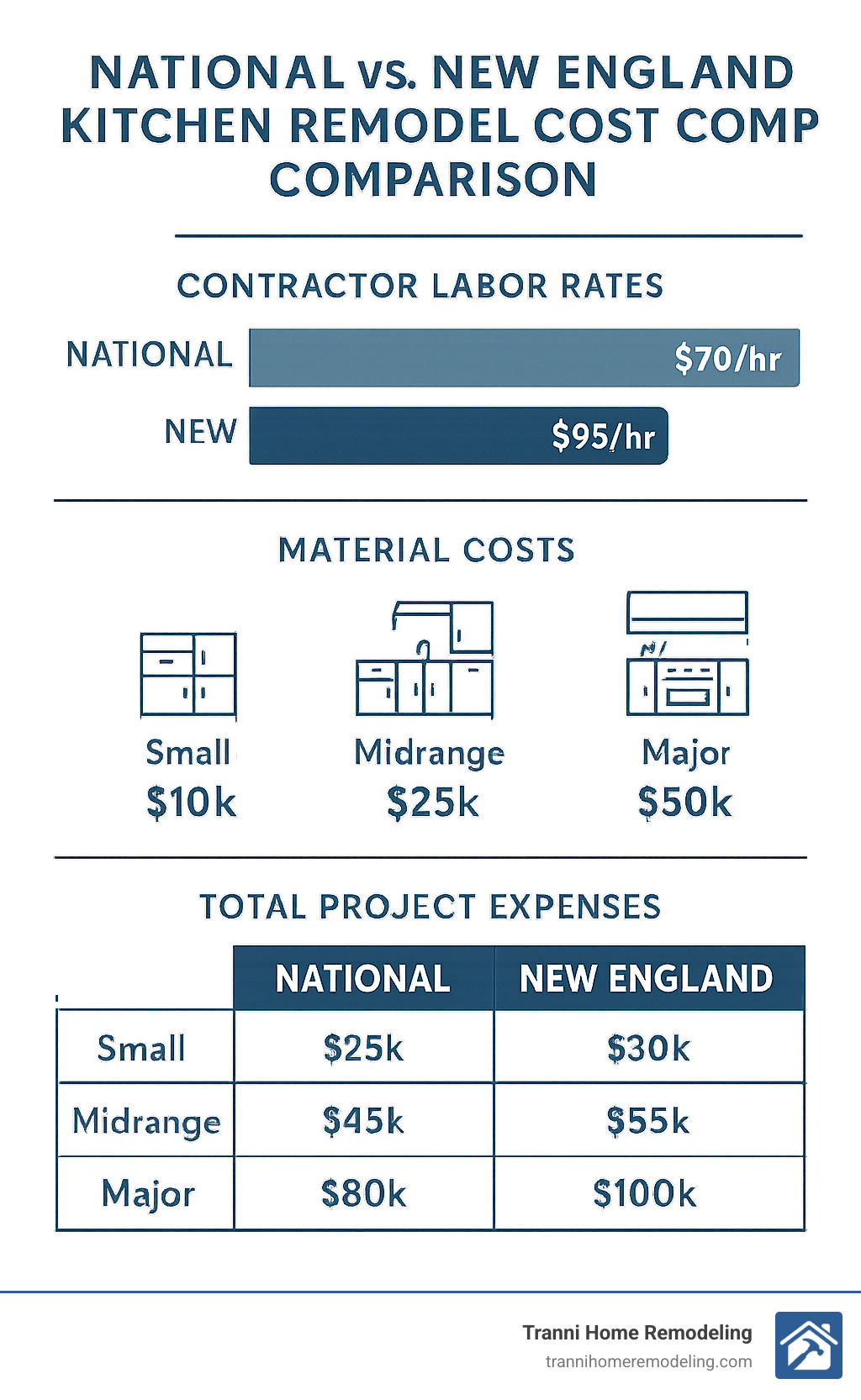
Location plays a crucial role too. A kitchen remodel in Billerica, MA will have different costs than one in other regions. Most New England kitchens tend to run slightly higher than the national average due to our skilled labor market and material shipping costs.
I’m Tyler Tranni, owner of Tranni Home Remodeling, and I’ve helped hundreds of homeowners understand exactly how much a contractor charge for a kitchen remodel through personalized consultations that account for their specific needs, space, and desired outcomes. My years of experience in kitchen renovations throughout Billerica and surrounding areas have given me deep insight into local pricing factors and how to maximize your remodeling budget.
Related content about how much does a contractor charge for a kitchen remodel:
– small kitchen remodel contractors
– kitchen addition contractors
– custom kitchen remodelers
How Much Does a Contractor Charge for a Kitchen Remodel in 2024/2025?
Kitchen remodel costs can feel like a moving target, especially as we head into 2024/2025. The national average currently sits at approximately $26,932, with most homeowners investing between $14,602 and $41,477. Here in New England, particularly in Billerica and surrounding Middlesex County communities where we work, expect to pay about 10-15% more than these national figures due to our higher regional labor rates and material transportation costs.
Breaking it down by square footage helps make sense of the numbers. Contractors typically charge between $75 and $300 per square foot for kitchen remodels, depending on the scope and quality of finishes. Budget-friendly renovations generally fall in the $75-$150 range, while mid-range projects typically cost $150-$250 per square foot. If you’re dreaming of a high-end luxury kitchen change, costs can easily exceed $300 per square foot.
“I always caution homeowners about taking square footage costs at face value,” shares our project manager at Tranni Home Remodeling. “A compact kitchen with premium appliances and custom cabinetry often costs more per square foot than a spacious kitchen with standard finishes. It’s really about what goes into the space, not just the size.”
General contractor markups typically range from 10-20% of your total project cost. This isn’t just profit—it covers crucial services like detailed project management, coordinating subcontractors, maintaining schedules, ensuring quality control, and handling the inevitable surprises that come with renovation work. With recent inflation and ongoing supply chain challenges affecting material costs, this markup helps ensure your contractor can maintain quality while covering increasing overhead expenses.
The good news? Kitchen renovations typically deliver a return on investment (ROI) of 60-80% when selling your home, making them one of the smartest home improvement investments you can make.
Average Contractor Cost per Square Foot: how much does a contractor charge for a kitchen remodel
Your kitchen’s size significantly impacts the bottom line of your renovation budget. Here’s what you might expect to pay based on kitchen dimensions:
- Small Kitchen (60-90 sq ft): $5,000-$20,000 ($83-$222/sq ft)
- Medium Kitchen (90-120 sq ft): $15,000-$40,000 ($125-$333/sq ft)
- Large Kitchen (120-200 sq ft): $30,000-$75,000+ ($150-$375+/sq ft)
For perspective, a standard medium-sized kitchen of about 100 square feet (10’x10′) typically costs around $15,000-$25,000 ($150-$250/sq ft) for a minor update or refresh. A mid-range full remodel of the same space might run $25,000-$40,000 ($250-$400/sq ft), while a high-end luxury change could easily reach $40,000-$75,000+ ($400-$750+/sq ft).
Just last month, we completed a 12’x12′ kitchen remodel for a Billerica family at approximately $36,000. Their project included beautiful semi-custom cabinets, durable quartz countertops, and a suite of new appliances—representing a mid-range investment of about $250 per square foot. The change was stunning, and the family gained not just beauty but significantly improved functionality.
Typical Contractor Fee Percentages: how much does a contractor charge for a kitchen remodel
Understanding how contractors structure their fees helps make sense of your kitchen remodel estimate. Here’s what typically goes into the pricing:
Overhead and Profit (10-20%) covers the contractor’s business expenses and compensation for their expertise, risk, and management services. On a $50,000 kitchen remodel, about $5,000-$10,000 typically goes toward these essential costs. This isn’t just padding—it’s what allows professional contractors to maintain insurance coverage, keep skilled staff employed, and stay in business to support your project and warranty.
Design Fees (5-15%) apply when your contractor provides design services or collaborates with a designer. This covers the creation of detailed plans, 3D renderings, material selection assistance, and professional design consultations. For a $50,000 project, you might invest $2,500-$7,500 in design services—often money well spent to avoid costly mistakes and create a cohesive, beautiful result.
Contingency (10-15%) is a smart allowance for unexpected issues that inevitably arise during remodeling. From hidden water damage behind walls to outdated wiring that needs updating to meet code, these surprises can derail both budget and timeline if not planned for. A reasonable contingency of $5,000-$7,500 on a $50,000 remodel provides peace of mind and project stability.
Most reputable contractors follow a payment schedule that aligns with project milestones, typically in a 30/40/30 structure:
– 30% deposit upon signing the contract
– 40% at the midpoint (usually after cabinets are installed)
– 30% upon completion and final inspection
“We structure our payment schedule to align with real project milestones,” explains our contracts manager. “This creates accountability and ensures our clients only pay for work that’s been completed to their satisfaction. It’s all about building trust throughout the process.”
Key Factors That Drive Contractor Pricing
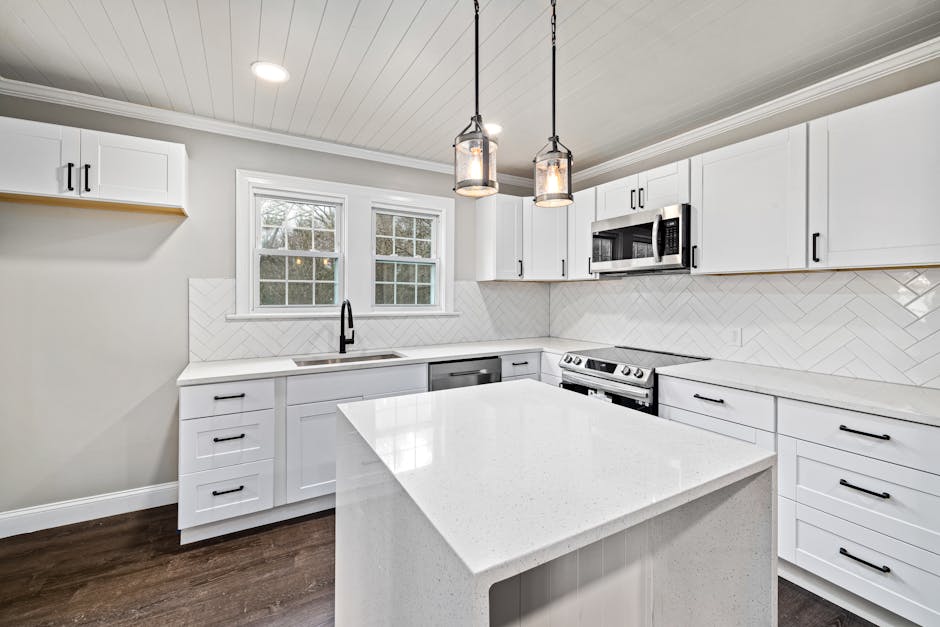
When homeowners ask me how much does a contractor charge for a kitchen remodel, I always explain that several key factors influence the final price tag. Understanding these variables helps make sense of why estimates can vary so dramatically from one project to another.
Size and layout changes are major cost drivers. Expanding your kitchen footprint or reconfiguring the layout requires additional labor, materials, and often structural work. When we move walls or relocate plumbing, the complexity increases substantially. One Billerica homeowner recently finded this when their simple update ballooned after deciding to remove a peninsula for a more open concept.
Finish level might be the most significant variable in your budget. The difference between budget-friendly stock cabinets at $70-$150 per linear foot and gorgeous custom cabinetry at $500-$1,200 per linear foot can easily double your overall project cost. The same applies to countertops, flooring, and appliances.
Here in Middlesex County, our regional labor rates tend to run higher than the national average. Skilled tradespeople like plumbers and electricians typically charge $75-$150 per hour in our area. This reflects the expertise of our local workforce and the higher cost of living in Massachusetts.
Since 2020, material lead times and supply chain issues have become major considerations. I’ve had clients surprised when their cabinet order takes 12 weeks instead of 6, or when specialty tile is suddenly backordered. These delays can impact both timeline and budget, so we build flexibility into our schedules.
Don’t forget about permits and inspections! Most kitchen remodels in Massachusetts require permits, adding $500-$2,000 to your project cost. More complex renovations may need additional engineering reports and inspections, especially if you’re modifying structural elements. You can learn more about whether a permit is required to remodel your kitchen before getting started.
I recently worked with a family in Tewksbury who experienced a 20% increase in their initial budget when they decided to remove a load-bearing wall. The additional structural work, permits, and engineering fees added approximately $12,000 to their project—but they felt the open, airy result was worth every penny.
Scope of Work: Rip-and-Replace vs. Gut Renovation
The depth of your remodel dramatically impacts the final price tag:
A rip-and-replace remodel keeps your existing layout but refreshes cabinets, countertops, and appliances. The electrical and plumbing systems remain largely untouched. This approach typically costs 30-40% less than a complete gut renovation.
By contrast, a gut renovation strips the kitchen to the studs, potentially moves walls, relocates plumbing and electrical systems, and completely reimagines the space. This comprehensive approach typically adds 15-25% to the materials and labor cost of a standard remodel.
One Chelmsford family I worked with planned a simple rip-and-replace for $42,000, but during demolition, we finded serious water damage and outdated wiring that didn’t meet code. The project evolved into a gut renovation, ultimately costing $68,000 with the necessary structural repairs and electrical upgrades. While not what they initially budgeted, the peace of mind from having safe, modern systems was invaluable.
Material & Finish Selections
Your material selections can easily double or triple your project cost:
Cabinetry typically consumes 25-40% of the budget. Stock cabinets ($70-$150 per linear foot) offer limited options but fit tighter budgets. Semi-custom cabinets ($150-$650 per linear foot) provide more flexibility in sizes and finishes, while custom cabinets ($500-$1,200+ per linear foot) deliver exactly what you want, though at a premium price.
Countertops range widely in cost, from budget-friendly laminate ($15-$40 per square foot installed) to mid-range quartz ($55-$155 per square foot installed) to luxury marble ($65-$230 per square foot installed). Granite and solid surface materials fall somewhere in between.
Appliance packages vary tremendously, from budget options ($2,000-$5,000) to mid-range selections ($5,000-$10,000) to high-end suites ($10,000-$30,000+) and premium professional-grade packages ($30,000-$80,000+).
Many of my clients in Middlesex County choose Energy Star appliances, which may cost more upfront but provide long-term savings on utility bills. These can also qualify for utility rebates through Mass Save programs, putting some money back in your pocket.
Geographic & Labor Market Impact
Location significantly impacts pricing. In the Billerica area where Tranni Home Remodeling operates, labor rates typically run 10-15% higher than the national average due to our skilled workforce and higher cost of living.
Surrounding towns like Burlington, Chelmsford, and Tewksbury see similar pricing, while more affluent communities like Lexington and Winchester often command premium rates due to higher property values and stricter building codes.
Contractor availability also affects pricing. During peak seasons (typically spring and summer), demand surges and contractors may charge premium rates. Planning your remodel during off-peak times (late fall or winter) might result in more competitive pricing—I’ve seen clients save 5-10% simply by scheduling during slower periods.
If you’re curious about typical costs in our area, you might want to check out more information about Average Kitchen Remodel Cost to get a better understanding of local pricing factors.
Detailed Cost Breakdown by Line Item
When homeowners ask me how much does a contractor charge for a kitchen remodel, I always find it helpful to break down where each dollar goes. Understanding this breakdown helps you make smarter decisions about where to splurge and where to save on your kitchen renovation.
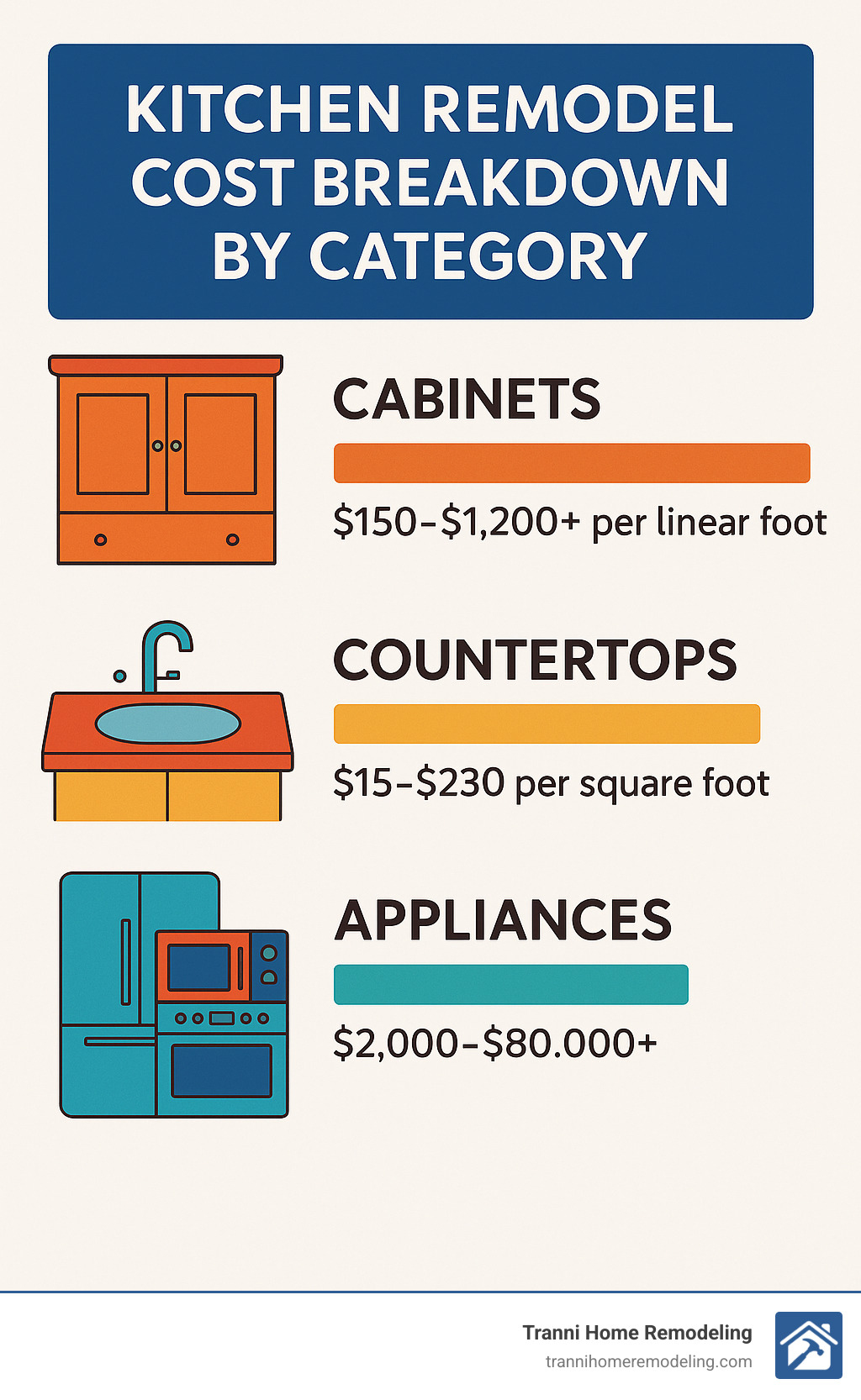
For a typical mid-range kitchen remodel in the Billerica area, your budget pie gets sliced something like this: cabinets and hardware consume the largest portion at 25-40% (about $10,000-$35,000), followed by appliances at 10-20% ($5,000-$20,000), and installation labor at 15-25% ($5,000-$25,000). The remaining budget gets divided among countertops (8-15% or $3,000-$15,000), plumbing and electrical work (10-15% or $3,000-$15,000), flooring (5-10% or $2,000-$10,000), lighting (3-7% or $1,000-$7,000), and demolition and disposal (3-5% or $1,000-$5,000). And don’t forget the general contractor fee at 10-20% ($3,000-$20,000).
“I always tell my clients to think about how they actually use their kitchen,” explains our design consultant at Tranni Home Remodeling. “If you’re an avid home chef, investing in quality countertops and professional-grade appliances might make sense. If you entertain frequently, perhaps beautiful cabinetry and an open layout deserve more of your budget.”
Cabinets & Hardware
Cabinetry is typically the biggest-ticket item in your kitchen renovation, and for good reason – they’re the face of your kitchen and take a daily beating.
Stock cabinets run about $150-$300 per linear foot installed. They’re pre-made in standard sizes, which means faster delivery (often available immediately), but you’ll have fewer style and finish options. These are perfect if you’re working with a tighter budget or timeline.
Moving up to semi-custom cabinets ($350-$600 per linear foot installed), you’ll get more size flexibility and style choices. Most of our Middlesex County clients opt for this middle ground, appreciating the 4-8 week lead time and good balance of quality and cost.
For those seeking the absolute perfect fit and finish, custom cabinets ($650-$1,200+ per linear foot installed) offer unlimited possibilities. They’re built precisely to your specifications with premium materials, though you’ll need to factor in 8-12+ weeks for production.
Don’t overlook hardware – those little knobs and pulls can add up! At $2-$50+ per piece, a kitchen with 30 doors and drawers might need $60-$1,500+ just for hardware. And while soft-close hinges and drawer glides add about $50-$100 per cabinet, most homeowners find this small upgrade well worth it for the luxury feel and increased durability.
Countertops & Backsplash
Your countertop choice dramatically impacts both aesthetics and functionality. Here in New England, we’re seeing strong preferences for certain materials:
Laminate ($20-$45 per square foot installed) remains the budget-friendly champion with surprisingly attractive design options, though it won’t hold up as well as stone options.
Solid surface options like Corian ($40-$90 per square foot installed) offer a seamless look and can be repaired if damaged – a nice middle-ground option.
Quartz ($70-$130 per square foot installed) has become our most requested countertop material. It’s engineered stone with consistent patterning, extremely durable, and requires virtually no maintenance.
Granite ($60-$120 per square foot installed) remains popular for its natural beauty and unique patterning. It’s heat resistant but does require periodic sealing.
Marble ($90-$250 per square foot installed) offers timeless luxury, though it’s more prone to staining and etching. Each slab tells its own geological story – no two are alike.
For backsplashes, material costs range from $8-$60+ per square foot, with installation adding another $10-$40 per square foot depending on the complexity of the pattern. Ceramic tile remains the most affordable option ($8-$30/sq ft), while glass tile ($20-$60+/sq ft) and natural stone ($25-$50+/sq ft) command premium prices for their distinctive looks.
Systems: Plumbing, Electrical, HVAC, Gas
These behind-the-walls updates might not be as visually exciting as new cabinets, but they’re crucial to your kitchen’s functionality.
Licensed plumbers in Massachusetts typically charge $50-$200 per hour. Something seemingly simple like moving a sink or adding a pot filler can cost $500-$2,000 depending on how far it needs to move and what’s behind your walls.
Electrical work runs at similar rates ($50-$200 per hour), with panel upgrades costing $1,500-$3,000, new appliance circuits running $500-$1,500, and lighting installation at $150-$500 per fixture. Many older homes in Billerica and surrounding towns need electrical updates to handle modern kitchen demands.
Adding or relocating gas lines for a range or cooktop averages $375-$750, while modifying HVAC ductwork or adding ventilation can add $500-$2,000+ to your budget.
All these systems require proper permits and inspections in Massachusetts. While this adds to your timeline, it ensures everything is safe and up to code – something we never compromise on at Tranni Home Remodeling.
A recent project in Tewksbury illustrates how these “invisible” costs can add up: what started as a simple kitchen update revealed knob-and-tube wiring that needed complete replacement. The homeowners hadn’t budgeted for this $4,200 surprise, but understood it was essential for safety. This is exactly why we recommend that contingency buffer of 10-15% for every kitchen project.
For more insights on kitchen renovation services and options, check out our detailed Kitchen Remodel Services page.
Remodel Levels & Budget Ranges
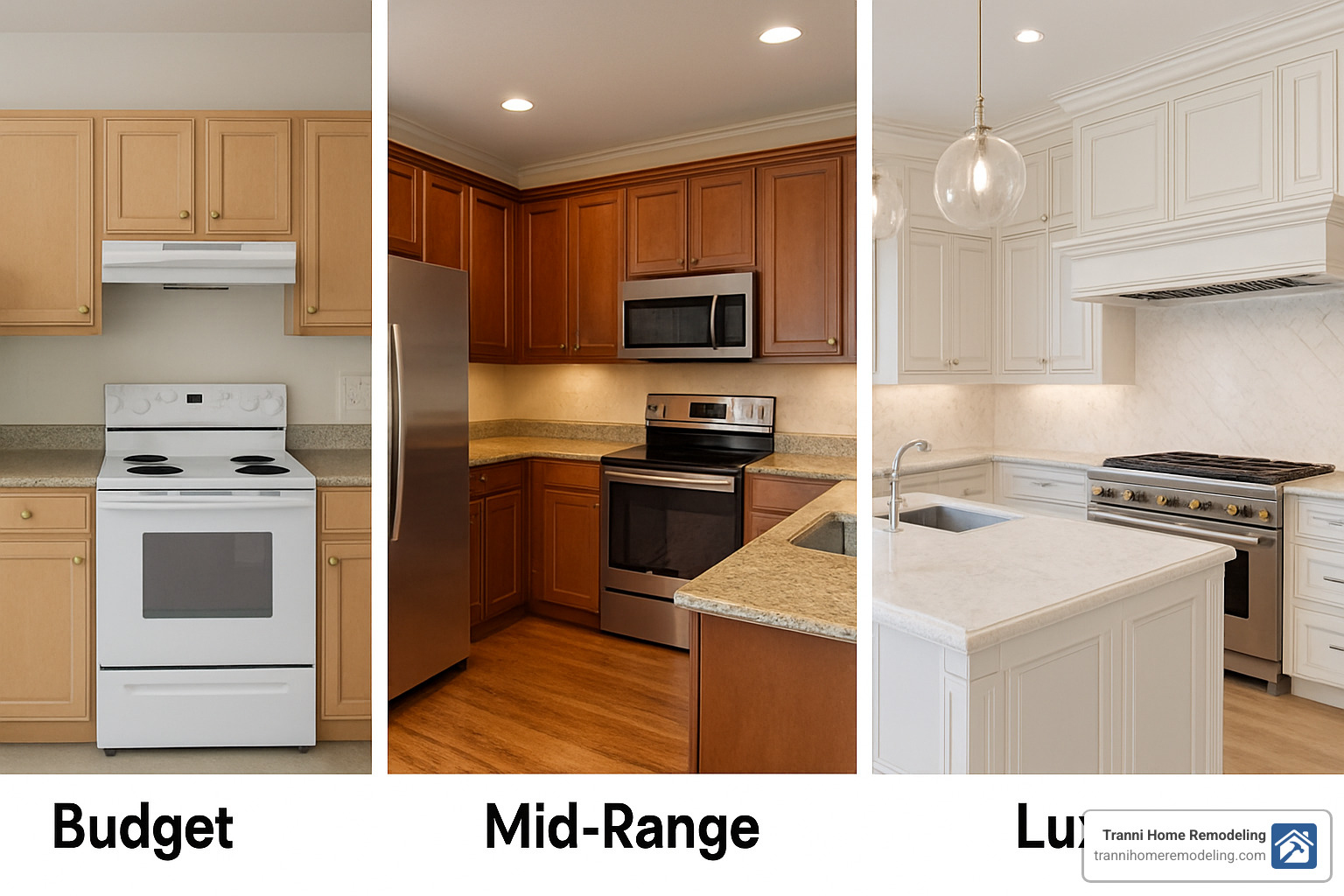
When clients ask me how much does a contractor charge for a kitchen remodel, I always explain that renovations typically fall into three distinct categories. Your budget, goals, and how you use your kitchen will guide which level makes the most sense for your home.
Budget (Minor) Remodel
Cost Range: $10,000-$25,000
A budget-friendly kitchen refresh focuses on cosmetic updates rather than major structural changes. Think of it as giving your kitchen a facelift while keeping its basic “bones” intact.
You’d be surprised what a fresh coat of paint on existing cabinets can do! One of our Burlington clients transformed their dated oak cabinets with crisp white paint, added modern brushed nickel hardware, and instantly brought their kitchen into this decade. Their total investment? Just $19,500, which also covered new budget-friendly quartz countertops, vinyl plank flooring, and a classic ceramic subway tile backsplash.
These minor remodels typically include cabinet refacing or painting, new hardware, laminate or entry-level countertops, basic sink and faucet upgrades, and perhaps new flooring using budget-friendly materials like vinyl or laminate. The existing layout stays put, and while you might replace an appliance or two, you’re not buying an entirely new suite.
The good news? Budget remodels often deliver the highest percentage return on investment, frequently recouping 75-80% of your costs at resale. Not bad for a relatively modest investment!
Midrange Remodel
Cost Range: $25,000-$65,000
This middle-ground approach gives you significant upgrades without completely gutting your kitchen. You’ll replace rather than refresh most elements, resulting in a dramatically improved space.
A Chelmsford family we worked with invested $48,000 in their midrange remodel. They kept their original layout (saving thousands on plumbing and electrical work) but installed beautiful semi-custom maple cabinets, durable quartz countertops, a coordinated appliance package, updated lighting, and luxury vinyl plank flooring that looks like hardwood but stands up better to kitchen spills.
Midrange remodels typically include new semi-custom cabinets, quality countertops like quartz or granite, a new appliance package in the $5,000-$10,000 range, upgraded flooring, and fresh lighting. You might make minor layout tweaks, but you’re not moving gas lines or completely reconfiguring the space.
These projects strike a nice balance between investment and return, typically recouping 65-75% of costs when you sell your home.
High-End Gut & Re-Design
Cost Range: $65,000-$150,000+
When clients say “I want to completely reimagine this space,” we’re talking about a high-end renovation. These projects often involve taking the kitchen down to the studs and rebuilding it from scratch with premium materials and cutting-edge features.
One Winchester client invested $135,000 in their dream kitchen, and the change was truly remarkable. We removed a wall to create an open-concept layout, installed custom walnut cabinets with specialized storage solutions, topped them with stunning quartzite countertops, and added a professional-grade appliance package that would make a chef jealous. Custom lighting design, hardwood flooring, and smart home integration completed the space.
These luxury renovations include custom cabinetry, premium countertops, high-end appliance packages ($15,000-$30,000), natural stone or hardwood flooring, designer lighting, and often significant layout changes. The electrical and plumbing systems are typically completely updated to accommodate the new design.
While high-end remodels return a smaller percentage of their cost at resale (typically 50-65%), they provide the greatest lifestyle benefits and strongest appeal to luxury home buyers. For many of our clients who plan to stay in their homes long-term, the daily enjoyment of a perfectly designed kitchen makes the investment worthwhile.
Each level offers its own blend of value and change. The right choice depends on your budget, how long you plan to stay in your home, and how important your kitchen is to your daily life and entertaining style.
Estimating, Contracts & Payment Milestones
When you’re starting on a kitchen renovation journey, understanding the paperwork and payment process can be just as important as picking out the perfect backsplash. Let’s break down what you can expect when working with a professional contractor.
A successful kitchen remodel always begins with crystal-clear communication. Your contractor should provide you with a detailed written scope of work that spells out exactly what’s being done, what materials will be used, and who’s responsible for providing what. Think of this as your roadmap for the entire project.
“Clear contracts protect both the homeowner and the contractor,” explains our contracts manager at Tranni Home Remodeling. “We want our clients to know exactly what they’re getting and what it will cost before we begin work.”
Good contractors provide line-item bids rather than just a lump sum estimate. This transparency shows you exactly where every dollar is going – from demolition to final touches. It’s like getting an itemized receipt before you’ve even started shopping!
For items you haven’t selected yet (maybe you’re still hunting for that perfect pendant light), your contractor will likely include allowances in your contract. These are budgeted amounts for specific items. If you fall in love with fixtures that cost more than the allowance, you’ll simply pay the difference.
One thing that catches many homeowners by surprise is the change order process. Any time you decide to modify the original plan – perhaps adding under-cabinet lighting that wasn’t in the initial design – this should be documented in writing with associated costs before any additional work begins. Change orders are the number one reason kitchen remodels go over budget, so be mindful of this before making on-the-fly decisions!
When it comes to paying for your kitchen change, expect a schedule that typically looks like this:
– 30% deposit when signing the contract
– 30-40% at the midpoint (usually after cabinets are installed)
– 25-30% upon substantial completion
– 5-10% final payment after all punch list items are addressed
Some contractors may request retainage – holding back a percentage until everything is complete – and should provide lien waivers from all subcontractors before you make that final payment. These waivers protect you from potential claims against your property if the contractor hasn’t paid their suppliers or subcontractors.
Permits, Inspections & Warranties
Most kitchen remodels in Massachusetts require permits, which typically cost $500-$2,000 depending on the scope and your specific location. Permit fees are usually calculated as approximately 1% of your total project cost – a small price to pay for ensuring everything is up to code.
The inspection timeline can vary depending on which town you live in, but generally follows this pattern:
1. Rough-in inspections for plumbing, electrical, and framing before walls are closed up
2. Final inspections after all work is complete
When it comes to protecting your investment, reputable contractors typically offer workmanship warranties ranging from 1-2 years. These cover any defects in installation or craftsmanship. This is separate from manufacturer warranties for products like appliances, cabinets, and countertops, which can range from 1 year to limited lifetime depending on the product.
“We stand behind our work with a 2-year workmanship warranty,” notes our service manager at Tranni Home Remodeling. “We also help our clients register all manufacturer warranties to ensure they’re protected for the long term.”
Contingency & Hidden Costs
Even with meticulous planning, kitchen remodels sometimes unveil surprises once work begins. This is especially true in older New England homes, where what’s behind the walls can be a mystery until demolition day.
Common unexpected issues include water damage (adding $500-$5,000+), asbestos or lead in older homes (requiring professional remediation at $1,000-$5,000+), structural surprises like finding a load-bearing wall where you didn’t expect one ($2,000-$10,000+), and material delays that can extend timelines and potentially increase costs.
We always recommend setting aside an additional 10-15% of your total budget for contingencies. For a $50,000 kitchen remodel, that means having $5,000-$7,500 in reserve for those “just in case” moments.
A Lexington homeowner recently finded significant water damage and mold behind their dishwasher during demolition. While the remediation added $3,800 to their project cost, addressing it was absolutely necessary for both structural integrity and their family’s health.
Being prepared for these possibilities – both financially and mentally – can help keep your renovation journey positive even when facing unexpected bumps in the road. That’s why at Tranni Home Remodeling, we always have thorough conversations about contingency planning before what to tell your contractor when remodelling your kitchen.
Money-Saving Tips Without Sacrificing Quality

Let’s face it—kitchen remodels aren’t cheap. But there are smart ways to stretch your dollar without compromising on the quality of your dream kitchen. As we’ve helped hundreds of homeowners throughout Middlesex County transform their kitchens, we’ve finded several budget-friendly strategies that deliver impressive results.
Keeping your existing footprint is perhaps the simplest way to save thousands. When you maintain your kitchen’s current layout, you avoid costly plumbing relocations, electrical rewiring, and structural modifications. One Billerica family saved nearly $6,500 by refreshing their kitchen while keeping all major fixtures in their original locations.
“The moment you start moving plumbing or gas lines, your budget takes a significant hit,” explains Tyler Tranni. “Many homeowners are surprised by how transformative a remodel can be even when appliances and sinks stay put.”
Cabinet decisions represent another major opportunity for savings. Refacing versus replacing can reduce your cabinet costs by 30-50% while delivering a completely refreshed look. For a kitchen with structurally sound cabinet boxes, this approach might save $5,000-$15,000 without compromising appearance or functionality.
Timing your purchases strategically also pays off. Shopping sales and closeouts, especially for appliance packages during holiday weekends, can yield substantial savings. A Tewksbury family we worked with recently saved over $3,000 on premium appliances by purchasing during a July 4th sale and opting for a floor model refrigerator that had a barely noticeable dent on a side that would be hidden against a wall.
The art of mixing high and low elements has transformed many of our projects. Consider splurging on items you interact with daily—like a quality faucet or distinctive cabinet hardware—while saving on less noticeable elements. One clever Chelmsford homeowner paired budget-friendly stock cabinets with a stunning quartz waterfall island, creating a focal point that draws attention away from the more economical choices elsewhere.
For the handy homeowner, DIY-ing selective tasks can trim labor costs. Demolition, painting, and cabinet hardware installation are all potential DIY opportunities that could save $500-$2,000. A Burlington client recently handled their own demolition (after proper guidance on safety and structural considerations) and painting, reducing their overall project cost by about $1,800.
Don’t overlook potential rebates and incentives. Massachusetts offers generous energy rebates through Mass Save for energy-efficient appliances and improvements. These programs can offset hundreds or even thousands in costs while reducing your future utility bills. Several of our recent clients qualified for rebates of $400-$1,200 on Energy Star appliances.
“We helped an Andover family save nearly $8,000 on their $45,000 remodel by strategically combining several of these approaches,” shares our design consultant. “They kept their existing layout, refaced rather than replaced cabinets, and tackled the painting themselves. The finished kitchen looks completely transformed, and no one would ever guess they’d made these budget-conscious choices.”
Saving money doesn’t mean cutting corners on quality. It’s about making strategic decisions about where to invest and where to economize. With thoughtful planning and expert guidance, you can achieve a beautiful, functional kitchen that fits your budget and improves your home’s value.
For more inspiration and guidance on creating your dream kitchen while managing costs, check out More info about kitchen remodel companies or contact us for a personalized consultation.
Frequently Asked Questions about Kitchen Contractor Costs
What is the biggest single expense in a contractor-run kitchen remodel?
When planning your kitchen renovation budget, it’s helpful to know where most of your money will go. Cabinetry typically claims the largest portion of your budget, accounting for 25-40% of total costs. This isn’t surprising when you consider their prominence in the kitchen and the craftsmanship involved.
“Many homeowners are shocked to learn their beautiful new cabinets cost more than their car,” our cabinet specialist often tells clients with a smile. “But when you consider quality cabinets should last 20-30 years with proper care, the investment makes sense.”
Custom cabinets for an average kitchen can easily exceed $35,000, while stock options might run $10,000-$15,000. This dramatic difference reflects not just material quality, but also construction methods, storage features, and customization options.
If you’re looking to manage cabinet costs without sacrificing quality, consider semi-custom options that offer a sweet spot between customization and value. Prioritize quality construction elements like solid wood doors and dovetail drawers over purely decorative details. Some homeowners also mix in open shelving for certain areas instead of upper cabinets, which can create visual interest while reducing costs.
How do payment schedules typically work with contractors?
No reputable contractor should ask for full payment upfront. At Tranni Home Remodeling, we believe in fair, transparent payment structures that protect both homeowner and contractor interests.
Most kitchen remodeling projects follow a milestone-based payment schedule:
Initial Deposit (25-35%): This payment secures your spot on the schedule and covers initial material orders. For a $50,000 kitchen, expect to pay $12,500-$17,500 at contract signing.
Progress Payments (30-50%): These payments align with specific project milestones such as completion of demolition, rough-in work, cabinet installation, and countertop installation. This ensures you’re only paying for work that’s actually been completed.
Final Payment (15-25%): This amount comes due upon substantial completion and passing of final inspections. Some contractors retain a small percentage (5-10%) until all punch list items are addressed.
“This structure creates accountability,” explains our contracts manager. “The homeowner never pays for work that hasn’t been completed, and we maintain the cash flow needed to pay for materials and labor as the project progresses.”
Be wary of contractors who demand excessive upfront payments, front-load the payment schedule without clear milestones, request cash-only transactions, or seem reluctant to provide detailed invoices. These are potential red flags that could signal problems ahead.
How much contingency should I budget for unexpected costs?
Even with the most careful planning, kitchen remodels often reveal surprises once walls are opened up. We recommend setting aside 10-20% of your total project cost as contingency, with the higher percentage for older homes or more complex renovations. For a $50,000 kitchen remodel, that means reserving $5,000-$10,000 for unexpected issues.
A Billerica homeowner recently thanked us for this advice after finding knob-and-tube wiring behind their kitchen walls. The necessary electrical update added $4,800 to their project, but their 15% contingency fund covered this unexpected but necessary expense.
What typically taps into these contingency funds? Hidden water damage, mold, or pest damage revealed during demolition is common. Outdated electrical panels might need upgrading to handle new appliances. What seemed like a simple wall removal could turn complicated if it’s load-bearing. And sometimes material substitutions become necessary if your first choices become unavailable or face extended lead times.
“Contingency isn’t just for problems,” adds our project manager with enthusiasm. “Sometimes during the remodel, homeowners spot opportunities to improve their kitchen that they hadn’t initially considered. Having that financial flexibility allows for those inspired additions that can take your kitchen from good to great.”
Think of your contingency fund as kitchen remodel insurance – you’ll be grateful to have it if needed, but you’ll be even happier if you don’t have to use it all.
Conclusion
Understanding how much a contractor charges for a kitchen remodel gives you the power to plan your renovation with confidence. While national averages provide helpful starting points, your specific project in Billerica or surrounding communities will have its own unique cost factors based on size, scope, materials, and our local Massachusetts market conditions.
At Tranni Home Remodeling, we’ve spent over a decade helping homeowners transform their kitchens with transparent pricing and detailed estimates. We’ve learned that the most successful renovations always begin with honest conversations about budget expectations and clear communication throughout the process.
“Many homeowners come to us with magazine dreams but are unsure about real-world costs,” shares Tyler Tranni, owner of Tranni Home Remodeling. “Our goal is to help bridge that gap by explaining exactly where your investment goes and how to maximize every dollar.”
As you plan your kitchen change, keep these essential principles in mind:
Budget realistically by allocating 5-15% of your home’s value for your kitchen remodel. A $500,000 Billerica home might warrant a $25,000-$75,000 kitchen investment. Don’t forget to set aside an additional 10-20% contingency for those inevitable surprises behind the walls.
Invest strategically in elements that deliver lasting value. Quality cabinets, durable countertops, and reliable appliances might cost more upfront but will reward you with years of trouble-free use and stronger appeal to future buyers.
Choose your contractor carefully by looking beyond just the bottom line. Experience in similar projects, transparent pricing practices, detailed contracts, and a portfolio that resonates with your vision are worth their weight in gold.
Consider the return on investment as part of your planning. Kitchen renovations typically return 60-80% of their cost when selling your home, with functional improvements often providing the strongest value proposition to future buyers.
Whether you’re dreaming of a modest refresh or a complete high-end change, we’re here to guide you through every step of the journey. Our team understands the unique character of homes in Middlesex County and can help you steer local building requirements while creating a kitchen that perfectly suits your lifestyle.
Ready to start planning your kitchen change? Learn more about our kitchen remodeling services or reach out today for a personalized consultation custom to your specific needs and budget.
