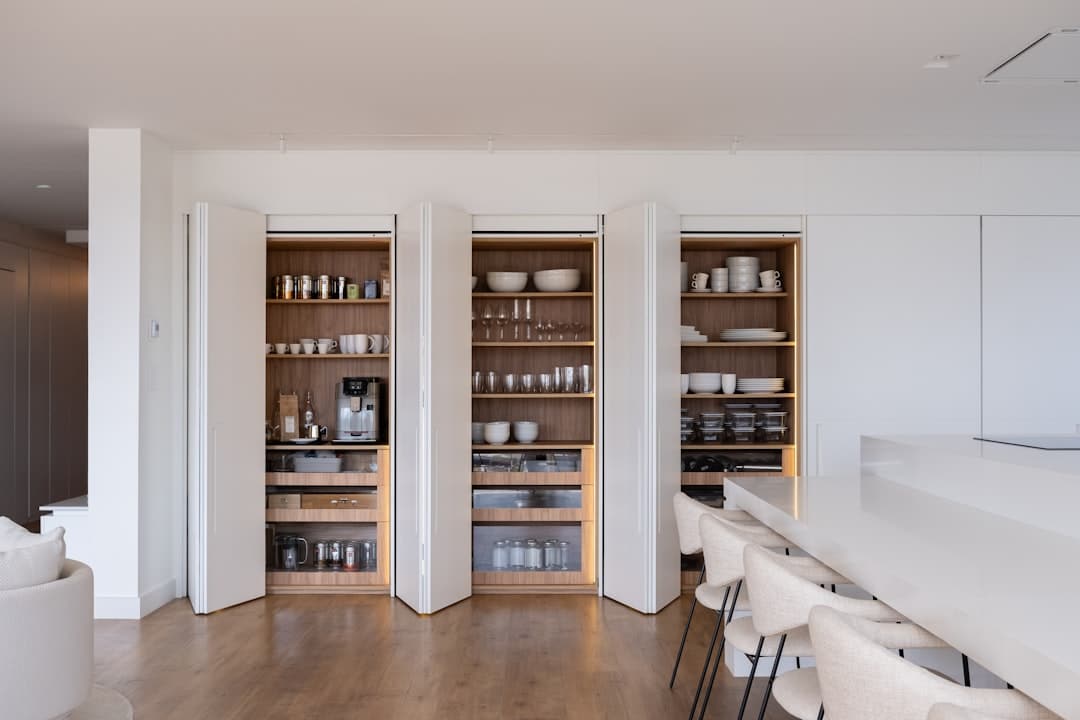





Is a 12-Inch Deep Pantry Cabinet Right for Your Kitchen?
A 12-inch deep pantry cabinet is the industry-standard depth for wall-mounted kitchen storage — and for good reason. Here’s a quick summary to help you decide if it’s the right fit for your space:
- Best for: Galley kitchens, narrow walls, and high-traffic areas where a full-depth cabinet would block movement
- Typical height range: 60 inches to 96 inches tall, maximizing vertical storage
- What fits inside: Canned goods, spices, dry foods, small boxes, and everyday essentials
- Key benefit: Items stay visible and within easy reach — no digging to the back of a deep shelf
- Main limitation: Not ideal for storing large appliances or bulky items
- Price range: Roughly $300 to $2,500+ depending on size, material, and supplier (based on average internet pricing)
If you have a small or awkward kitchen and need more storage without sacrificing floor space, a 12-inch deep pantry cabinet is often the smartest solution available.
Most homeowners don’t realize how much storage they’re leaving on the wall. A shallow pantry cabinet — just 12 inches deep — can hold an entire family’s worth of dry goods, spices, and daily kitchen essentials, all within arm’s reach. As one homeowner on a popular remodeling forum put it after installing a floor-to-ceiling 12-inch pantry in their galley kitchen: they were surprised by just how much it held once they started loading it up.
The challenge isn’t finding the space. It’s knowing how to use it well.
I’m Tyler Tranni, owner of Tranni Home Remodeling in Billerica, MA. I’ve helped many Massachusetts homeowners integrate 12-inch deep pantry cabinets into tight kitchen layouts where every inch counts, and I’ll walk you through everything you need to know to make the right choice.
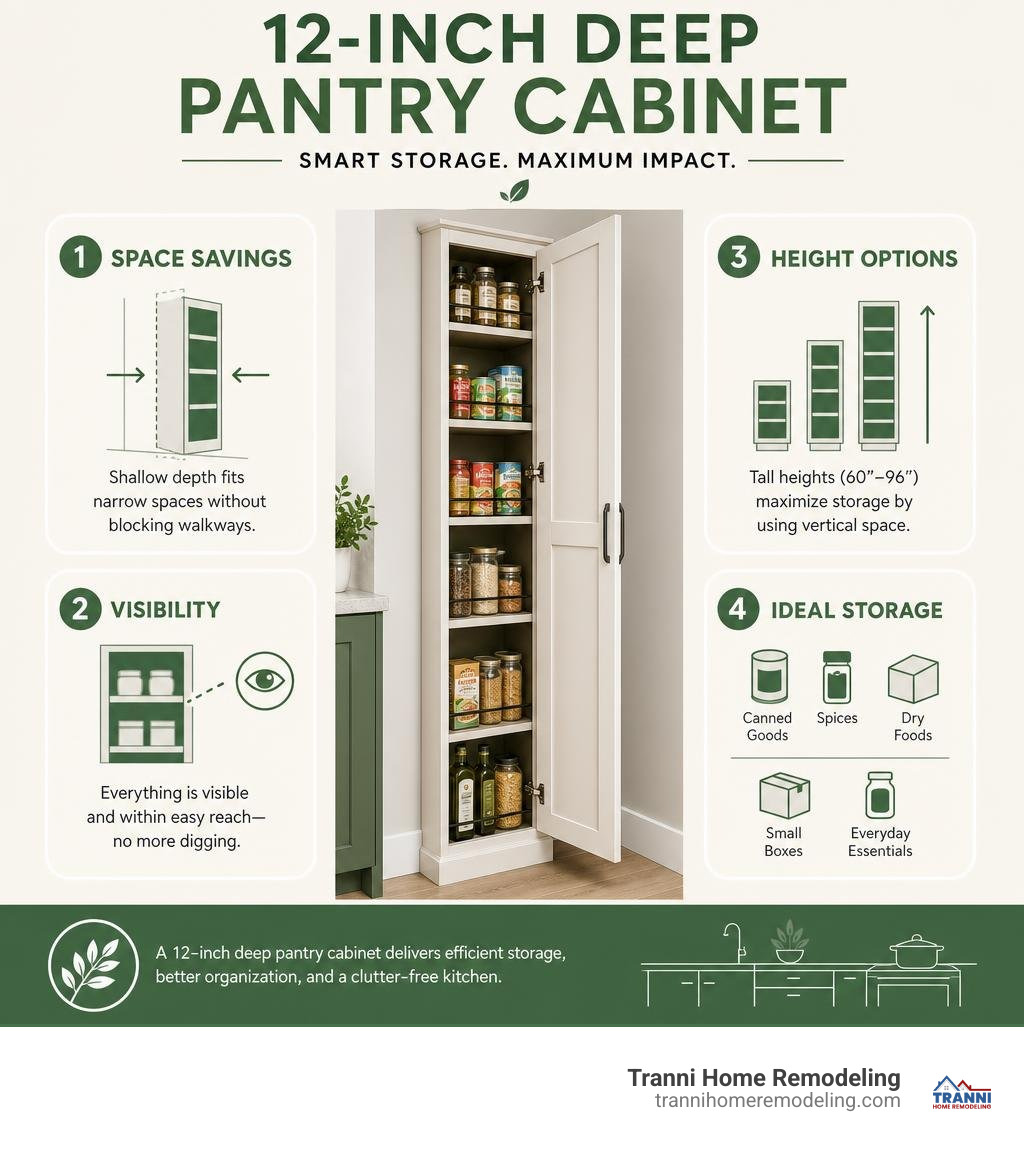
Quick look at 12 inch deep pantry cabinet:
Designing with a 12 Inch Deep Pantry Cabinet

When we think of a kitchen pantry, we often picture a deep, cavernous closet where cereal boxes disappear for months and half-used bags of flour go to die in the dark corners. While a deep pantry has its place, it often leads to what we call “cabinet Tetris”—a frustrating game of moving ten items just to reach the one bottle of olive oil you actually need.
A 12-inch deep pantry cabinet flips this design philosophy on its head. By matching the industry-standard depth of upper wall cabinets, a shallow pantry keeps everything on display. Instead of stacking items three or four rows deep, a 12-inch depth typically allows for only one or two rows of items. This simple change dramatically improves your day-to-day kitchen experience because you can see everything you own at a single glance.
To help visualize how this depth compares to a standard kitchen layout, let’s look at the differences between a shallow 12-inch pantry and a standard 24-inch deep model:
| Feature | 12-Inch Deep Pantry Cabinet | 24-Inch Deep Pantry Cabinet |
|---|---|---|
| Footprint Impact | Minimal; fits in narrow walkways and tight corners | Significant; requires standard base cabinet footprint |
| Item Visibility | Excellent; single or double-row storage prevents “lost” items | Poor; items easily get lost in the back without pull-out drawers |
| Ideal Storage Items | Canned goods, spices, boxes, jars, dry goods | Small appliances, mixing bowls, bulk packages, pots & pans |
| Traffic Flow | Preserves aisle width; ideal for high-traffic zones | Can restrict movement in tight or galley kitchens |
| Accessibility | Everything is immediately within arm’s reach | Often requires pull-out wire baskets or drawers to access the back |
Advantages of a 12 Inch Deep Pantry Cabinet
The most obvious advantage of choosing a 12-inch deep pantry cabinet is the sheer space savings. In many older homes throughout Middlesex County—from classic split-levels in Woburn to traditional homes in Burlington—kitchen footprints are tight. Adding a standard 24-inch cabinet would choke the room’s flow, making it feel cramped and dark. A 12-inch alternative provides a massive amount of vertical storage while leaving plenty of floor space for you to move around.
Additionally, because the shelves are shallow, you don’t need expensive or heavy pull-out drawer hardware to access your food. Standard stationary shelves work beautifully because nothing can hide behind a larger box. If you are exploring various kitchen cabinet designs, you will find that a shallow pantry can easily be integrated next to a refrigerator or along an empty wall to create a built-in look that feels custom-tailored to your home.
Potential Drawbacks to Consider
Of course, no single cabinet style is a magic bullet for every household. The primary drawback of a 12-inch deep pantry is its physical limitation when it comes to larger kitchen gear.
If you are hoping to store your stand mixer, a large food processor, slow cookers, or oversized serving platters, a 12-inch shelf simply won’t be deep enough. These larger appliances typically require a depth of at least 15 to 18 inches to sit comfortably behind closed doors. Furthermore, buying bulk items from warehouse stores can be a challenge; while standard cereal boxes and pasta packages fit perfectly, giant bulk boxes of paper towels or multi-packs of chips may have to live elsewhere.
Best Kitchen Layouts for Shallow Pantry Storage
When we plan a kitchen layout, we look closely at how people move through the space. A kitchen is more than just a place to cook; it’s the central highway of the home. That is why understanding your layout is so critical before purchasing cabinetry. You can learn more about arranging your space by reading our guide on kitchen layout ideas.
Maximizing Small Spaces and Galley Kitchens
In a classic galley kitchen, where parallel counters face each other, aisle clearance is your most precious resource. Standard kitchen design guidelines suggest a minimum walkway width of 36 inches for a single cook, and 48 inches for a shared space.
If you have an unused wall in a narrow kitchen, installing a standard 24-inch cabinet might reduce your walkway to a tight squeeze. However, a 12-inch deep pantry cabinet allows you to preserve that vital aisle width while still gaining vertical storage. This makes them highly effective in:
- Narrow Galley Kitchens: Allowing two people to pass each other without awkward bumping.
- Behind-the-Door Gaps: Utilizing the shallow space behind an entryway or basement door.
- Dining Room Transitions: Creating a seamless dry-goods storage zone between the kitchen and dining area without encroaching on seating space.
For those working with highly restrictive floor plans, reading up on kitchen design ideas for small spaces can spark creative ways to blend these shallow cabinets into your existing footprint.
Real-World Success with a 12 Inch Deep Pantry Cabinet
Homeowners on design forums like Houzz frequently share their experiences with shallow pantries, and the feedback is overwhelmingly positive. Many report that dedicating a shallow, floor-to-ceiling cabinet strictly to food storage completely transformed their kitchen organization.
By offloading all the canned goods, spices, and dry boxes to a shallow pantry wall, they freed up their deeper base cabinets for heavy pots, pans, and small appliances. This division of labor—shallow cabinets for food, deep cabinets for gear—is one of the most efficient design rules you can apply.
Sizing, Materials, and Hardware Options
Like standard cabinetry, shallow pantries come in a wide range of build qualities. Because these cabinets are tall and narrow, material selection is incredibly important for long-term durability.
We always recommend choosing cabinets constructed from premium plywood boxes rather than cheap particleboard. Plywood holds screws better, resists moisture from accidental spills, and won’t sag over time under the heavy weight of canned goods.
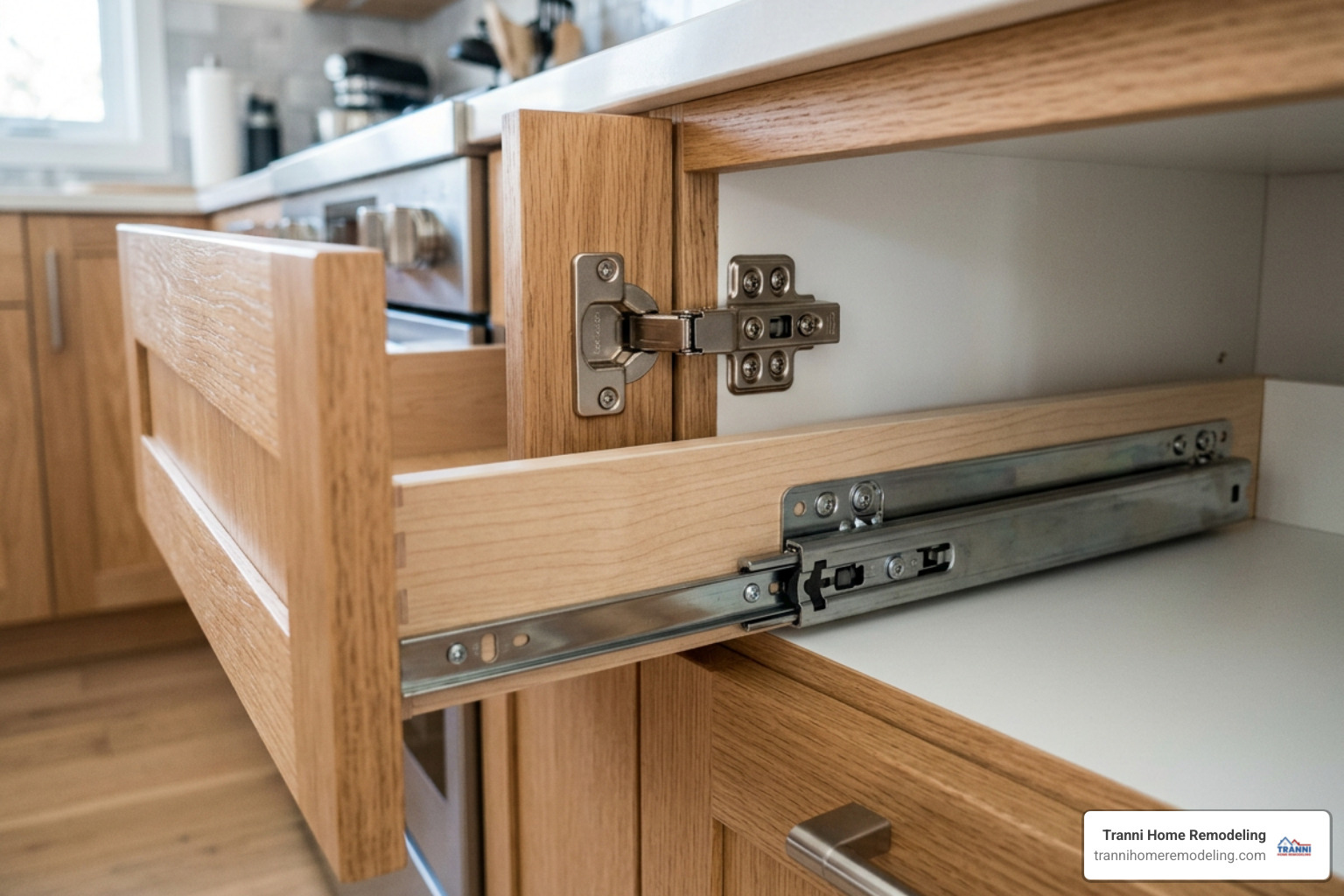
Height and Width Configurations
A 12-inch deep pantry cabinet is highly versatile because it is available in several height and width configurations:
- Heights: Typically start around 60 inches and can go all the way up to 84, 90, or 96 inches. Choosing a cabinet that reaches close to your ceiling allows you to maximize vertical storage space for items you only use occasionally, like holiday platters or extra paper goods.
- Widths: Usually range from a very narrow 12 inches up to a double-door 36 inches. A 12-inch wide by 12-inch deep cabinet is perfect for filling awkward gaps at the end of a cabinet run, while a 24-inch or 30-inch wide unit can serve as a primary family pantry.
Realistic Storage Capacity and Organization
What can you actually fit inside? To give you a realistic idea, a single 24-inch wide, 90-inch tall, and 12-inch deep pantry cabinet can easily hold:
- Up to 80-100 standard soup or vegetable cans
- 15-20 boxes of cereal or pasta
- Dozens of spice jars, baking ingredients, and oils
- A dedicated rack for snacks and school lunches
To take your organization to the next level, look for models that feature built-in door storage. Some units utilize the back of the doors to hold spices, small jars, and condiments. This effectively doubles your easily accessible storage space without adding an inch to the cabinet’s external footprint.
Cost, Availability, and Professional Installation
When planning your kitchen budget, it is helpful to understand how shallow cabinets compare to standard sizes in terms of cost and installation complexity. While they use fewer raw materials than a 24-inch deep cabinet, they still require the same level of craftsmanship, door hardware, and finish work. For a smooth project, we always advise working with professionals. You can read more about what to expect during this phase in our guide to kitchen cabinet installation.
Price Ranges and Market Availability
The cost of a 12-inch deep pantry cabinet can vary wildly based on whether you choose a flat-pack Ready-to-Assemble (RTA) option, a semi-custom unit, or a fully custom-built cabinet.
Based on average internet pricing data, a basic RTA or stock shallow pantry can start as low as $300 to $500. Mid-range, semi-custom options made of plywood with soft-close doors typically run between $600 and $1,200. On the high end, fully custom-built units designed to match your exact kitchen dimensions and finishes can exceed $2,500.
Please note: these price ranges are based on general internet market data and do not represent the actual project or installation costs for Tranni Home Remodeling.
If you are shopping online, you will find a variety of specialty suppliers offering specialized configurations. For instance, you can find premium options that blend the benefits of a shallow depth with the convenience of pull-out storage.
Crucial Installation and Safety Considerations
Because a 12-inch deep pantry cabinet is tall, narrow, and shallow, it has a high center of gravity. Once you load it up with heavy canned goods, it can easily become front-heavy. Safety is paramount here: these cabinets must be securely anchored to the wall studs.
During installation, we use heavy-duty cabinet screws to anchor the unit directly into at least two wall studs. If you are installing a freestanding unit, always use the manufacturer-provided anti-tip hardware.
Other key installation details include:
- Door Swing Clearance: Ensure the cabinet doors can open fully (ideally 110 degrees or more) without hitting adjacent walls, trim, or appliances.
- Floor Leveling: Older homes in towns like Winchester, Woburn, and Reading often have sloping floors. Using adjustable cabinet legs or shims is essential to ensure the cabinet stands perfectly plumb.
- Scribe Molding: To make a stock shallow cabinet look like a high-end custom build, we install matching scribe molding along the wall joints to hide any gaps caused by uneven plaster or drywall.
If you are planning a larger renovation alongside your new storage, our team offers comprehensive kitchen remodeling services to help you design, source, and install the perfect layout.
Frequently Asked Questions about Shallow Pantries
What can you actually fit inside a 12-inch deep pantry cabinet?
You can easily fit almost all standard dry grocery items. This includes canned goods, soda cans, jars of pasta sauce, olive oil bottles, cereal boxes, flour canisters, and spice racks. It is also an excellent spot to store aluminum foil, plastic wrap, and garbage bags. It is generally too shallow for large appliances like microwave ovens, stand mixers, or large slow cookers.
Do 12-inch deep pantry cabinets require wall anchoring?
Yes, absolutely. Because of their tall height and narrow 12-inch depth, these cabinets are highly susceptible to tipping forward when the doors are opened or if a child attempts to climb the shelves. They should always be anchored securely to the wall studs using high-quality cabinet screws.
How do shallow pantries compare in price to standard 24-inch cabinets?
Surprisingly, they are often very similar in price to standard 24-inch deep cabinets. While they use slightly less wood for the side panels and shelves, the most expensive components of any cabinet—the doors, face frames, hinges, drawer fronts, and finishing processes—remain exactly the same. However, they can save you money by eliminating the need for expensive pull-out wire baskets or heavy-duty drawer glides.
Conclusion
A 12-inch deep pantry cabinet is one of the most underrated tools in kitchen design. By utilizing vertical wall space without stealing valuable floor area, it offers a highly organized, visible, and accessible home for your family’s daily essentials. Whether you are dealing with a tight galley kitchen in Stoneham, a cozy kitchen in Wilmington, or simply want to eliminate the “black holes” in your current storage, a shallow pantry is a smart, stylish upgrade.
At Tranni Home Remodeling, based in Billerica, MA, we pride ourselves on delivering top-tier craftsmanship and personalized service to homeowners throughout Middlesex County. We can help you select, configure, and professionally install the ideal cabinetry to make your kitchen highly functional and beautiful.
Ready to transform your kitchen storage? Schedule a kitchen remodeling consultation with us today, and let’s build a space that works for you!
Like us on Facebook!