




HVAC Installation: 5 Essential Commercial Solutions for Success
The Essentials of Commercial HVAC Installation
HVAC installation for commercial buildings is a complex process requiring specialized knowledge and precise execution. If you’re considering a commercial HVAC system, here’s what you need to know:
- Average Cost Range: $30,000-$100,000+ depending on building size and system type
- Installation Timeline: Typically 1-2 weeks for standard installations
- Key Components: Air handlers, chillers, ductwork, ventilation systems
- Required Professionals: Licensed HVAC technicians with EPA certifications
- Energy Efficiency Ratings: Look for high SEER (13+) and AFUE (90%+) ratings
Commercial HVAC systems differ significantly from residential units in terms of size, complexity, and installation requirements. These systems must be properly sized based on building specifications, load calculations, and occupancy patterns to ensure optimal performance and energy efficiency.
Proper installation is critical for system longevity, operational efficiency, and compliance with building codes. When installed correctly, a commercial HVAC system can provide reliable climate control while minimizing energy consumption and maintenance costs.
I’m Tyler Tranni, owner of Tranni Home Remodeling, and I’ve overseen numerous commercial HVAC installation projects that have helped businesses maintain comfortable environments while optimizing their energy usage. My experience has taught me that proper planning and professional installation are the cornerstones of any successful commercial HVAC project.
Understanding Commercial HVAC Installation
Commercial HVAC systems are truly the lifeblood of your building, regulating temperature, humidity, and air quality for everyone inside. Unlike residential systems designed for a single family home, commercial systems face the challenge of managing varying occupancy levels, multiple zones, and diverse usage patterns throughout the day.
I like to think of it the way David Steckel, a home expert, describes it: “Just remember that your HVAC system is your home’s respiratory system, and it’s crucial to take care of it with regular maintenance.” This comparison is even more relevant for commercial buildings, where a system failure doesn’t just affect one family—it can impact dozens or even hundreds of people all at once.
Types of Commercial HVAC Systems
When you’re planning your commercial HVAC installation, you’ll need to select the right system type that matches your specific building needs:
Split Systems bring flexibility to smaller commercial spaces. With separate indoor and outdoor components working together, they’re perfect for creating different temperature zones within your building. The typical setup includes an outdoor condensing unit paired with an indoor air handler or furnace—simple but effective for many small to medium businesses.
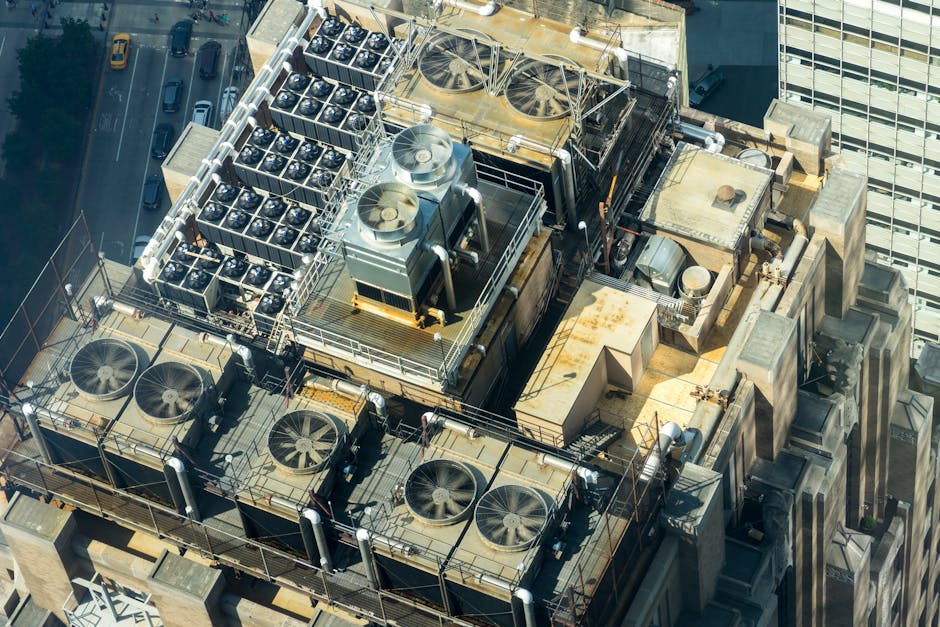
Rooftop Units (RTUs) are the space-savers of the commercial HVAC world. By combining all heating and cooling components in one cabinet installed on your roof, they free up valuable floor space inside. These are particularly popular for Billerica restaurants, retail spaces, and offices where every square foot counts. Plus, maintenance technicians can access them without disrupting your daily operations.
Variable Refrigerant Flow (VRF) Systems offer the ultimate in temperature control precision. These sophisticated systems can simultaneously heat one area while cooling another—ideal for buildings with diverse needs like hotels and office buildings with both sun-facing and interior rooms. While more expensive initially, they often pay for themselves through energy savings over time.
Heat Pumps provide both heating and cooling by simply moving heat from one place to another. They’re remarkably energy-efficient, especially in our Massachusetts climate, and can be configured as air-source, water-source, or geothermal systems depending on your property and budget.
The right choice depends on your building’s unique characteristics. For instance, a multi-story office building might benefit from a VRF system that can simultaneously heat perimeter offices while cooling interior conference rooms, while a single-story retail space might be perfectly served by rooftop units.
Components Involved in Commercial HVAC Installation
A successful commercial HVAC installation requires several key components working together seamlessly:
Air Handlers are the workhorses of your system, containing fans, heating and cooling elements, filter racks, and dampers. They’re carefully sized according to the volume of air they need to move throughout your building. Think of them as the heart that pumps conditioned air through your building’s circulatory system.
Chillers handle the cooling side of things by removing heat from liquid (usually water) that circulates through your building. This chilled water then cools and dehumidifies air in the air handling units. You can choose between air-cooled chillers (simpler but less efficient) or water-cooled varieties (more efficient but requiring cooling towers).
Ductwork is your system’s highway system, distributing conditioned air throughout the building. Commercial ductwork is typically larger and more complex than what you’d find in homes, often requiring custom fabrication to steer around structural elements. Proper ductwork design is crucial for maintaining consistent temperatures throughout your space.
Ventilation Systems ensure your building gets fresh air exchange with the outdoors, maintaining indoor air quality for occupants. Modern commercial ventilation often includes energy recovery ventilators (ERVs) that capture heat from exhausted air to pre-condition incoming fresh air—saving energy while providing better air quality.
Refrigerant Lines are the copper pipes that carry refrigerant between system components. For optimal performance, “The new refrigerant line set should be installed with minimal bends or turns and secured every 4 to 6 feet” to ensure efficient operation and prevent vibration issues.
For buildings with specific space constraints or where traditional ductwork isn’t practical, ductless heat pump systems offer an excellent alternative. These systems provide efficient heating and cooling without the extensive ductwork installation that can be disruptive and expensive in existing buildings.
Key Considerations Before HVAC Installation
Before jumping into a commercial HVAC installation, there are several critical factors you’ll want to consider. Taking the time to plan properly now can save you thousands in operating costs and prevent headaches down the road.
System Sizing and Load Calculations
Getting the right-sized system for your commercial building might be the single most important decision you’ll make. Think of it like buying shoes—too small and you’ll be uncomfortable; too large and you’ll trip over yourself.
“Improper sizing of an HVAC unit can lead to reduced efficiency and increased long-term costs,” is something we see all too often in buildings throughout Middlesex County. When a system is undersized, it runs constantly but never quite keeps up during peak demand. On the flip side, an oversized system cycles on and off frequently—like a car in stop-and-go traffic—which wears out equipment faster and wastes energy.
Professional load calculations take into account everything that affects your building’s heating and cooling needs:
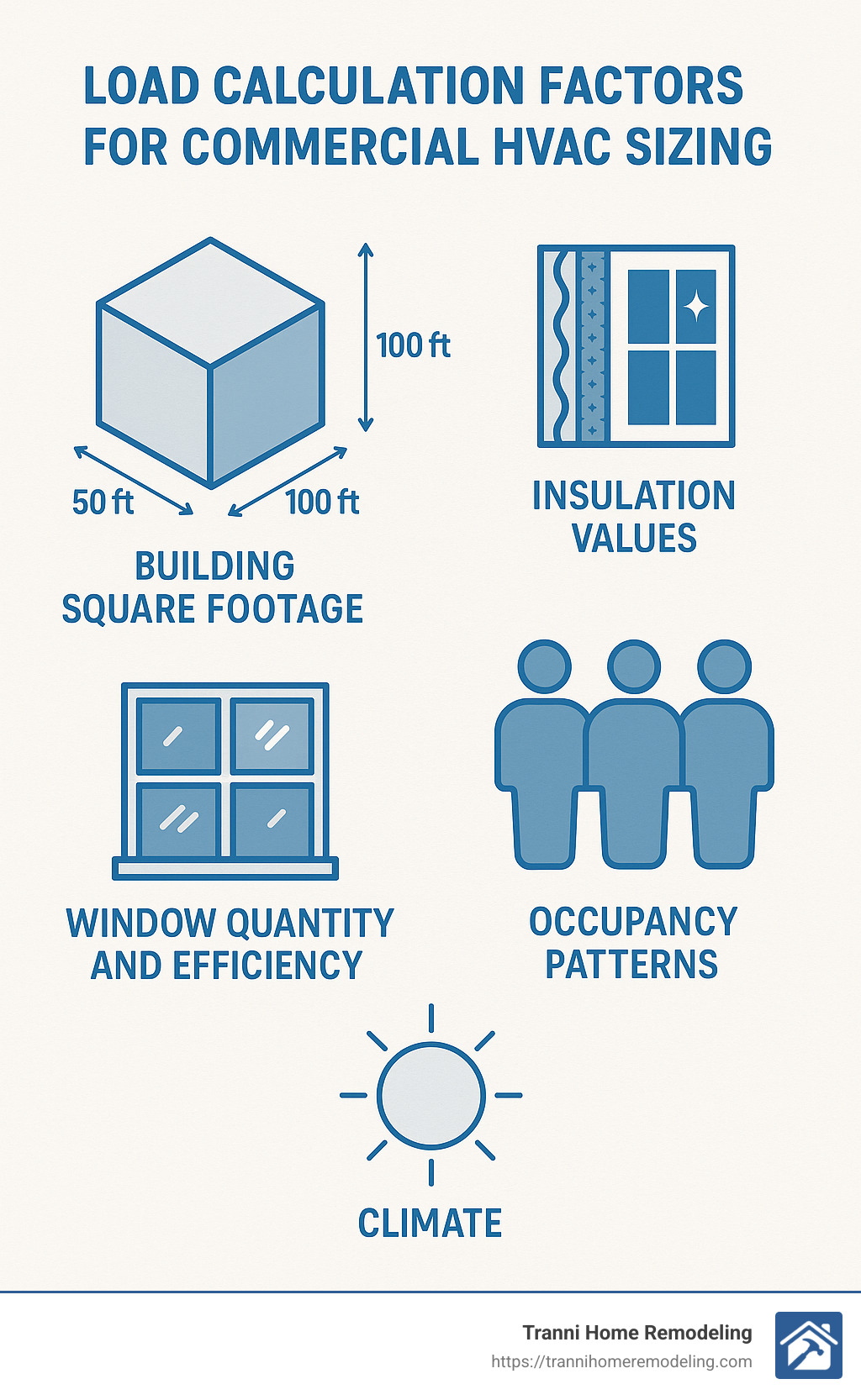
When we work with clients in Chelmsford or Wilmington, we don’t rely on rules of thumb like “one ton per 400 square feet.” Instead, we use industry-standard protocols such as ACCA Manual N to precisely match your system to your building’s unique requirements.
As one thirty-year veteran refrigeration mechanic put it, “You become more or less like an engineer.” That’s exactly right—proper commercial sizing is engineering, not guesswork. It’s a complex process that considers how your building’s orientation, insulation, windows, occupancy patterns, and even your lighting all affect your heating and cooling needs.
Compliance and Regulations
Commercial HVAC installation involves navigating a maze of regulations that protect building occupants and the environment.
First, you’ll need permits. In Massachusetts communities like Concord and Lexington, the permitting process for commercial HVAC can be particularly thorough, with inspections required at various installation stages. These aren’t just bureaucratic hoops—they ensure your system meets safety standards that protect everyone.
Building codes set minimum standards for installation quality. Your system must comply with the Massachusetts Building Code, which incorporates the International Mechanical Code and other standards. These codes cover everything from how equipment is secured to how ductwork is insulated.
Energy efficiency standards are increasingly stringent. Commercial buildings must meet minimum efficiency requirements established by ASHRAE Standard 90.1, which is part of the Massachusetts energy code. These standards help reduce energy consumption and operating costs.
Environmental regulations are particularly important when it comes to refrigerants. As our research shows, “Refrigerant recovery must be performed using EPA-certified equipment, and technicians handling refrigerants require proper certification.” The fines for improper refrigerant handling can be substantial—we’re talking thousands of dollars.
“Using licensed professionals with proper certifications is essential for a safe and efficient installation,” notes an industry expert. This is especially true for commercial projects where the consequences of poor installation affect more people and larger investments.
At Tranni Home Remodeling, we steer these requirements for our clients daily. We’re familiar with local building departments throughout Middlesex County and work closely with them to ensure full compliance with all regulations.
For those who want to dive deeper into quality installation requirements, the Quality Installation Checklist from ACCA provides excellent guidance on ensuring your system meets industry standards.
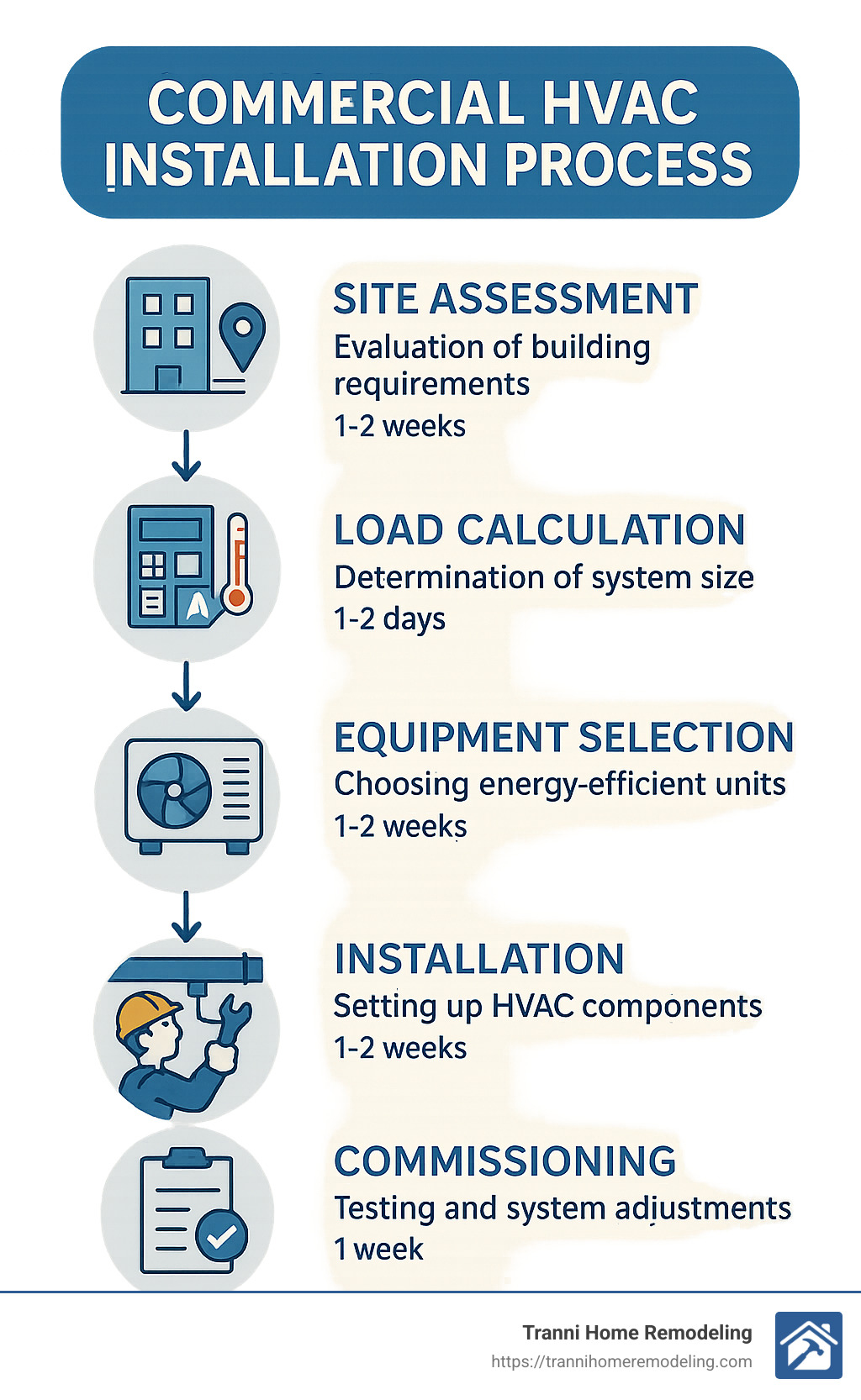
The Commercial HVAC Installation Process
A successful commercial HVAC installation isn’t just about placing equipment—it’s a carefully choreographed dance of planning, coordination, and technical expertise. When we tackle these projects at Tranni Home Remodeling, we follow a proven process that ensures your business gets a system that performs flawlessly for years to come.
Steps in Commercial HVAC Installation
1. Site Assessment and Planning
Before we touch a single tool, we spend time getting to know your building inside and out. I remember walking through a manufacturing facility in Tewksbury where the existing system struggled with both the heat from machinery and the building’s southern exposure. Only by thoroughly understanding these challenges could we design the right solution.
During this phase, we evaluate any existing systems, identify structural considerations that might impact installation, map out utility connections, assess available space for equipment, and spot potential obstacles before they become problems. This detective work upfront saves headaches down the road.
2. System Design and Engineering
With a clear understanding of your building’s needs, we roll up our sleeves and get to the detailed design work. This isn’t just about picking equipment—it’s about creating a comprehensive system where every component works in harmony.
Our team develops detailed plans including equipment specifications, ductwork layouts, electrical requirements, control system designs, and how everything will coordinate with other building systems. When designing for a medical office in Billerica last year, we had to carefully integrate the HVAC system with their sensitive equipment requirements—attention to detail matters!
3. Equipment and Material Procurement
Once designs are finalized and permits secured, we order all necessary equipment and materials. This stage requires patience, especially for specialized commercial equipment that might not be sitting on a shelf somewhere. Lead times can stretch from a few weeks to several months for custom or high-efficiency systems.
4. Demolition and Preparation
For replacement projects, we need to properly remove the old system first. This isn’t as simple as yanking out old equipment—it requires careful handling, especially of refrigerants. EPA regulations demand that refrigerant must be safely recovered by certified technicians using specialized equipment, preventing harmful releases into the atmosphere. We take these environmental responsibilities seriously.
5. Equipment Installation
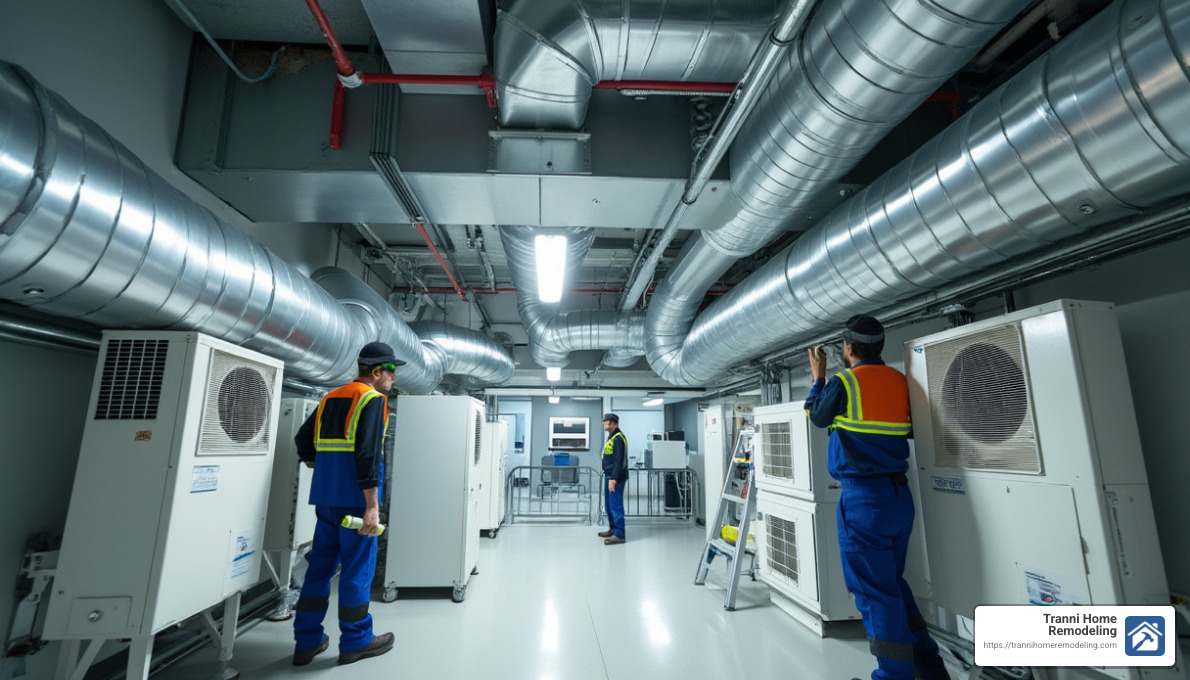
Now comes the heavy lifting—literally! Major components are carefully positioned according to design specifications. This might involve setting concrete pads for ground units, building roof curbs for rooftop equipment, or carefully positioning air handlers in mechanical rooms.
The precision required here can’t be overstated. I’ve seen installations where equipment was placed without considering service access, making maintenance a nightmare for years afterward. We always think about the technicians who’ll be servicing these systems down the road.
6. Ductwork Installation
Commercial ductwork is a major component of any HVAC installation. Unlike residential ductwork, commercial systems often require custom fabrication to steer around structural elements while maintaining proper airflow.
Our team fabricates and installs supply and return ducts, places fire dampers where required by code, carefully seals and insulates everything to prevent energy loss, and ensures proper support throughout the system. Good ductwork should be both functional and virtually invisible in its operation—no rattles, no whistles, just smooth, efficient airflow.
7. Piping and Electrical Connections
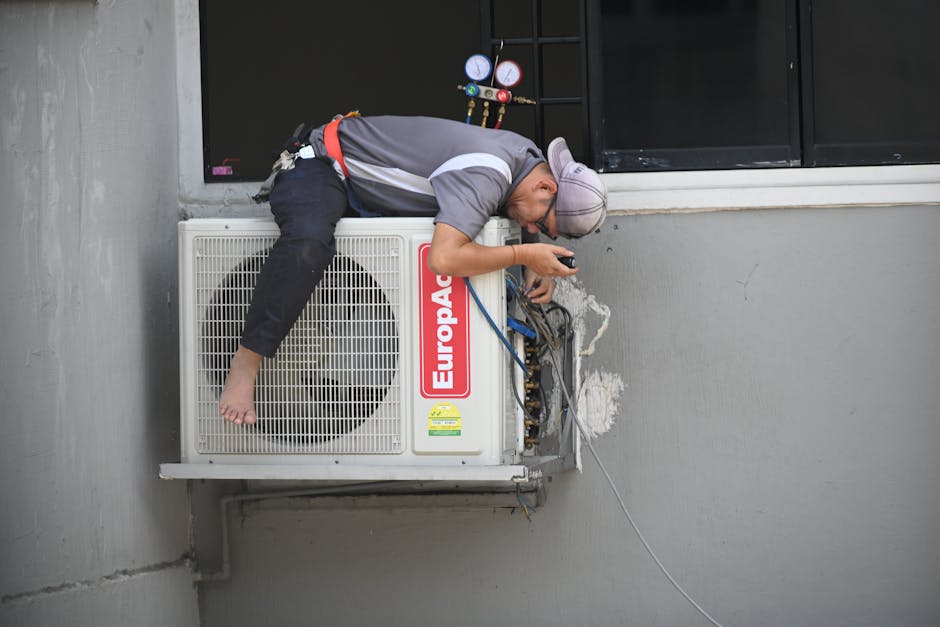
The nervous system of your HVAC setup comes together during this phase. We install refrigerant lines with proper sizing and support, connect electrical power to all components (often requiring coordination with electricians), set up condensate drainage systems, and install control wiring for thermostats and building automation.
One small mistake here—a pinched refrigerant line or an improperly sized electrical connection—can compromise the entire system. That’s why we triple-check every connection before moving forward.
8. Testing and Commissioning
The final and perhaps most critical step is thorough testing. We pressure-test refrigerant lines, verify electrical connections, balance airflow throughout the building, confirm proper operation of all components, and test every safety system.
This commissioning process isn’t just a quick once-over—it’s a methodical verification that every aspect of the system performs exactly as designed. When we installed a VRF system for an office building in Chelmsford, the commissioning took a full day to ensure each zone responded correctly to its individual controls.
Timeline and Expectations
While our introduction mentioned that typical installations take 1-2 weeks, that’s just the installation phase itself. The complete journey from concept to completion usually takes considerably longer.
For a medium-sized commercial project, here’s what you might expect:
- Initial consultation and site assessment: 1-2 weeks
- System design and engineering: 2-4 weeks
- Permitting: 2-6 weeks (this varies widely by municipality)
- Equipment procurement: 2-12 weeks (depending on equipment availability)
- Installation: 1-3 weeks
- Testing and commissioning: 1-2 days
- Final inspections: 1-2 weeks
We understand that HVAC installation can disrupt your business operations, which is why we work closely with our commercial clients in places like Burlington, Dracut, and Reading to minimize impact. Sometimes this means scheduling work during weekends or after hours—whatever it takes to keep your business running smoothly.
Communication is the backbone of a successful project. We provide regular updates throughout the process so you’re never left wondering what’s happening or what comes next. Many of our clients tell us this transparency is what they appreciated most about working with us—knowing exactly what to expect each step of the way.
Cost Factors and Benefits of Professional Installation
Let’s face it – when you’re planning a commercial HVAC installation, the price tag matters. But understanding what drives those costs and the value you get from professional installation helps put everything in perspective.
Cost Factors for Commercial HVAC Systems
Commercial HVAC systems typically range from $30,000 to over $100,000, based on internet data (not actual costs for Tranni Home Remodeling). For larger buildings or specialized systems, costs can climb even higher. But what exactly goes into that number?
Your building’s size and layout play a huge role. A sprawling warehouse in Billerica has different needs than a multi-story office building in Chelmsford. Larger spaces need more powerful systems and extensive ductwork, while complex layouts with multiple zones add layers of complexity.
The type of system you choose significantly impacts your budget:
| System Type | Average Cost Range (Internet Data) |
|---|---|
| Split Systems | $30,000 – $90,000 |
| Rooftop Units (RTUs) | $40,000 – $120,000 |
| Variable Refrigerant Flow (VRF) | $50,000 – $150,000 |
| Geothermal Heat Pumps | $75,000 – $225,000 |
When we work with clients in places like Dracut or Tewksbury, we often find that energy efficiency ratings become a key consideration. Higher-efficiency systems cost more upfront but can save up to 20% on energy costs compared to older units. For commercial buildings that run systems nearly constantly, these savings add up quickly.
Ductwork requirements often surprise building owners with their impact on the bottom line. At roughly $15 per linear foot (according to internet data), ductwork for a commercial space can quickly become a major budget item. I’ve seen projects where the ductwork alone accounted for nearly a third of the total installation cost!
Don’t forget about control systems – modern commercial buildings often benefit from sophisticated controls that optimize performance. While these add to upfront costs, they typically pay for themselves through improved efficiency and comfort.
Finally, installation challenges like limited access points or structural obstacles can increase labor costs. Historic buildings in Concord or unique architectural features in Lexington often require creative solutions that take more time and specialized equipment.
Benefits of Professional Installation
I’ve seen what happens when commercial HVAC installation is handled by inexperienced teams – it’s rarely pretty and often expensive to fix. Here’s why professional installation is worth every penny:
System performance and efficiency starts with proper installation. When we install commercial systems, we carefully optimize airflow and refrigerant levels to ensure peak performance. As one 26-year industry veteran told me, “Everybody’s trying to get the power consumption down…” – and that begins with expert installation that gets all the details right.
Code compliance and safety aren’t negotiable in commercial buildings. Professional installers understand the complex web of building codes, fire safety requirements, and environmental regulations that apply to commercial HVAC. This protects not just your investment, but the safety of everyone who enters your building.
Your system’s longevity and reliability depend heavily on proper installation. With professional installation, your system can reach the upper end of its 15-20 year potential lifespan. I’ve seen poorly installed systems fail in half that time, forcing businesses into premature, unbudgeted replacements.
Warranty protection is another critical benefit. Most manufacturers require professional installation to maintain warranty coverage. When we install systems in places like Burlington or Reading, we carefully document everything to ensure our clients’ warranties remain fully intact.
Professional installers also perform comprehensive testing and commissioning before considering a job complete. This includes detailed performance evaluations that verify every component works exactly as designed. We don’t consider a job finished until the system performs perfectly.
For businesses looking for alternatives to traditional ducted systems, Ductless Heating and Cooling Systems offer excellent efficiency with simpler installation requirements. These systems can be particularly valuable for renovations or additions where extending existing ductwork would be challenging.
As home expert Mallory Micetich wisely advises, “Get at least three estimates and don’t be shy about asking as many questions as you’d like.” This approach helps ensure you find a qualified professional who understands your specific needs and can provide appropriate solutions.
When planning your budget, check out these Detailed Cost Estimates for Commercial HVAC Installation to understand industry averages and prepare accordingly.
At Tranni Home Remodeling, we’ve seen how quality HVAC installation transforms commercial spaces throughout Middlesex County. While the initial investment might seem substantial, professional installation pays dividends through efficiency, reliability, and peace of mind for years to come.
Choosing the Right Commercial HVAC System
Selecting the appropriate system for your commercial space is a critical decision that will impact comfort, energy consumption, and operational costs for years to come. At Tranni Home Remodeling, we’ve helped numerous businesses throughout Middlesex County find the perfect HVAC solution for their unique needs.
Matching Systems to Building Requirements
Different commercial buildings have vastly different HVAC requirements, and there’s no one-size-fits-all solution. Let me walk you through some common scenarios we encounter:
Office Buildings present unique challenges with their varying occupancy levels throughout the day. When we work with clients in Woburn or Winchester, we often recommend VRF systems that can provide individualized comfort control for different zones. This means the accounting department that’s always cold can stay warm while the server room stays cool – keeping everyone happy and productive.
Retail Spaces face constant fluctuations in heat load as customers come and go. Those automatic doors in Stoneham or Tewksbury shops can let in a blast of winter air dozens of times an hour! For these environments, we typically recommend packaged rooftop units that can respond quickly to changing conditions while keeping energy costs manageable.
Restaurants are some of the most demanding environments for HVAC installation. That sizzling grill in your kitchen might be great for steaks, but it creates serious heat that needs to be managed. We design systems with powerful ventilation and separate zones for dining and kitchen areas so your customers can enjoy a comfortable meal while your chefs aren’t sweating through their uniforms. Makeup air systems are often essential to replace all that exhausted kitchen air.
Healthcare Facilities demand precision and reliability. When we work with medical offices, we focus on systems that maintain exact temperature and humidity levels while providing superior air filtration. These environments often benefit from redundant systems to ensure continuous operation – because medical equipment and patient comfort can’t wait for HVAC repairs.
Warehouses in North Reading or Wilmington present their own set of challenges with their vast open spaces. For these environments, we might recommend infrared heating systems that warm objects and people directly rather than trying to heat all that air. High-volume, low-speed fans combined with strategically placed heating and cooling units can also create comfortable working conditions without breaking the budget.
Energy Efficiency Considerations
Energy efficiency isn’t just good for the planet – it’s good for your bottom line. When planning your commercial HVAC installation, we pay close attention to efficiency ratings that will impact your long-term operating costs.
SEER Ratings measure cooling efficiency, and the difference between a standard and high-efficiency system can be substantial. For commercial applications, we recommend systems with a SEER rating of at least 14, though high-efficiency options can reach 18 or higher. One client in Billerica saw their summer cooling costs drop by nearly 30% after upgrading from an old system to one with a higher SEER rating.
AFUE Ratings tell us how efficiently heating equipment converts fuel to heat. Modern commercial furnaces should achieve AFUE ratings of 90% or higher, meaning 90 cents of every dollar you spend on fuel goes directly to heating your space. The rest is lost in the combustion process.
EER Ratings measure cooling efficiency specifically at peak conditions – like those scorching July afternoons when your system is working hardest. Commercial equipment should have an EER of at least 11, with high-efficiency units reaching 13 or higher. This rating is particularly important for businesses that experience high cooling demands during peak hours.
Variable Capacity Technology has revolutionized commercial HVAC efficiency. Rather than simply turning on and off like older systems, these modern units can modulate their output based on actual demand. It’s like having a car with a gas pedal instead of just an on/off switch. As one expert noted in our research, “The use of two-stage compressors and variable-speed blowers in high SEER systems increases energy efficiency.”
A properly sized system with high-efficiency ratings can significantly reduce operational costs over the equipment’s lifespan. For businesses in Middlesex County looking to balance comfort with energy savings, we take the time to explain how a slightly higher initial investment in efficiency can pay substantial dividends through years of lower utility bills.
After all, your commercial HVAC system will likely be with you for 15-20 years – it’s worth getting it right the first time with professional HVAC installation from a team that understands both the technical requirements and the business considerations of commercial systems.
Maintenance Requirements for Commercial HVAC Systems
After your professional HVAC installation is complete, the journey is just beginning. Like a high-performance vehicle, your commercial HVAC system needs regular care to keep it running smoothly for years to come.
Establishing a Maintenance Schedule
I’ve seen how proper maintenance can extend system life by years and prevent those painful emergency repair calls that always seem to happen during the busiest times or extreme weather.
Commercial HVAC systems work hard—often running 10-12 hours daily—and this continuous operation takes a toll. A structured maintenance program isn’t just recommended; it’s essential for protecting your investment.
Your monthly maintenance should include checking and replacing air filters, which can become clogged surprisingly quickly in commercial settings. Don’t forget to inspect condensate drains for clogs (which can cause water damage if overlooked), check belts for proper tension, and verify that thermostats are reading accurately.
Quarterly, you’ll want to have professionals clean those condenser and evaporator coils, which collect dust and debris that can reduce efficiency by up to 30% if left uncleaned. They should also check refrigerant levels, inspect electrical connections for safety, and test all control systems.
Annually, your system needs a comprehensive inspection that includes lubricating all moving parts, thoroughly cleaning burners and heat exchangers, and recalibrating controls for optimal performance.
As David Steckel wisely noted: “Just remember that your HVAC system is your home’s respiratory system, and it’s crucial to take care of it with regular maintenance.” This comparison is even more apt for commercial systems, which move massive volumes of air through your building daily.
At Tranni Home Remodeling, we often remind our clients in places like Chelmsford and Tewksbury that skipping maintenance is like skipping oil changes in your car—it might seem fine for a while, but you’re setting yourself up for a much bigger problem down the road.
The Role of Building Management Systems
Modern commercial HVAC installations have gotten smarter, with building management systems (BMS) revolutionizing how we monitor and maintain these complex systems.
These intelligent systems serve as the brain of your HVAC operation, providing real-time performance monitoring that can detect subtle changes in operation before they become noticeable problems. They track energy usage patterns, allowing you to identify inefficiencies and optimize performance based on actual building usage.
One of the biggest advantages for busy facility managers is remote control capability. Imagine adjusting temperature settings or responding to an alert without driving across town to your building at 2 AM. For businesses in Wilmington or Tyngsborough, this technology transforms maintenance from reactive to proactive.
I recently worked with a client in Dracut whose BMS alerted us to a gradual pressure drop in one zone—something that would have gone unnoticed until it failed completely. We were able to schedule a convenient repair time rather than dealing with an emergency shutdown during business hours.
These systems also provide valuable data that helps maintenance technicians pinpoint issues quickly. Instead of spending hours troubleshooting, they can often identify the problem before they even arrive on site, making maintenance visits more efficient and less disruptive to your operations.
While building management systems represent an additional investment during HVAC installation, the operational benefits and extended equipment life typically deliver an excellent return on investment for commercial property owners throughout Middlesex County.
Conclusion: Making the Right Choice for Your Commercial HVAC Installation
Choosing the right commercial HVAC installation is one of those decisions that will impact your building for years to come. It’s not just about comfort—though that’s certainly important—it’s about creating an efficient, reliable system that serves your business needs while keeping energy costs in check.
At Tranni Home Remodeling, we’ve seen how proper installation makes all the difference. While our roots are in residential remodeling, we’ve grown to serve select commercial clients throughout Middlesex County who need thoughtful HVAC solutions for their businesses.
When you work with us on your commercial HVAC installation, you can expect a personalized approach that puts your needs first. We’ll start with a thorough assessment of your building, carefully calculating load requirements to ensure your system is perfectly sized—never too big or too small. We believe in getting it right the first time, which means precise planning before any equipment arrives on site.
Our team takes pride in selecting quality equipment that matches your specific requirements and budget. Once installation begins, our certified technicians handle every aspect with professional care, from positioning major components to running the final tests that ensure everything works in harmony. Throughout the process, we keep the lines of communication open so you always know what’s happening and what to expect next.
For businesses with unique needs or space constraints, we also offer specialized solutions like Mini Split Heat Pump systems. These versatile units provide excellent zone-specific comfort control and can be ideal for certain commercial applications where traditional systems might not be the best fit.
Yes, quality commercial HVAC systems represent a significant investment. The internet data shows systems ranging from $30,000 to over $100,000 depending on your building’s size and requirements. But when you consider the long-term benefits—lower energy bills, fewer repairs, longer system life, and consistent comfort for employees and customers—professional installation truly pays for itself over time.
Whether you’re planning a brand-new system for your Billerica office building, upgrading an aging system in your Dracut retail space, or exploring options for your Chelmsford restaurant, we’re here to help steer the complexities of commercial HVAC installation. Our goal is simple: to deliver a system that works as hard as you do, day in and day out.
Contact Tranni Home Remodeling today, and let’s talk about creating the perfect climate for your business success. After all, comfort shouldn’t be complicated—and with the right partner, it won’t be.