





Mini split installation cost: Unlock 2025 Savings
Your Guide to Understanding Mini Split Pricing
The mini split installation cost typically ranges from $2,000 to $14,500, with most homeowners paying around $3,000 for a single-zone system. Here’s what you need to know:
Quick Cost Overview:
- Single-zone systems: $2,000 – $6,000
- Multi-zone systems: $5,000 – $15,000+
- Equipment costs: $1,400 – $7,300
- Labor costs: $700 – $3,000
- Additional costs: $250 – $2,000 (permits, electrical, etc.)
When homeowners ask about mini split systems, the first question is always about cost. And honestly, I get it – you want to know what you’re getting into before you start planning.
The truth is, mini split installation costs vary a lot based on your specific situation. A simple wall-mounted unit for one room costs much less than a whole-house system with multiple indoor units. The brand you choose, your home’s electrical setup, and even your location all play a role in the final price.
What affects your total cost?
- System type (single vs. multi-zone)
- Unit capacity and efficiency ratings
- Installation complexity
- Local labor rates
- Required permits and upgrades
I’m Tyler Tranni, owner of Tranni Home Remodeling in Billerica, MA, and I’ve helped dozens of homeowners steer mini split installation cost decisions during kitchen and whole-home renovations. Understanding these costs upfront helps you make the right choice for your budget and comfort needs.

Simple guide to mini split installation cost:
What Factors Influence Mini Split Installation Cost?
When homeowners ask me about mini split installation cost, I always explain that it’s not just about picking a unit off the shelf. There are several moving pieces that affect your final investment, and understanding these upfront helps you budget realistically.
The biggest cost drivers include the type of system you choose (single or multi-zone), the heating and cooling capacity you need, energy efficiency ratings, brand quality, and how complex your specific installation will be. Your location also matters – labor rates in our service area might be different from what you’d pay in other states.
Note: All prices mentioned are national averages from online data and do not represent a quote from Tranni Home Remodeling. Costs can vary significantly.
For more comprehensive information about our installation process, check out our Ductless AC Unit Installation page.
The Impact of System Type: Single-Zone vs. Multi-Zone
The first big decision that impacts your mini split installation cost is choosing between a single-zone or multi-zone system. Think of this as the foundation of your entire project budget.
Single-zone systems are the simpler option – one outdoor unit connected to one indoor unit. These work great when you need climate control for just one area, like a home addition, converted garage, or that one room that’s always too hot or cold. Installation is straightforward, and the price reflects that simplicity.
You’re looking at roughly $2,000 to $6,000 for a complete single-zone installation. That’s equipment, labor, and basic materials all rolled together.
Multi-zone systems are where things get more interesting (and more expensive). One outdoor unit powers multiple indoor units throughout your home, giving you independent temperature control in different rooms. It’s like having multiple air conditioners, but with just one outdoor unit taking up space.
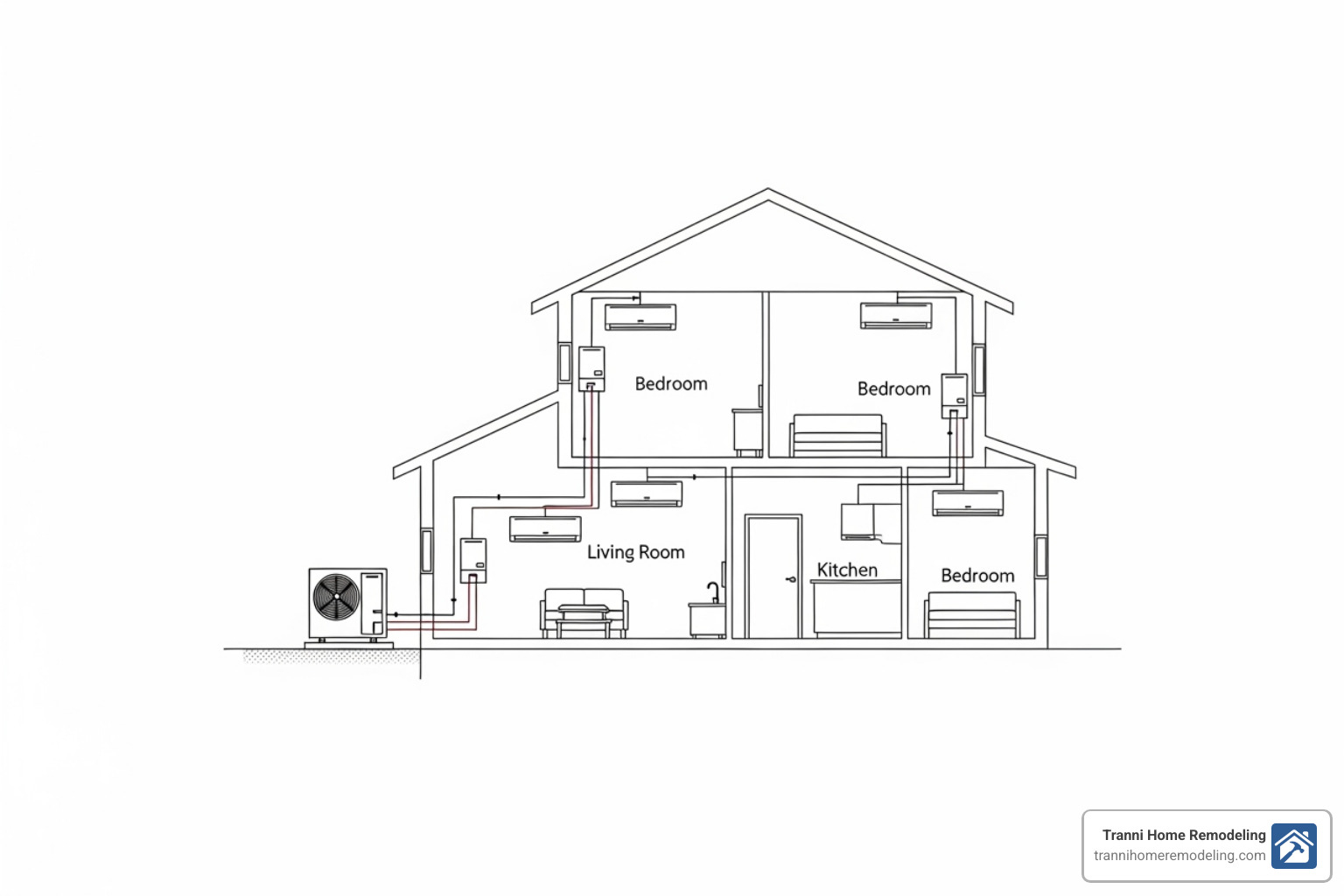
Multi-zone systems typically run $5,000 to $15,000 or more, depending on how many zones you need. Yes, it’s a bigger upfront investment, but the flexibility and energy savings can be worth it if you’re conditioning multiple rooms.
Sizing and Capacity (BTUs)
Here’s where the math comes in. BTUs (British Thermal Units) measure your system’s heating and cooling power. Too small, and you’ll never reach comfortable temperatures. Too big, and the system cycles on and off constantly, wasting energy and creating uneven temperatures.
Most HVAC contractors will do a proper load calculation to get this right, but there’s a general rule: you need about 12,000 BTUs for every 450 to 550 square feet. The bigger the space, the more BTUs you need, and higher BTU units cost more.
Here’s how sizing affects your mini split installation cost:
| Room Size (Square Feet) | Recommended BTU Capacity | Average Unit Cost Range* |
|---|---|---|
| 150 – 250 | 6,000 BTUs | $450 – $1,600 |
| 250 – 350 | 9,000 BTUs | $600 – $2,300 |
| 350 – 500 | 12,000 BTUs | $700 – $3,200 |
| 500 – 750 | 18,000 BTUs | $1,000 – $4,200 |
| 750 – 1,000 | 24,000 BTUs | $1,100 – $5,200 |
| 1,000 – 1,250 | 30,000 BTUs | $1,600 – $5,700 |
| 1,250 – 1,500 | 36,000 BTUs | $1,800 – $6,000 |
| 1,500 – 2,000+ | 42,000 BTUs+ | $3,000 – $8,000+ |
*These are equipment costs only – installation labor and materials are extra.
Efficiency Ratings and Brands
Energy efficiency ratings like SEER, EER, and HSPF tell you how much cooling or heating you get per dollar of electricity. Higher ratings mean lower monthly bills, but they also mean higher upfront costs.
A system with a SEER rating of 20 or higher will cost more initially than one with a SEER of 15, but it’ll save you money every month on electricity. Over 15-20 years, those savings really add up.
Brand quality also affects pricing. Established names like Mitsubishi, Daikin, and Fujitsu command premium prices – typically $1,200 to $8,650 for the unit alone. More budget-friendly options might range from $700 to $5,900. The premium brands usually offer better warranties, quieter operation, and more advanced features.
You’re essentially choosing between paying more upfront for quality and efficiency, or keeping initial costs lower but potentially paying more in repairs and energy bills later. For guidance on energy-efficient options, check out Choosing an energy efficient system.
Installation Complexity and Additional Costs
Beyond the equipment and basic installation, several factors can add to your total mini split installation cost. These “extras” can sometimes catch homeowners off guard.
New construction versus retrofit makes a big difference. Installing in a new build is usually straightforward, while retrofitting an existing home – especially an older one – can involve surprises like outdated wiring or tricky wall configurations.
Unit type and placement also matter. Wall-mounted units are the most common and affordable option, with total installed costs ranging from $775 to $2,000. Ceiling cassette units look sleek but require cutting into ceilings and more complex installation, pushing costs to $875 to $3,500.
Line set length is another variable. These refrigerant lines connect your indoor and outdoor units, and longer distances mean more materials and labor. Expect to pay an extra $100 to $300 per additional foot beyond the standard installation.
Electrical upgrades can be a significant expense, especially in older homes. Mini splits need dedicated circuits, and if your electrical panel can’t handle the load, you’re looking at $500 to $2,000 in electrical work. That’s where our Electrical Services come in handy.
Permit costs vary by location but typically run $250 to $1,000 or more. Most municipalities require permits to ensure the work meets safety codes.
Finally, if you’re removing an old HVAC system, add another $80 to $150 for safe disposal of the old equipment.
Cost Breakdown: Equipment vs. Professional Labor
When you’re planning your mini split installation cost budget, it helps to understand exactly where your money goes. Think of it like any home improvement project – you’ve got your materials and your labor, but with mini splits, both pieces are equally important for getting a system that works properly and lasts for years.
Here’s the thing about mini split installations: while you might be tempted to focus only on getting the cheapest equipment, professional installation isn’t just recommended – it’s absolutely essential. A poorly installed system can void your warranty, waste energy, and even create safety hazards. Trust me, I’ve seen too many DIY attempts that ended up costing more to fix than if they’d been done right the first time.
The Price of the Mini Split Unit Itself
The equipment portion of your mini split installation cost includes several key components that work together to keep you comfortable year-round.
Your outdoor condenser unit is essentially the powerhouse of the whole system. This box sitting outside your home contains the compressor and condenser coil that make the magic happen. Depending on the capacity, brand, and efficiency ratings you choose, you’re looking at anywhere from $1,000 to $5,500 or more for this unit alone.
The indoor air handlers are what actually deliver the conditioned air into your rooms. Each wall-mounted unit typically runs between $400 and $1,800, though ceiling cassettes and other specialty types can cost more. If you’re going with a multi-zone system, you’ll need one indoor unit for each zone you want to control independently.
Don’t forget about the installation materials and kits either. These include the refrigerant lines (usually around $5 to $7 per foot), electrical components, mounting brackets, and drainage materials. While some contractors include these in their labor costs, others list them separately, so make sure you understand what’s included in your quote.
For more details about the different types of units and their features, check out our comprehensive guide to the Mini Split AC Unit.
Understanding the Labor Portion of Your Mini Split Installation Cost
The labor portion of your investment covers the skilled work needed to properly install, test, and commission your new system. HVAC technicians typically charge between $100 and $200 per hour, and honestly, this is money well spent when you consider what’s involved.
A single-zone installation usually takes between 6 to 10 hours, which translates to labor costs ranging from $300 to $2,000. Multi-zone systems are more complex, involving multiple indoor units, longer refrigerant runs, and more intricate electrical work. For these installations, you can expect labor costs between $700 and $3,000.
What makes professional installation worth every penny? Proper refrigerant handling ensures your system runs efficiently and doesn’t leak harmful chemicals. Correct electrical connections prevent fires and equipment damage. Precise mounting and leveling keeps your system running quietly and prevents water damage from improper drainage.
The importance of certified installers can’t be overstated. Look for technicians with proper NATE certification or similar credentials. These professionals have the training and tools to handle refrigerants safely, make proper electrical connections, and ensure your system meets all local codes. You can find certified professionals through organizations like Find a certified professional.
At Tranni Home Remodeling, we’ve been installing mini splits for years as part of our home renovation projects. We’ve seen how proper installation makes the difference between a system that works great for decades and one that causes nothing but headaches.

Is a Mini Split Worth the Investment? Benefits & Long-Term Savings
When you’re looking at the mini split installation cost upfront, it’s natural to wonder if you’re making a smart investment. After helping homeowners in the Billerica area with their HVAC decisions during renovations, I can tell you with confidence – mini splits are absolutely worth it.
Let me break down why these systems pay for themselves over time, and why so many of our clients are thrilled with their decision.
The energy savings alone are impressive. Most homeowners see their cooling costs drop by up to 30% compared to traditional systems. Why? Because mini splits don’t use ductwork, which means no energy gets lost through leaky ducts (and trust me, most ducts leak more than you’d think). Your conditioned air goes directly where you need it, not into your walls or crawl space.
Zoned comfort is a game-changer for families. With a multi-zone system, each room becomes its own climate zone. Mom can keep the bedroom cool while Dad cranks up the heat in his home office. No more thermostat battles, and you’re only paying to condition the spaces you’re actually using.
Your indoor air quality improves significantly with mini splits. Unlike traditional systems that can blow dust and allergens through old ductwork, these units have built-in filtration that actually cleans the air as it circulates. This is especially noticeable in older homes where ductwork might harbor years of accumulated dust.
The quiet operation surprises most people. The loudest part – the compressor – sits outside your home. Inside, these units run at about 32 decibels, which is quieter than most people whisper. You’ll actually forget they’re running.
For homeowners dealing with HVAC Installation for Older Homes without existing ductwork, mini splits are often the perfect solution. Installing ductwork in a 100-year-old home can be incredibly disruptive and expensive. Mini splits give you modern comfort without tearing apart your walls.
Home value gets a boost too. Energy-efficient climate control systems are increasingly important to buyers, especially in our area where older homes are common. A well-installed mini split system shows potential buyers that the home has modern, efficient systems they won’t need to upgrade right away.
The bottom line? While the initial mini split installation cost might seem significant, the combination of energy savings, improved comfort, and increased home value makes it a smart long-term investment for most homeowners.
DIY vs. Professional Installation: Is Saving Money Worth the Risk?
I get it – when you see the mini split installation cost broken down, the labor portion can feel steep. You might be thinking, “Can’t I just buy the unit online and install it myself?” It’s a tempting thought, especially when you see DIY success stories online.
Let me share what we’ve learned from years of fixing DIY installations gone wrong. While you might save $1,000 to $3,000 upfront on labor costs, the hidden expenses and risks often make it a costly gamble.
The Real Cost of Going DIY
You can buy a mini split unit for $900 to $2,000 online. But here’s what most DIYers don’t realize until they’re halfway through the project – you need specialized tools that cost almost as much as hiring a professional.
You’ll need a vacuum pump ($80 to $350) to remove moisture from the refrigerant lines, a micron gauge ($175) to check for leaks, and a torque wrench for proper connections. Add in HVAC hoses ($20 to $850), a core removal tool ($70), and access to a nitrogen tank for pressure testing, and you’re looking at $500 to $1,500 in tools alone.
Where DIY Installations Go Wrong
The biggest issue we see? Voided warranties. Most manufacturers require professional installation by a certified technician. Install it yourself, and you’re on your own if something breaks.
Then there are refrigerant leaks. Handling R-410A refrigerant isn’t like changing your car’s oil. Improper connections lead to leaks that harm the environment and kill your system’s efficiency. In fact, venting refrigerants is illegal and can cost you up to $25,000 per day in EPA fines.
Electrical hazards are another serious concern. Mini splits need dedicated circuits with specific amperage requirements. Get the wiring wrong, and you risk electrical fires or serious injury.
Poor performance is almost guaranteed with improper installation. We’ve seen DIY systems that short-cycle, freeze up, or use twice the energy they should because the installation wasn’t done correctly.
Permit and code violations are the final nail in the coffin. Most areas require permits and inspections for mini split installations. Skip these, and you might face fines or have to remove the entire system.
The value of a professional HVAC Installer Near Me goes beyond just having the right tools. We understand load calculations, proper refrigerant handling, electrical requirements, and local codes. More importantly, we stand behind our work with warranties and ongoing support.
When you factor in the cost of tools, the risk of voided warranties, potential code violations, and the likelihood of poor performance, that initial labor savings often disappears quickly. Professional installation protects your investment and ensures your system works efficiently for years to come.
Frequently Asked Questions about Mini Split Installation Cost
When homeowners call us about mini split systems, they always have great questions. After helping families in Billerica and surrounding areas for over a decade, I’ve noticed the same concerns come up again and again. Let me share the answers to the most common questions about mini split installation cost and how these systems really work in practice.
How does a mini split compare to a traditional central air system?
This is probably the question I hear most often, and it’s a smart one to ask. The comparison really depends on what you’re trying to accomplish and your home’s current setup.
Initial costs can surprise people. A single-zone mini split might run you around $3,000 installed, which often costs less than central air. But here’s where it gets interesting – central AC installation ranges from $5,800 to $17,500 nationally, depending on your home’s size and complexity. If you need a whole-house mini split system with multiple zones, you could end up spending just as much as central air, especially if we need to upgrade your electrical panel.
The ductwork factor is huge. Central air needs ducts running throughout your entire home – and if you don’t have them, that’s a major expense and disruption. Mini splits skip all that. During our kitchen remodels, I’ve seen homeowners choose mini splits specifically because adding ductwork would mean tearing into finished walls and ceilings.
Energy efficiency is where mini splits really shine. Central air systems lose a lot of energy through leaky ducts – sometimes 20-30% of what you’re paying for never reaches the rooms. Mini splits deliver conditioned air directly where you need it. Plus, with zoned control, you’re not cooling the whole house when you’re only using a few rooms.
Suitability comes down to your lifestyle. Central air gives you uniform temperatures throughout the house – great if that’s what you want. Mini splits give you control room by room. Perfect for families where someone’s always too hot or too cold.
For more details on our general Air Conditioning Installation services, check out our dedicated page.
Are there rebates or tax credits available?
Yes, and this is one area where doing your homework can really pay off! The mini split installation cost can be significantly reduced through various incentive programs.
Federal tax credits have been available for ENERGY STAR-certified mini split systems. These programs change from year to year, so it’s worth checking what’s currently available for high-efficiency HVAC systems. When we’re planning your project, we always discuss any federal incentives that might apply.
State and local programs can be even more generous. Many utility companies offer substantial rebates for energy-efficient upgrades. I’ve seen programs offering $1,000 to $3,000 back for qualifying mini split installations. Some local utilities even provide additional rebates on top of state programs.
The trick is knowing where to look. We recommend starting with the Database of State Incentives for Renewables & Efficiency (DSIRE). It’s the most comprehensive resource for finding programs in your area.
During our consultation process, we help identify available incentives for your specific project. Sometimes these rebates can reduce your mini split installation cost by 15-25%, which makes a real difference in your budget.
How long does a mini split system last?
This question usually comes up when homeowners are trying to figure out the real value of their investment. The good news is that mini splits are built to last.
Average lifespan runs 15 to 20 years with proper care. That’s comparable to central air systems, and often better. I’ve serviced units that are still running strong after 18 years.
Installation quality makes a huge difference in longevity. A properly installed system will serve you well for decades. Cut corners on installation, and you’ll likely face problems within the first few years. This is why we emphasize professional installation – it’s not just about warranty coverage, it’s about getting the full lifespan from your investment.
Regular maintenance is surprisingly simple but absolutely critical. Clean or replace filters regularly, keep the outdoor unit clear of debris, and schedule annual professional check-ups. Most homeowners can handle the basic maintenance themselves.
Usage patterns and system quality also matter. Higher-end units from reputable manufacturers typically use more durable components. And systems that aren’t constantly running at maximum capacity tend to last longer.
When you factor in 15-20 years of energy savings, the long-term value proposition is excellent. Many of our customers tell us their mini split has paid for itself in energy savings well before it needs replacement.
Ready for an Efficient and Flexible HVAC Solution?
After diving deep into mini split installation cost and all the factors that influence your investment, here’s what really matters: mini splits offer incredible value that goes far beyond the initial price tag.
Yes, you might spend $3,000 to $8,000 for a quality system and professional installation. But think about what you’re getting – precise temperature control in every room, energy savings of up to 30% on your monthly bills, and a whisper-quiet system that won’t wake you up at night.
Mini splits are particularly smart for homeowners who want zoned comfort without the expense and disruption of installing ductwork. Whether you’re dealing with that always-too-hot upstairs bedroom, a chilly basement office, or a new addition that needs its own climate control, these systems deliver exactly what you need.
Here in the Billerica area, we see a lot of older homes that were never designed for central air. Mini splits are perfect for these situations – no tearing up walls, no major structural changes, just efficient heating and cooling where you need it most.
At Tranni Home Remodeling, we’ve been helping homeowners throughout our service area make smart HVAC decisions for over a decade. Whether you’re planning a Home Addition that needs its own climate control, or you’re tired of uneven temperatures in your current space, we can help you choose the right system for your needs and budget.
We serve homeowners in Andover, Bedford, Burlington, Carlisle, Chelmsford, Concord, Dracut, Lexington, Lincoln, Lynnfield, Methuen, North Andover, North Reading, Reading, Stoneham, Tewksbury, Wilmington, Winchester, and Woburn – basically, if you’re dealing with our local weather, we understand your comfort challenges.
Don’t let the upfront mini split installation cost scare you away from exploring this technology. When you factor in the energy savings, increased home value, and years of comfortable living, it’s an investment that pays for itself.
Ready to discuss your specific situation? Contact us today to learn more about our HVAC Installation Services. We’ll walk you through your options, provide a transparent estimate, and make sure you get exactly the comfort solution your home needs.
