





Why the Contractor Question Matters More Than You Think
Do I need a contractor for a kitchen remodel? It depends on three key factors: your project scope, your skill level, and your available time. Here’s the quick answer:
- Yes, hire a contractor if: You’re doing structural work, moving plumbing/electrical, lack specific trade skills, or want warranties and accountability
- Maybe go DIY if: You’re only doing cosmetic updates (paint, hardware, lighting), have proven renovation experience, and have 3+ months of free time
- Consider a hybrid approach if: You can handle some tasks (demo, painting) but need pros for specialized work (electrical, plumbing, cabinets)
A kitchen remodel is one of the biggest investments you’ll make in your home, with the average project costing $25,885 and potentially reaching $130,000+ for high-end renovations. The return on investment runs between 75 and 100 percent, but only if the work is done right. As one contractor bluntly put it: “A kitchen remodel is not just a matter of choosing the perfect countertop. It is a major undertaking, not to mention a major investment in your home.”
The real question isn’t just whether you can do it yourself—it’s whether you should. DIY kitchen remodels can cost about half as much as hiring a professional, but they come with significant risks. You’re responsible for fixing every problem, you have no workmanship warranty, and some material warranties may be voided if not installed by a licensed contractor. Meanwhile, hiring the wrong contractor—or trying to save money by cutting corners—can turn your dream kitchen into a budget-busting nightmare.
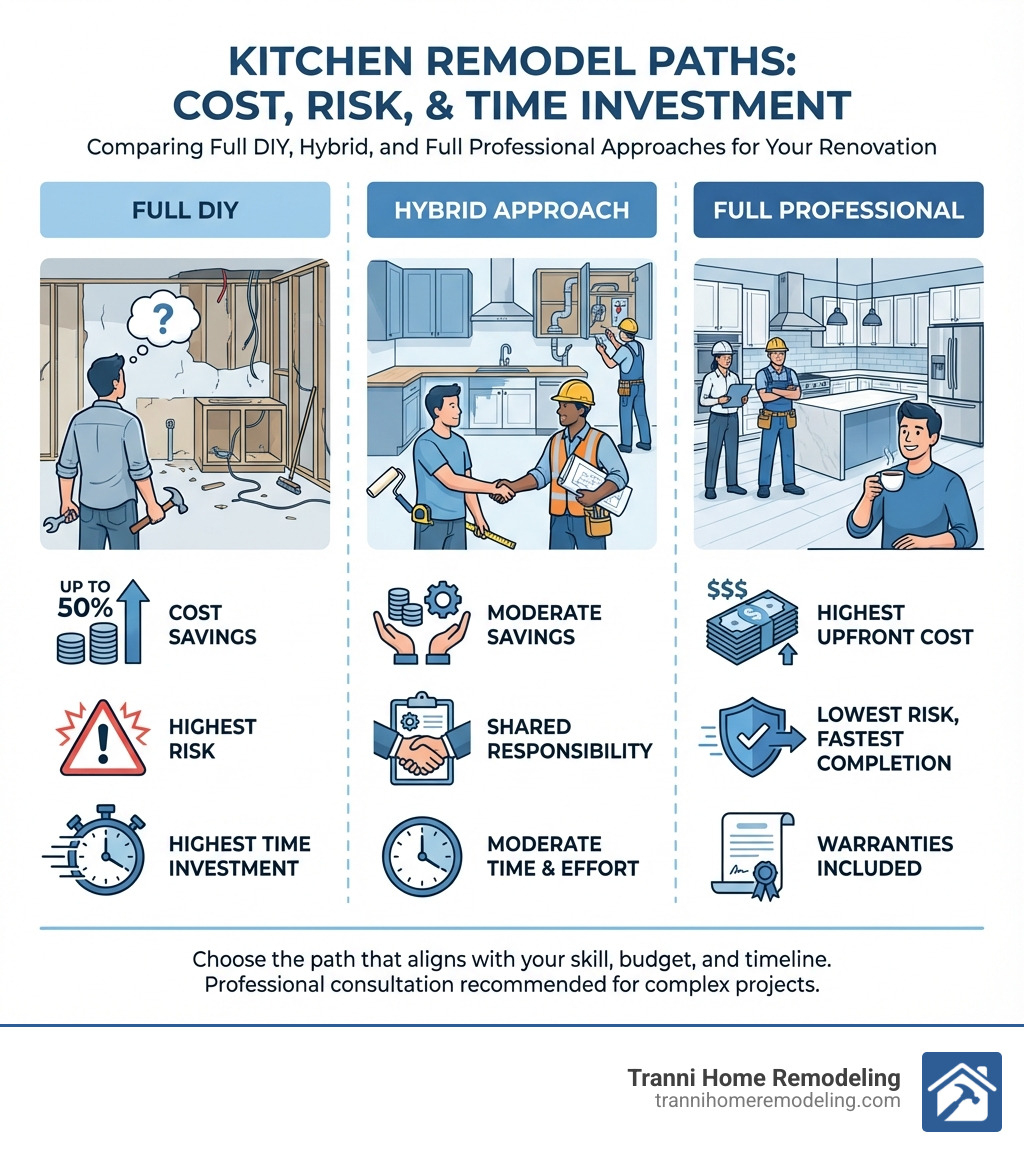
The three main paths you can take are:
- Full DIY – You manage everything and do most of the work yourself
- Hybrid approach – You handle simple tasks and hire pros for specialized work
- Full professional hire – A general contractor or kitchen specialist manages the entire project
Each path has different cost implications, risk levels, and time commitments. The key is understanding which one matches your situation.
I’m Tyler Tranni, owner of Tranni Home Remodeling. Over the years, I’ve seen homeowners struggle with this question. Some go DIY and regret it, while others hire pros and are thrilled. My goal is to provide an honest breakdown based on real-world experience to help you make the right choice for your situation.
First, Evaluate Your Kitchen Remodel Scope and Your Skills
Before you even think about swinging a hammer or signing a contract, you need to take a good, hard look at your project’s scope, your finances, and, most importantly, your own capabilities. This initial evaluation is crucial for determining if you truly need a contractor for a kitchen remodel or if a DIY approach is feasible.
What is the Scope of Your Project?
The first step in any kitchen remodel is defining its scope. Are you simply giving your kitchen a facelift, or are you planning a complete overhaul?
- Cosmetic Updates: If your project involves minor changes like painting walls, replacing cabinet hardware, updating light fixtures, or even refacing existing cabinets, you might be able to tackle much of this yourself. These are often within the field of an ambitious DIYer.
- Full Gut Renovation: This is where things get serious. A full gut remodel means tearing everything down to the studs. This often involves:
- Structural Changes: Moving load-bearing walls or opening up spaces. This requires permits, structural engineering knowledge, and often, specialized framing contractors.
- Moving Walls: Even non-load-bearing walls can impact electrical and plumbing lines.
- Layout Changes: Altering the “work triangle” (sink, stove, refrigerator) means moving plumbing lines and electrical outlets, which are complex and often require permits and licensed professionals.
If your vision includes any of these more complex elements, the answer to “do I need a contractor for a kitchen remodel?” quickly leans towards “yes.” These tasks carry significant risks if not done correctly, from safety hazards to code violations, and even potential damage to your home’s structural integrity.

What’s Your Realistic Budget and Timeline?
Understanding your financial limits and how long you’re willing to live without a functional kitchen is paramount.
-
Cost: The average price for a kitchen remodel is approximately $25,885, or about $150 per square foot. However, this is just an average. A typical renovation can land between $13,375 and $38,414. For a luxurious, high-end remodel, you could be looking at $130,000 or more. These are average costs based on internet data and not actual costs for Tranni Home Remodeling.
While DIY projects can often cost about half as much as hiring a professional, this saving often comes at the expense of your time, potential quality issues, and the need to purchase tools. You’ll still have material costs, and unexpected expenses can quickly eat into your savings. Always plan for a 10-20% contingency fund in your budget to cover unforeseen issues.
-
Timeline: Most kitchen remodels take anywhere from 4 to 12 weeks, depending on the scale of the project. A DIY remodel will almost certainly take longer, especially if you’re juggling it with a full-time job. Are you prepared to live in a construction zone for months? This can be particularly challenging for families. Hiring a professional can significantly reduce this timeframe, allowing you to enjoy your new kitchen sooner.
How to Honestly Assess Your DIY Skills
This is perhaps the most critical self-assessment. Be brutally honest with yourself about your capabilities and experience. It’s one thing to watch a “how-to” video; it’s another to execute a complex task flawlessly.
Here’s a list of essential skills often required for a successful DIY kitchen remodel. If you’re not proficient in most of these, you’ll likely need a contractor for a kitchen remodel or at least specialized subcontractors:
- Plumbing: Installing sinks, faucets, dishwashers, and possibly relocating water or gas lines. Incorrect plumbing can lead to leaks and water damage.
- Electrical Work: Installing new outlets, light fixtures, and wiring for appliances. Faulty electrical work is a major fire hazard. Learn more about our electrical services.
- Cabinet Installation: Leveling, securing, and aligning cabinets. Crooked cabinets are a dead giveaway of a poor DIY job.
- Countertop Fitting: Measuring, cutting, and installing countertops, especially around sinks. This often requires specialized tools.
- Tiling: Laying floor tiles or installing a backsplash. Precision is key for a professional look.
- Drywall: Repairing or installing new drywall after demolition. A smooth finish is essential for a polished look.
- Flooring: Installing new kitchen flooring. We offer comprehensive flooring installation services for various materials.
- Painting: Achieving a professional, smooth finish on walls and trim. Our painting services can help with this.
DIY guides often emphasize that this approach allows for personalization, but if you lack confidence, consulting a professional can save you headaches later. If you’re unsure about your ability to handle complex tasks, it’s smarter to bring in a professional from the start.
The DIY Approach: High Rewards vs. High Risks
The allure of a DIY kitchen remodel is strong, primarily driven by the promise of significant cost savings and the satisfaction of building something with your own hands. However, it’s crucial to weigh these benefits against the very real risks involved.

Pros and Cons of a DIY Kitchen Remodel
Let’s break down the advantages and disadvantages of taking on your kitchen remodel yourself:
| Feature | Pros of DIY Kitchen Remodel | Cons of DIY Kitchen Remodel |
|---|---|---|
| Cost Savings | Can save up to 50% of the total project cost. | Hidden costs (tools, unexpected repairs), potential for costly mistakes. |
| Creative Control | Complete freedom to design and execute your vision without compromise. | Lack of professional design input, potential for design flaws or impracticalities. |
| Personal Satisfaction | Pride of craftsmanship, a sense of accomplishment. | Stress, frustration, potential for burnout, living in a prolonged construction zone. |
| Scheduling Flexibility | Work at your own pace, fit around your schedule. | Projects often take much longer than anticipated, leading to delays and inconvenience. |
| Material Access | Choose materials from any retailer. | May not have access to contractor-grade materials or discounts. |
| Quality Control | Directly oversee every detail. | Quality can suffer due to inexperience or lack of specialized tools. |
| Warranties | N/A (no workmanship warranty). | No professional workmanship warranty; material warranties may be voided if not professionally installed. |
| Risk & Liability | You are solely responsible for all issues, safety, and code compliance. | High risk of costly mistakes, safety hazards, code violations, and insurance issues. |
While saving money is a huge motivator, new tools can significantly add to the overall expenses of a DIY project. Furthermore, if you’re not getting contractor discounts on materials, some of your cost savings might disappear.
What are the Biggest Risks of a DIY Remodel?
Beyond a less-than-perfect finish, DIY remodels carry substantial risks that can end up costing you more in the long run.
- Unexpected Issues: When you start tearing out old cabinets or opening up walls, you might uncover unpleasant surprises. Corroded pipes, rotten wood, mold, or even structural problems are common findies. A professional contractor can handle these issues efficiently with a network of specialists. As a DIYer, you’re on your own, facing potential delays and budget overruns.
- Code Violations and Permit Issues: Many major kitchen remodel tasks, especially those involving plumbing, electrical, or structural changes, require permits and must adhere to local building codes. In towns like Billerica, MA, Andover, MA, or Winchester, MA, failing to obtain permits or not meeting code can lead to fines, stop-work orders, and even requiring you to tear out completed work. A professional contractor is responsible for navigating these regulations and ensuring compliance.
- Insurance Liability: If you’re managing subcontractors yourself (for tasks like electrical or plumbing), you become the general contractor in the eyes of the law. This means you could be liable if a worker is injured on your property or if their work causes damage. A reputable contractor carries comprehensive insurance, including worker’s compensation and general liability, protecting you from these risks.
- Material and Workmanship Warranties: This is a big one. When you hire a professional, they typically provide a workmanship warranty, often for at least a year. If something goes wrong with their installation, they fix it. With DIY, you have no such warranty. Furthermore, some manufacturers’ warranties for materials (like appliances or flooring) can be voided if they are not installed by a licensed professional. You might buy a high-quality product, but if you install it incorrectly, you could be out of luck if it fails.
We’ve seen homeowners in places like Woburn, MA, and Burlington, MA, start a DIY project only to call us later, overwhelmed and in need of professional intervention. It’s why we always recommend a careful assessment of these risks.
So, Do I Need a Contractor for a Kitchen Remodel?
If reading about the potential pitfalls of DIY has you feeling a bit queasy, don’t worry—that’s a perfectly normal reaction! It means you’re taking this significant investment seriously. For many homeowners, the peace of mind, expertise, and efficiency a professional brings far outweigh the upfront cost.
General Contractor vs. Kitchen Remodeling Specialist: What’s the Difference?
When you decide to hire a professional, you’ll generally encounter two types of contractors relevant to kitchen remodels: a general contractor (GC) and a kitchen remodeling specialist. Understanding their differences is key to making the right choice for your project.
-
General Contractor (GC):
- Scope of Work: GCs are masters of orchestration. They oversee entire home renovation projects, which can include kitchens, bathrooms, additions, and even full-home changes. They coordinate all aspects, from managing subcontractors (electricians, plumbers, carpenters, plasterers) to scheduling, budgeting, and ensuring compliance with building codes and permits.
- Specialization: Their expertise is broad, encompassing various trades and project types. They are excellent for projects that touch multiple areas of your home or involve significant structural changes.
- Cost Structure: GCs typically charge a percentage of the total project cost, often between 10% and 25%, to cover their overhead, profit, and project management.
- Subcontractor Network: They have established relationships with a reliable network of skilled tradespeople.
-
Kitchen Remodeling Specialist:
- Scope of Work: As their name suggests, these professionals focus exclusively on kitchens. They are deeply immersed in kitchen design, functionality, and the latest trends and materials.
- Specialization: Their expertise is deep within the kitchen domain. They often offer integrated design services, helping you with layout optimization, cabinet and countertop selection, appliance integration, and maximizing every inch of your kitchen space.
- Cost Structure: They may charge a flat fee for their services, or their pricing might be structured differently, often incorporating design fees and material costs. They can sometimes offer more budget-friendly solutions for kitchen-only upgrades compared to a GC, as their scope is narrower.
- Subcontractor Network: While they might manage subcontractors, their network is specifically curated for kitchen-related trades.
For homeowners in areas like Woburn, MA, or Winchester, MA, deciding between these two often comes down to the complexity and scale of the kitchen project within the context of their home.
When to Hire a General Contractor
You’ll definitely need a contractor for a kitchen remodel if your project extends beyond just the kitchen walls or involves significant structural modifications. Consider a general contractor if:
- Large-Scale Renovations: Your kitchen remodel is part of a larger home remodeling project, perhaps involving other rooms or a complete home change.
- Structural Changes: You plan to move or remove load-bearing walls, requiring structural engineering and potentially changes to the home’s foundation or roofline.
- Projects Involving Multiple Rooms: If the kitchen remodel spills into adjacent living areas, requires modifications to a nearby bathroom, or is part of a home addition, a GC is essential for coordinating all the moving parts. Learn more about our home additions.
- Coordinating Multiple Trades: A GC excels at managing diverse teams, including plumbers, electricians, HVAC specialists, framers, and finish carpenters. They ensure everyone works together seamlessly and on schedule. For example, if your remodel in Chelmsford, MA, requires relocating gas lines, updating electrical panels, and adding new windows, a GC is your go-to professional.
When to Hire a Kitchen Remodeling Specialist
If your project is solely focused on changing your kitchen, and you’re not planning any structural changes that affect other parts of your home, a kitchen remodeling specialist might be the ideal choice. You might need a contractor for a kitchen remodel but specifically a specialist if:
- Kitchen-Focused Projects: Your renovation is contained entirely within the existing kitchen footprint.
- Layout Optimization: You want expert advice on improving the flow, ergonomics, and overall design of your kitchen.
- Cabinet and Countertop Expertise: These specialists have deep knowledge of various cabinet styles, materials (custom vs. stock), and countertop options (quartz vs. granite), and can guide you to selections that perfectly match your aesthetic and functional needs.
- Appliance Integration: They can help you choose and seamlessly integrate new appliances, ensuring proper hookups and maximizing efficiency.
- Maximizing Kitchen Functionality: Their focus is on making your kitchen as practical and enjoyable as possible, often by incorporating smart storage solutions and optimizing work surfaces.
For homeowners in Reading, MA, looking for a dedicated kitchen change without the broader scope of a whole-home renovation, a kitchen remodeling specialist can offer unparalleled expertise.
How to Hire the Right Kitchen Remodeling Contractor
Once you’ve decided that you need a contractor for a kitchen remodel, the next crucial step is finding the right one. This involves a thorough vetting process to ensure you’re entrusting your home to a qualified, reliable, and trustworthy professional. As Family Handyman emphasizes in their guide on what to know about hiring a kitchen remodeling contractor, due diligence is paramount.
Key Questions to Ask a Potential Contractor
When interviewing potential contractors, don’t be afraid to ask tough questions. We believe in transparency, and any good contractor will welcome your inquiries. Here’s a list to get you started:
- How many years have you been in business? Experience matters. A contractor with a long history likely has refined processes and a stable team.
- Who will supervise the project daily, and what is their experience? You want to know who your main point of contact will be and that they are knowledgeable.
- Do you use consistent employees and subcontractors? A consistent team indicates reliability and a smoother workflow. In-demand subcontractors often prefer working with GCs they know and trust.
- What is your communication process? How often can I expect updates? Clear and consistent communication is vital to a stress-free renovation.
- Can I get an itemized bid, not just a lump-sum estimate? An itemized bid helps you understand costs and compare bids accurately. An estimate is a guess; a bid becomes part of your contract.
- What type of contract do you use (fixed-price, cost-plus)? Understand the terms for payment, change orders, and project completion.
- Are you licensed and insured? Can you provide proof? This is non-negotiable. Verify their license number with the state licensing board (e.g., Massachusetts Home Improvement Contractor license) and ask for certificates of insurance for general liability and worker’s compensation.
When we meet with clients in Tewksbury, MA, or Boxford, MA, we ensure all these questions are answered upfront, building trust from day one.
Verifying Credentials and Checking References
Don’t just take a contractor’s word for it. Always verify their claims.
- License Verification: In Massachusetts, contractors performing home improvement work must be registered with the State Board of Building Regulations and Standards (BBRS). Verify their Home Improvement Contractor (HIC) registration number.
- Insurance Proof: Request current certificates of insurance for general liability (covers damage to your property or a neighbor’s) and worker’s compensation (covers injuries to their employees). This protects you from significant financial risk.
- Portfolio Review: Ask to see photos of their completed kitchen projects. Look for quality of workmanship and consistency in style if that’s important to you. Many contractors also have online portfolios, like our own kitchen portfolio.
- Client Testimonials and References: Contact previous clients. Ask about their experience with the contractor’s communication, adherence to budget and schedule, problem-solving skills, and overall satisfaction. Word-of-mouth reputation is often the strongest indicator of a good contractor.
- Supplier References: A contractor with good relationships with suppliers is a good sign. It can indicate they pay their bills on time and are respected in the industry.
By diligently checking these credentials, you significantly reduce the risk of hiring a subpar contractor. This due diligence is equally important whether you are in Burlington, MA, or Stoneham, MA.
Frequently Asked Questions about Kitchen Remodels
We often hear similar questions from homeowners considering a kitchen remodel. Here are some of the most common ones:
How long does a professional kitchen remodel take?
A professional kitchen remodel’s duration varies with complexity but typically takes between 4 to 12 weeks.
- Smaller, cosmetic updates might be completed in 4-6 weeks.
- Mid-range remodels involving new cabinets, countertops, and appliances usually fall into the 6-10 week range.
- Large-scale remodels with structural changes, layout reconfigurations, or custom elements can extend to 10-12 weeks or even longer.
Factors like material availability, homeowner decisions, and unexpected issues can all influence the timeline. A good contractor will keep you informed of the schedule and any potential delays.
What is the most expensive part of a kitchen remodel?
While several components contribute to the cost, the most expensive part of a kitchen remodel is typically the kitchen cabinets.
- Cabinets: This can account for 30-40% of your total budget. The cost varies widely depending on whether you choose stock, semi-custom, or fully custom cabinets. Custom cabinets offer unparalleled flexibility and precision but come at a higher price point.
- Countertops: Depending on the material (granite, quartz, marble, laminate), countertops can also be a significant expense.
- Appliances: High-end, integrated, or smart appliances can add considerably to the cost.
- Labor Costs: The cost of skilled labor (plumbers, electricians, carpenters) for demolition, installation, and finishing work is a substantial portion of the budget, especially for complex projects.
If you’re looking to reduce costs, consider cabinet refacing instead of full replacement, or opting for more budget-friendly countertop materials.
Do I need a permit for a kitchen remodel in Massachusetts?
Yes, in Massachusetts, you will generally need a permit for a kitchen remodel if you are making major changes that go beyond cosmetic updates. This is crucial for ensuring safety and compliance with local building codes.
Permits are typically required for:
- Structural Work: Any changes to load-bearing walls or the structural integrity of your home.
- Electrical Updates: Adding new circuits, moving outlets, or upgrading your electrical panel.
- Plumbing Changes: Relocating sinks, dishwashers, or gas lines.
- HVAC Modifications: Changing ductwork or installing new ventilation systems.
Your contractor is responsible for identifying and obtaining all necessary permits before work begins. This is an important part of the project management that professionals handle, ensuring your remodel is safe, legal, and adds value to your home. We are well-versed in the permitting requirements for towns across Middlesex County, Massachusetts, including Reading, MA, Stoneham, MA, and Tewksbury, MA.
Your Dream Kitchen Awaits
Deciding if you need a contractor for a kitchen remodel is a major choice for your home and wallet. As we’ve explored, your skills, budget, timeline, and risk tolerance should guide your decision between a DIY, hybrid, or professional approach.
While DIY can offer cost savings and immense satisfaction, it comes with the heavy burden of project management, potential costly mistakes, and no professional warranties. For many, the complexities of plumbing, electrical work, structural changes, and navigating permits make a professional contractor an indispensable partner.
At Tranni Home Remodeling, we pride ourselves on high-quality craftsmanship and outstanding service. We understand the local regulations and unique needs of homeowners in Billerica, MA, and the surrounding communities like North Andover, MA, and Lynnfield, MA. Whether you’re planning a full gut renovation or a targeted kitchen upgrade, we’re here to ensure your project is completed efficiently, to code, and to your utmost satisfaction.
For a professional, stress-free renovation that brings your vision to life, explore our kitchen remodeling services. We’re ready to help you create the kitchen of your dreams.
Like us on Facebook!
