




What Does It Really Cost to Install Quartz Countertops in 2026?
The average cost of installing quartz countertops in 2026 ranges widely — and knowing what to expect before you call a contractor can save you thousands.
Here’s a quick snapshot based on internet averages (not actual Tranni Home Remodeling pricing):
| Project Type | Typical Range (Internet Averages) |
|---|---|
| Per square foot installed (national) | $50 – $200+ |
| Average kitchen (30-50 sq ft) | $3,000 – $9,000 |
| Large kitchen with island | $6,000 – $20,000+ |
| Bathroom vanity (6-25 sq ft) | $750 – $2,500 |
| Northeast / Massachusetts premium | +15% to +40% above national average |
Important: All price ranges in this article are based on publicly available internet data from national sources. They are not quotes from Tranni Home Remodeling. Your actual project cost will depend on your specific space, materials, and local labor rates.
These numbers vary because quartz countertop installation isn’t one-size-fits-all. The material grade, slab thickness, edge style, number of cutouts, and your location all pull the price up or down — sometimes dramatically.
For homeowners in Billerica, Woburn, Wilmington, Burlington, and surrounding communities in northeastern Massachusetts, regional labor rates and delivery costs mean local prices often run toward the higher end of national ranges.
I’m Tyler Tranni, owner of Tranni Home Remodeling in Billerica, MA, and I’ve helped countless homeowners in our area navigate the real-world average cost of installing quartz countertops — from modest bathroom vanities to full kitchen overhauls. In this guide, I’ll break down every cost factor so you can budget with confidence before getting your first estimate.
Average Cost of Installing Quartz Countertops in 2026
Based on current internet averages for May 2026, installed quartz countertops often fall somewhere between $50 and $250+ per square foot, depending on the material, fabrication, labor, and project complexity.
That is a wide range, but it needs to be wide. A simple bathroom vanity using a remnant slab is a completely different project from a large kitchen with premium marble-look quartz, waterfall island panels, multiple cutouts, and upgraded edge profiles.
Several 2026 countertop cost guides show that countertop prices have continued rising over the past few years, especially in higher-labor regions. For broader countertop installation trends, the 2026 countertop installation cost data shows how material type, state, and project scope can change the final number.
For quartz specifically, many national sources place common installed costs in the $70 to $150 per square foot range, while premium or complex projects can climb much higher.
National Average Cost to Install Quartz Countertops
Nationally, the average cost of installing quartz countertops is often reported around:
| Cost Category | Internet Average Range |
|---|---|
| Budget installed quartz | $50 – $80 per sq ft |
| Mid-range installed quartz | $80 – $140 per sq ft |
| Premium installed quartz | $140 – $250+ per sq ft |
| Typical full kitchen project | $3,000 – $9,000 |
| Large or luxury project | $10,000 – $20,000+ |
These are installed ranges, meaning they usually include some combination of material, fabrication, delivery, and installation labor. However, every quote is different. Some estimates include sink cutouts and basic edges. Others list those as separate charges.
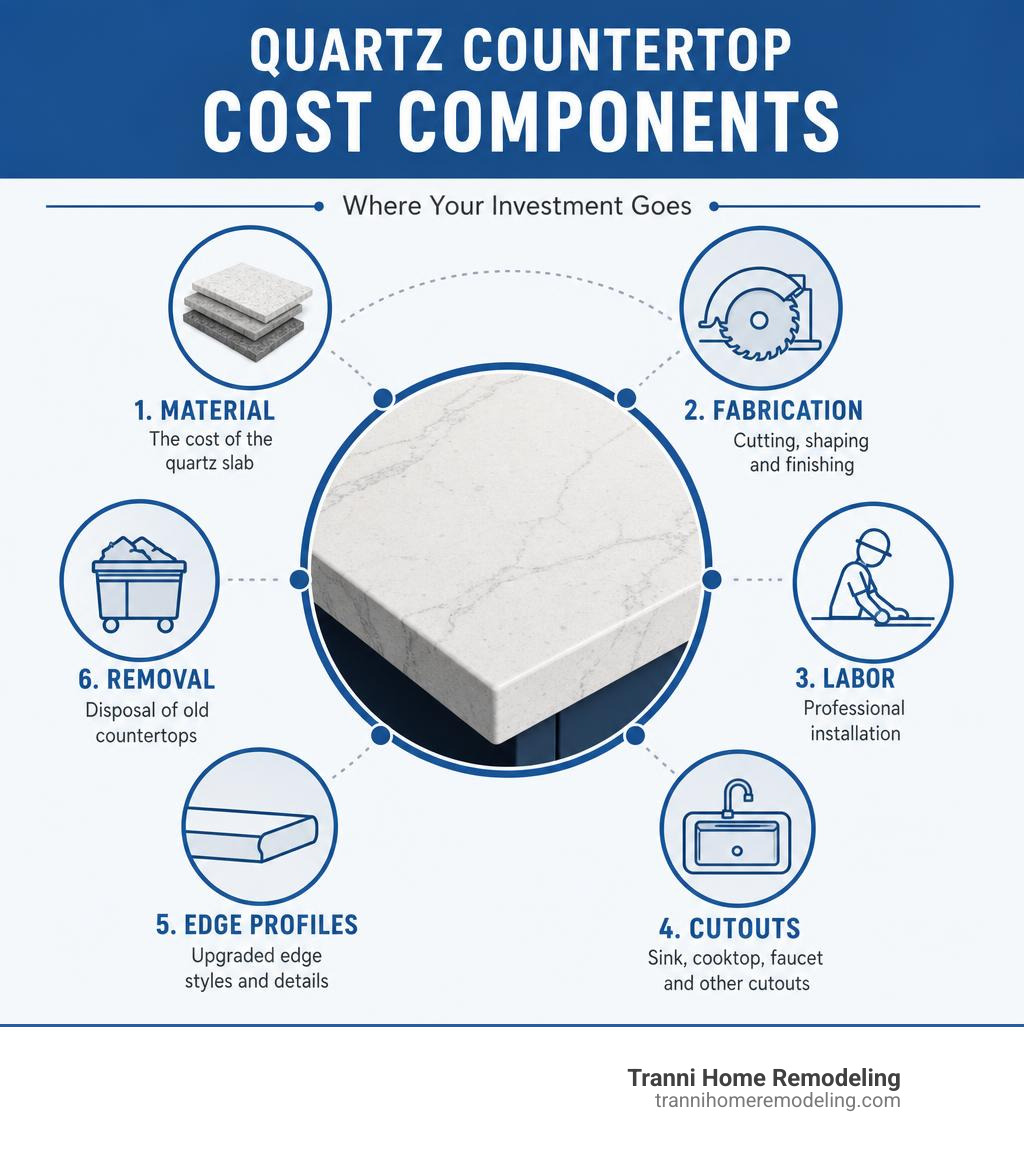
Material usually makes up the largest share of the total cost. Fabrication and labor are the next major pieces. One reason quartz pricing can surprise homeowners is slab waste. If your layout requires two slabs but only uses part of the second one, you may still pay for more material than the visible countertop area suggests. Quartz is not sold like carpet from a giant roll. Sadly, there is no magical quartz printer hiding in the shop.
For additional national pricing context, guides such as How much are quartz countertops?, Quartz Countertops Cost in 2026, and Quartz Countertops Cost Per Square Foot show similar wide ranges.
Average Cost of Installing Quartz Countertops by Region
Location matters. In northeastern Massachusetts, including Billerica, Burlington, Woburn, Wilmington, Bedford, Lexington, Chelmsford, Tewksbury, Dracut, Andover, North Andover, Reading, North Reading, Stoneham, Winchester, and nearby Middlesex County communities, installed countertop costs often run above national averages.
Why?
- Skilled labor rates are higher.
- Delivery and fabrication scheduling can be more expensive.
- Older homes may have uneven walls or out-of-level cabinets.
- Parking, access, stairs, and tight layouts can slow installation.
- Premium material demand is strong in many local renovation markets.
A reasonable planning adjustment for our service area is often 15% to 40% above lower national averages, especially for custom kitchen remodeling projects. That does not mean every quartz job will be expensive. It means homeowners should avoid budgeting from the lowest number they find online.
Realistic Total Costs for Kitchens and Bathroom Vanities

For an average kitchen with 30 to 50 square feet of countertop space, internet averages commonly land between $3,000 and $9,000 for quartz installation. A straightforward 40-square-foot kitchen might come in around $2,500 to $9,000, while complex or premium projects can reach $12,000 to $20,000+.
Bathroom vanities are smaller, but they can have minimum charges. A 6 to 25 square foot vanity may cost $750 to $2,500 on average, but a tiny job does not always mean a tiny bill. Fabricators still need to template, cut, polish, deliver, and install the piece.
| Project Size | Typical Internet Average Range |
|---|---|
| 10 sq ft bathroom vanity | $750 – $2,000 |
| 25 sq ft small kitchen or laundry | $1,500 – $5,500 |
| 40 sq ft average kitchen | $2,500 – $9,000 |
| 60+ sq ft kitchen with island | $6,000 – $20,000+ |
Remnants can help smaller projects. If you are doing a bathroom vanity, laundry counter, or small built-in, ask whether remnant quartz is available.
What Changes Quartz Countertop Installation Costs?
Quartz pricing changes because every project is a mix of design choices, material costs, fabrication labor, and site conditions. The biggest cost drivers are:
- Quartz brand and quality tier
- Color and pattern
- Slab thickness
- Edge profile
- Number of sink, faucet, outlet, and cooktop cutouts
- Backsplash design
- Existing countertop removal
- Cabinet condition and support
- Seams and slab utilization
- Local labor and delivery costs
Quartz Quality, Brand Tier, Color, and Pattern
Quartz is usually priced in tiers:
| Quartz Tier | Common Description | Installed Internet Average |
|---|---|---|
| Budget | Standard colors, simpler patterns | $50 – $100 per sq ft |
| Mid-range | More colors, better pattern options | $80 – $150 per sq ft |
| Premium | Designer colors, bold veining | $120 – $200+ per sq ft |
| Luxury | Rare looks, high-end domestic or specialty lines | $180 – $250+ per sq ft |
Budget quartz often includes solid colors or simple speckled designs. Mid-range quartz gives you more options, including subtle veining. Premium quartz often mimics marble with dramatic movement, bookmatched looks, or specialty finishes.
Brand also matters. Imported quartz lines may cost less than premium domestic brands. Well-known brands such as MSI, Caesarstone, Silestone, Cambria, and LG Viatera can vary significantly by color, availability, warranty, and distribution.
Color affects cost too. White, gray, and neutral tones are often widely available. Dramatic marble-look slabs, matte finishes, and rare patterns can cost more.
Thickness, Edge Profiles, and Waterfall Details

Most quartz countertops use either 2 cm or 3 cm slabs. A 3 cm slab is thicker, heavier, and often more expensive, but it provides a more substantial look. A 2 cm slab can sometimes be built up at the edge to look thicker, though it may require extra support.
Edge profiles also affect the price:
| Edge Profile | Cost Impact |
|---|---|
| Eased or straight edge | Often included or lowest cost |
| Beveled edge | Moderate upgrade |
| Half bullnose or full bullnose | Moderate to higher upgrade |
| Ogee edge | Premium fabrication |
| Mitered edge | Higher cost |
| Waterfall edge | Significant cost increase |
A waterfall edge, where quartz continues down the side of an island, can add hundreds or thousands of dollars depending on the size and material. It looks beautiful, but it is not exactly the budget option. It is the countertop equivalent of showing up to the grocery store in a tuxedo.
Cutouts, Sinks, Cooktops, Backsplashes, and Supports
Cutouts are another big factor. Common add-ons include:
- Undermount sink cutout
- Drop-in sink cutout
- Cooktop cutout
- Faucet holes
- Soap dispenser holes
- Outlet cutouts
- Air switch holes
- Polished sink edges
Undermount sinks usually cost more than drop-in sinks because the exposed quartz edge around the sink opening must be polished carefully. Cooktop cutouts also require precision.
Backsplashes can change the budget too. A simple 4-inch quartz backsplash costs less than a full-height slab backsplash. Tile backsplash work may involve a separate trade and additional materials.
Support brackets may be needed for large overhangs, islands, or seating areas. If cabinets are not level or strong enough, that must be addressed before quartz goes in.
Removal and Disposal of Existing Countertops
Old countertop removal is sometimes included, sometimes not. Internet averages often show removal and disposal in the range of $250 to $900, or about $5 to $20 per square foot, depending on the material.
Laminate is usually easier to remove. Existing granite, quartz, tile, or concrete can be heavier and more labor-intensive. There may also be hidden issues underneath, such as water damage around the sink, weak cabinets, or uneven surfaces.
If a dumpster or special haul-away is required, that can add cost. Removal is one of those line items people forget about until the old countertop is sitting in the driveway like an extremely heavy reminder.
What Is Included in a Quartz Countertop Installation Quote?
A good quartz quote should be clear, itemized, and easy to compare. If you get three quotes and each one includes different things, the lowest price may not actually be the lowest.
Standard Quote Inclusions Homeowners Should Expect
A typical quartz installation quote may include:
- Field measurements
- Digital or physical templating
- Quartz slab material
- Shop fabrication
- Standard edge finishing
- Sink cutout
- Faucet holes
- Delivery
- Installation labor
- Adhesives and seam materials
- Basic cleanup
- Workmanship warranty
Some quotes include a basic edge and one sink cutout. Others charge separately. Always ask.
Average Cost of Installing Quartz Countertops Line-Item Checklist
When comparing the average cost of installing quartz countertops, use this checklist:
- Quartz material
- Slab quantity and waste allowance
- Fabrication labor
- Edge profile
- Sink cutout
- Cooktop cutout
- Faucet holes
- Outlet cutouts
- Backsplash material
- Installation labor
- Delivery
- Old countertop removal
- Disposal or haul-away
- Sink installation
- Faucet reconnection
- Plumbing adjustments
- Electrical adjustments
- Cabinet leveling or reinforcement
- Sales tax
- Warranty
- Contingency amount
We recommend setting aside a 10% to 15% contingency for surprises, especially in older homes.
What May Not Be Included in the First Estimate
The first estimate may not include:
- Appliance disconnects
- Plumbing reconnection
- Electrical changes
- Cabinet leveling
- Wall repair after old backsplash removal
- Tile backsplash installation
- Extra support brackets
- Unusual access issues
- Stairs or tight turns
- Hazardous material testing
- Weekend scheduling
- Change orders after templating
This is why itemized quotes matter. A vague quote can look attractive at first, then grow faster than weeds after a rainy week.
Typical Timeline and Installation Process
Most quartz countertop projects take 1 to 3 weeks from final measurement to installation, though timelines vary by material availability and scheduling.
A typical process looks like this:
- Initial consultation and rough measurements
- Material and color selection
- Estimate and deposit
- Template appointment after cabinets are installed and level
- Fabrication at the shop
- Existing countertop removal, if needed
- Installation day
- Sink mounting and adhesive curing
- Plumbing reconnection, often after cure time
- Final walkthrough
Actual installation may take one day for many kitchens, but larger projects may require more time.
Quartz vs Granite, Marble, Laminate, and Other Countertop Materials
Quartz is popular because it balances durability, style, and low maintenance. But it is not the only option. For broader material comparisons, see this 2026 countertop price guide by material and the countertop installation cost guide.
| Material | Installed Internet Average | Durability | Maintenance | Sealing Needed | Heat Resistance | Stain Resistance | Resale Appeal |
|---|---|---|---|---|---|---|---|
| Quartz | $50 – $250+ per sq ft | Excellent | Low | No | Good, use trivets | Excellent | High |
| Granite | $40 – $150+ per sq ft | Excellent | Moderate | Yes | Excellent | Good if sealed | High |
| Marble | $75 – $250+ per sq ft | Moderate | High | Yes | Good | Lower | High in luxury spaces |
| Laminate | $15 – $60+ per sq ft | Moderate | Low | No | Low | Moderate | Lower |
| Solid surface | $40 – $120+ per sq ft | Good | Low | No | Moderate | Good | Moderate |
| Butcher block | $40 – $150+ per sq ft | Good | High | Oil/seal | Moderate | Moderate | Warm, style-specific |
| Porcelain | $80 – $250+ per sq ft | Excellent | Low | No | Excellent | Excellent | High |
Quartz vs Granite
Quartz and granite overlap in price. Budget granite can be cheaper than mid-range quartz, while exotic granite can cost more than premium quartz.
Granite is natural stone, so every slab is unique. It handles heat very well, but it usually needs sealing to resist stains. Quartz is engineered, non-porous, and does not need sealing. For busy kitchens, that low-maintenance factor is a major reason homeowners choose quartz.
Quartz vs Marble and Quartzite
Marble is beautiful, but it is softer and more porous than quartz. It can stain and etch from acidic foods like lemon juice or tomato sauce. Marble can work well in bathrooms, baking areas, or lower-traffic spaces, but families who cook every day often prefer quartz.
Quartzite is a natural stone, not the same as engineered quartz. It is durable and beautiful, but often expensive and still requires sealing.
Quartz vs Laminate, Solid Surface, Butcher Block, and Porcelain
Laminate is the budget winner. It costs much less, but it does not offer the same durability, depth, or resale appeal as quartz.
Solid surface is seamless-looking and repairable, but it can scratch and scorch more easily. Butcher block adds warmth but requires regular care. Porcelain is extremely durable and stylish, though fabrication can be specialized and pricing can be high.
For many kitchens, quartz sits in the sweet spot: durable, attractive, low-maintenance, and widely appealing.
How to Save Money Without Sacrificing Quality
You do not need to pick the most expensive slab in the showroom to get a beautiful result. Smart design choices can keep the project under control.
Smart Ways to Lower the Final Price
Try these cost-saving strategies:
- Choose standard or stock quartz colors.
- Use a simple eased edge.
- Ask about remnants for vanities or small counters.
- Keep the existing kitchen layout.
- Reuse a sink or faucet if it is in good condition.
- Limit extra cutouts.
- Avoid full-height slab backsplash if tile works better for the budget.
- Minimize seams by planning around slab sizes.
- Bundle kitchen and bathroom work when possible.
- Schedule during slower seasons if your timeline is flexible.
- Compare at least three itemized quotes.
- Ask what is included before comparing totals.
Standard colors can sometimes save 10% to 20%. Remnants can save even more on small projects.
Where Not to Cut Corners
Some savings are smart. Others are risky.
Do not cut corners on:
- Accurate templating
- Cabinet leveling
- Professional fabrication
- Seam quality
- Sink support
- Overhang support
- Licensed plumbing or electrical work
- Warranty terms
- Slab inspection before fabrication
Quartz slabs are heavy, often around 20 to 25 pounds per square foot. A 40-square-foot kitchen can involve hundreds of pounds of material. This is not the ideal weekend project unless your weekend hobbies include back pain and regret.
Resale Value and ROI of Quartz Countertops
Quartz countertops can add resale appeal because buyers like durable, low-maintenance kitchens and bathrooms. Internet sources commonly estimate that kitchen upgrades may recover 50% to 80% of their cost at resale, depending on the market, scope, and quality of the overall renovation.
Quartz can last 20 to 30 years or more with proper care. Neutral colors, practical layouts, and good installation tend to perform best for long-term value.
Frequently Asked Questions About the Average Cost of Installing Quartz Countertops
Is Quartz Cheaper Than Granite?
Sometimes, but not always. Granite and quartz have overlapping price ranges. Basic granite may cost less than mid-range quartz, but premium granite can cost more than many quartz options.
Quartz may save money over time because it does not need sealing. Granite sealing costs are not huge, but they do add maintenance.
How Much Should I Budget for a 40 Square Foot Kitchen?
For a 40-square-foot kitchen, internet averages suggest budgeting around $2,500 to $9,000 for many quartz projects. A very basic project may be lower, while premium quartz, complex edges, extra cutouts, backsplash work, or local labor premiums can push the total to $12,000 to $20,000+.
For Billerica, Burlington, Woburn, Wilmington, Lexington, Chelmsford, Tewksbury, Dracut, Andover, and nearby communities, we recommend planning toward the middle or upper part of national ranges unless your project is very simple.
Can Homeowners Install Quartz Countertops Themselves?
We do not recommend DIY quartz installation for most homeowners. Quartz is heavy, brittle during handling, and unforgiving if cut incorrectly. Mistakes can damage cabinets, crack slabs, ruin seams, or void warranties.
Small prefab vanity tops may be manageable for experienced homeowners, but full kitchen quartz installation should be handled by professionals.
Conclusion
The average cost of installing quartz countertops in 2026 is best understood as a range, not a single number. National internet averages commonly run from $50 to $200+ per square foot installed, with premium or complex projects reaching $250+ per square foot. Average kitchens often land between $3,000 and $9,000, while large custom kitchens can exceed $20,000.
Again, these are internet averages, not Tranni Home Remodeling pricing. Your actual cost depends on your layout, slab choice, thickness, edge profile, cutouts, removal needs, and local labor conditions.
At Tranni Home Remodeling, we help homeowners in Billerica, Woburn, Wilmington, Burlington, Bedford, Lexington, Chelmsford, Andover, North Andover, Reading, Stoneham, Winchester, and surrounding Middlesex County communities make confident renovation decisions with clear planning and quality craftsmanship.
If you are considering new quartz countertops as part of a larger kitchen upgrade, schedule a kitchen remodeling consultation with our team. We will help you understand your options, avoid costly surprises, and create a kitchen that looks great and works beautifully.