




Garage Addition for Home: 7 Powerful Benefits in 2025
Changing Your Home with a Garage Addition
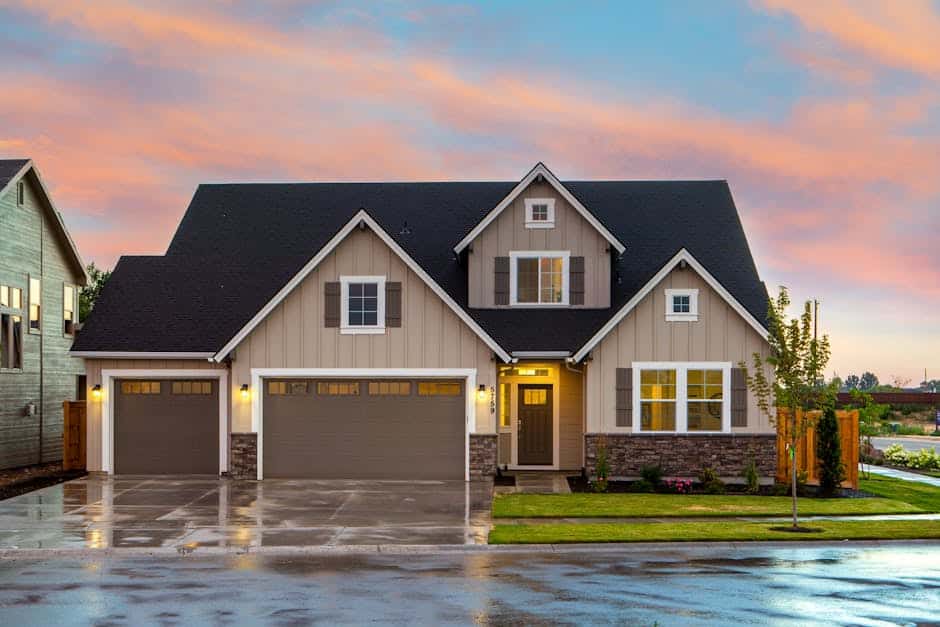
A garage addition for home provides significant benefits for homeowners seeking additional space and functionality.
Quick Answer: Garage Addition Essentials
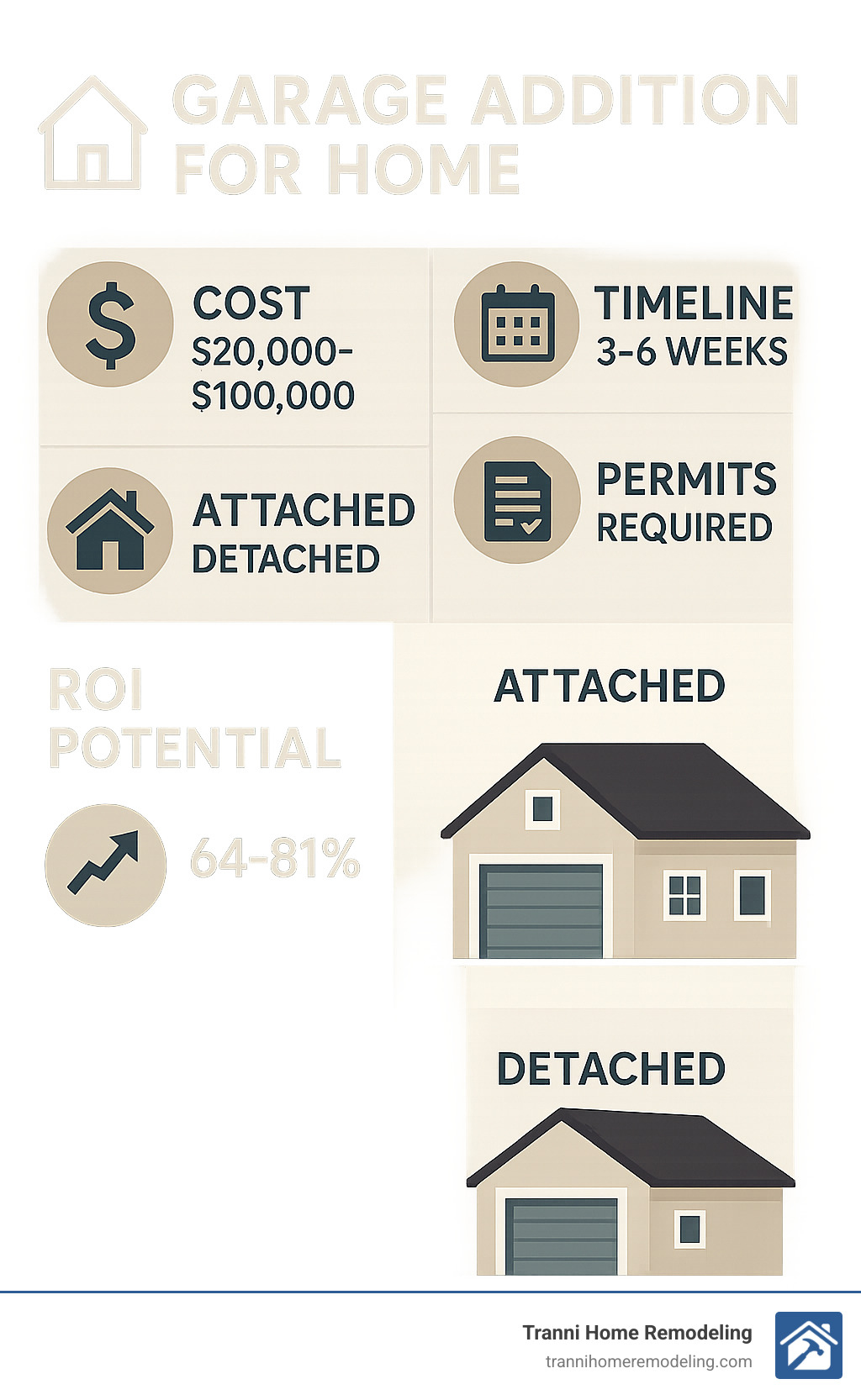
* Cost Range: $20,000-$100,000 depending on size and features
* ROI: 64-81% return on investment
* Timeline: Typically 3-6 weeks for construction
* Types: Attached (10-15% cheaper) or detached
* Size Options: Single-car (14×20 ft), two-car (20×24 ft), three-car (32×22 ft)
* Permits Required: Zoning approval, building permits, possible HOA authorization
So, you’ve decided to give your vehicles a proper home while adding valuable space and increasing your property’s value? A garage addition might be one of the smartest home improvement investments you can make. Whether you’re tired of scraping ice off your windshield on winter mornings or need additional storage space for tools and equipment, a well-planned garage can transform how you use your home.
Last year, homeowners spent nearly $19 billion on home improvements, and garage additions remain one of the most practical projects with substantial returns. Beyond protecting vehicles from the elements, a garage addition creates versatile space that can serve as a workshop, storage area, or even a future living space with proper planning.
I’m Tyler Tranni, owner of Tranni Home Remodeling, and I’ve helped dozens of homeowners design and build garage additions for homes that perfectly balance functionality, aesthetics, and budget considerations. With years of experience in garage addition for home projects, I understand the critical decisions homeowners face when expanding their living space.
Explore more about Garage Addition for Home:
– 2 story attached garage addition
– add bedroom over garage
Why Add a Garage? Benefits & ROI
There’s something truly magical about pulling into your very own garage after a long day—especially when the rain is pouring or snow is piling up outside. A garage addition for home delivers far more than just a place to park your car; it’s an investment that transforms how you experience your property every single day.
“Hands down one of the best decisions I ever made was adding a garage to my home,” shared a delighted Billerica homeowner. “After years of brushing snow off my windshield during those brutal Massachusetts winters, I only wish I’d done it sooner!”
When you invest in a garage addition for home, you’re actually gaining multiple benefits that improve both your daily life and your financial future. Your vehicles stay protected from harsh New England weather, which means less maintenance costs and better resale value down the road. You’ll also gain valuable storage space for everything from holiday decorations to sports equipment that’s currently cluttering your basement or living spaces.
Many homeowners find the joy of having a dedicated workshop space where hobbies and DIY projects can flourish without taking over the dining room table. The improved security is another major plus—keeping valuable tools and equipment safely locked away rather than exposed to potential theft.
According to recent research from Forbes, homeowners typically recoup between 64% and 81% of their garage addition investment when selling their property. That impressive return makes garage additions one of the smartest home improvement investments you can make in today’s market.
Boosting Home Equity with a Garage Addition for Home
The numbers don’t lie—homes with garages simply command higher prices. A well-designed garage addition for home can increase your property value by $10,000 to $20,000 on average, making it a substantial equity builder.
This premium exists because today’s buyers consider garages essential rather than optional. Homes featuring garages typically sell faster in competitive markets, with the additional square footage directly increasing your property’s overall value. The versatility of garage space also appeals to diverse buyer needs, whether they’re looking for storage, workshop space, or room for multiple vehicles.
As one Middlesex County realtor noted, “In our local market, a garage has shifted from being a nice-to-have to a must-have feature for most serious buyers. Properties without garages often sit longer and ultimately sell for less.”
Everyday Convenience of a Garage Addition for Home
The quality-of-life improvements from a garage addition for home start from day one and continue every single day thereafter. No more scraping ice from windshields during freezing Massachusetts mornings or making mad dashes through downpours with armloads of groceries.
The direct entry from your garage to your home becomes a daily blessing, especially during harsh weather or when your arms are full of shopping bags. This convenience factor alone is worth its weight in gold for many homeowners in our climate.
What surprises many homeowners is how quickly their garage becomes a multi-purpose space beyond just vehicle storage. That extra square footage transforms into workout areas, hobby stations, or organized storage systems that free up space inside your main living areas.
“Our garage has become the most versatile room in our house,” explained a homeowner from Lexington. “Beyond parking, my husband has his woodworking bench in one corner, I have my gardening station along the wall, and there’s still room for the kids’ bikes and sports equipment. It’s completely changed how we use our home.”
When you consider the daily convenience combined with the strong financial return, it’s easy to see why a garage addition for home ranks among the smartest investments Massachusetts homeowners can make in their properties.
More info about Home Additions
Garage Addition for Home: Cost Breakdown & Key Factors
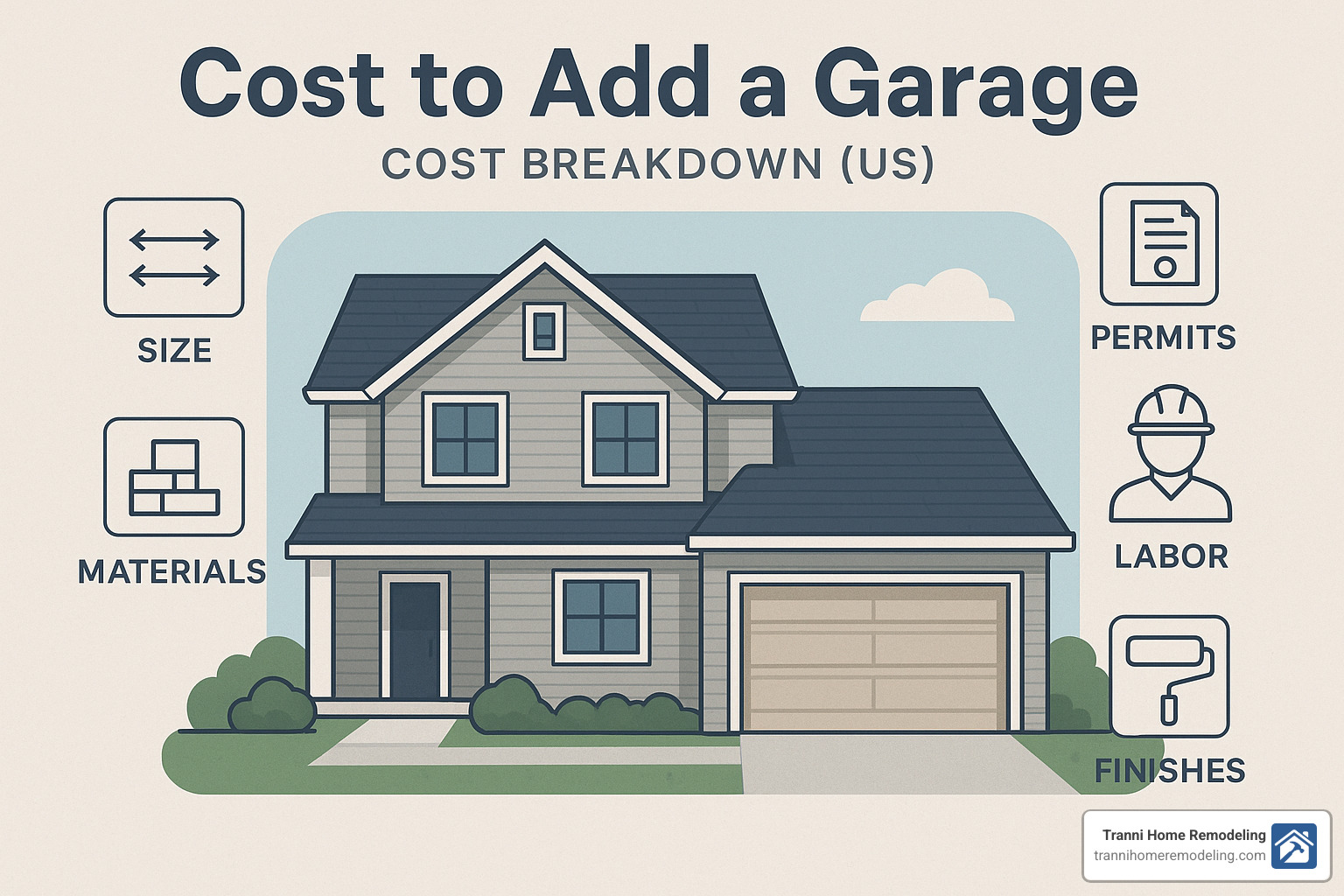
Let’s talk money – because we all know that’s where planning a garage addition for home typically starts and sometimes stops. Based on industry data (not specific to Tranni Home Remodeling), garage additions can range dramatically from $20,000 to $100,000. Why such a wide range? Well, it’s a bit like buying a car – you can go basic or fully loaded with all the bells and whistles.
Size matters enormously when it comes to cost. A cozy single-car garage around 14×20 feet might run you $10,000-$25,000, while a spacious three-car garage could easily push past $50,000. Think of it this way: every additional square foot means more materials, more labor, and ultimately, more budget.
Materials quality plays a huge role too. Economy-grade materials might cost $30-$40 per square foot, but if you’re dreaming of a showroom-worthy space with premium finishes, you’re looking at $70-$120+ per square foot. As one of our Lexington clients joked, “I think my garage doors cost more than my first car!”
Labor typically gobbles up 50-60% of your total budget. Here in Massachusetts, skilled construction labor doesn’t come cheap – expect $20-$50 per square foot depending on your location, with towns like Winchester and Concord often at the higher end of that spectrum.
“We thought our flat yard would make our garage addition straightforward,” shared a homeowner in Bedford. “Then we finded drainage issues that added $4,000 to prep the site properly.” Site preparation can indeed throw curveballs, potentially adding $2,000-$10,000 for challenges like slopes, rocks, or poor soil conditions.
For more comprehensive information about home additions beyond just garages, check out our Home Additions page.
Major Line-Items to Budget
When I sit down with homeowners to plan their garage addition for home, I always break down the major expenses to avoid sticker shock later.
Your foundation is literally what everything else rests on – both physically and budget-wise. A basic concrete slab might run $4-$8 per square foot, while more complex foundation systems like pier and beam can reach $8-$12 per square foot. All told, expect to allocate $4,000-$12,000 for this critical component.
Framing forms your garage’s skeleton, typically running $9,000-$20,000 depending on whether you choose traditional wood ($9-$12 per square foot) or steel framing ($12-$20 per square foot). Complex roof designs or higher ceilings will push these costs up.
Your roof isn’t just about keeping rain out – it’s a significant investment ranging from $3,000 to $10,000. Basic asphalt shingles might only cost $1-$5 per square foot, but decorative tile roofing could set you back $7-$20 per square foot. Many homeowners choose to match their existing home’s roofing for aesthetic continuity.
Doors and windows are where many homeowners splurge, and for good reason – they’re the most visible elements of your garage. A basic garage door starts around $750, but high-end insulated models with windows and smart features can easily reach $4,000. Windows typically run $300-$1,000 each, depending on size and energy efficiency.
Electrical work is non-negotiable, starting at $1,000 for basic lighting and outlets. If you’re planning for an electric vehicle charger or a workshop with power tools, budget $2,500-$5,000. And if you need plumbing for a sink or bathroom, add another $1,500-$4,000.
Finishing touches like insulation, drywall, and flooring might seem optional, but they’re what transform a basic structure into a comfortable, usable space. Budget $2,000-$10,000 here, with special flooring treatments like epoxy potentially adding to that total.
Common Hidden or Unexpected Costs
“The price we were quoted seemed perfect… until we realized it didn’t include permits, the driveway extension, or moving the electrical box,” a Billerica homeowner told me recently. These hidden costs catch many homeowners by surprise.
Permits and fees are unavoidable bureaucratic necessities, ranging from $500-$2,000 depending on your town. This includes building permits, possible zoning variances, impact fees, and multiple inspection fees. Some Massachusetts towns are notoriously strict about permits, so budget accordingly.
Utility relocation can be a budget-buster. Finding that your gas meter, electrical panel, or water lines need moving can add $2,000-$10,000 to your project. Always have your contractor check for these issues during the initial site assessment.
Your beautiful new garage needs a way to get cars in and out! Driveway extensions typically cost $2,000-$6,000, with concrete running about $3,075-$5,500 for a 10’×20′ section and asphalt slightly less at $2,675-$4,700 for the same area.
Water management is often overlooked until it becomes a problem. Drainage solutions like French drains, lot regrading, or sump pumps can add $1,500-$5,000 to prevent future water issues that could damage your new structure.
I always advise my clients to add a 15-20% contingency buffer to their budget. As one seasoned Middlesex County homeowner wisely noted after completing his garage addition, “It’s the things you don’t think about that end up costing you. That contingency fund saved our project when we finded old buried utilities that needed professional removal.”
For those considering the bigger picture of home expansion, you might also want to explore options for adding an attached garage to a house or working with a qualified contractor to add onto house.
Attached vs. Detached: Choosing the Right Fit
When planning your garage addition for home, one of the biggest decisions you’ll face is whether to build an attached or detached structure. This choice affects everything from your budget to how you’ll use the space for years to come.
“The attached-versus-detached question is usually the first thing homeowners ask me about,” says Tyler Tranni. “It’s not just about cost—it’s about how you plan to use the space and what works best with your existing home.”
| Feature | Attached Garage | Detached Garage |
|---|---|---|
| Cost | 10-15% less expensive | Higher due to separate foundation and utilities |
| Convenience | Direct home access | Requires walking outside |
| Space Requirements | Needs available wall space | Requires separate yard space |
| Noise Isolation | Less (noise transfers to home) | Better (noise contained) |
| Future Expansion | Limited by house structure | More flexible expansion options |
| Aesthetics | Must complement house | More design flexibility |
| Safety | Potential carbon monoxide concerns | Eliminates gas/fume concerns |
| ROI | Typically higher | Varies by neighborhood |
I recently worked with a family in Chelmsford who chose a detached garage specifically for the workshop potential. As the homeowner told me: “I wanted a workshop space where power tool noise wouldn’t disturb the family. The separation has been perfect—I can work on projects late into the evening without worrying about waking anyone.”
Planning an Attached Garage Addition for Home
An attached garage addition for home remains the most popular choice among Massachusetts homeowners, and for good reason. The convenience of walking directly from your car into your home on a snowy January evening simply can’t be overstated!
The cost savings are substantial too—sharing at least one wall with your existing home typically reduces material and labor costs by 10-15%. This shared wall also makes connecting to your home’s utilities much simpler and less expensive.
From a practical standpoint, attached garages usually require less land than detached options, making them ideal for smaller lots with limited space. However, they do require careful planning to ensure proper structural connections and safety features.
Safety note: Building codes require fire-rated doors and walls between your garage and living space, plus carbon monoxide detectors to protect your family. These aren’t just good ideas—they’re absolute necessities.
Want to dive deeper into attached garage projects? Visit our detailed guide on Adding an Attached Garage to a House for everything you need to know.
When a Detached Structure Makes Sense
Sometimes, a bit of separation makes perfect sense. A detached garage addition for home gives you physical and acoustic distance from your main living space, which can be invaluable in certain situations.
If you’re planning to use your garage as a workshop, band practice space, or for noisy hobbies, a detached structure keeps the peace. One Lincoln homeowner told me: “We opted for a detached garage with a small studio space above it. It’s become a multi-purpose space—my husband uses the garage area for his woodworking, and I have a quiet painting studio upstairs. The separation from the main house gives us both dedicated creative space.”
Detached garages also offer exciting future possibilities. With some thoughtful planning, they can be designed with the potential to convert to an accessory dwelling unit down the road—perfect for housing aging parents, adult children, or even generating rental income.
From an architectural standpoint, detached garages offer more design flexibility, especially when working with historic homes or unique architectural styles where an attached addition might look awkward or compromise the home’s character.
They’re often the only practical option when your property’s layout, setback requirements, or existing home design simply won’t accommodate an attached structure. And for homeowners concerned about carbon monoxide or chemical fumes, the physical separation provides peace of mind that these won’t find their way into living spaces.
The trade-off, of course, is convenience—especially during New England winters when that walk from house to garage might feel a lot longer than it actually is!
Permits, Zoning & Project Timeline

Let’s talk about the paperwork dance you’ll need to master before hammering a single nail for your garage addition for home. I know—permits aren’t the exciting part of your project, but they’re absolutely essential to keeping your project legal and your neighbors happy.
Understanding Permit Requirements
Every Massachusetts town has its own flavor of building regulations, but they all share common ingredients. Before your contractor can break ground, you’ll need to secure several approvals:
Your building permit is the main ticket to the construction show, giving official permission for structural work. You’ll also need zoning approval to confirm your garage dreams align with local land use rules. If you live in a neighborhood with an HOA, you’ll need their blessing too (sometimes the toughest audience of all!).
Don’t forget about electrical permits for all those outlets and lights you’re planning, and plumbing permits if you’re including a utility sink or bathroom in your design.
“The permit process was actually less painful than I expected,” shared a homeowner from Burlington. “The building department walked me through exactly what they needed, and though it took about three weeks to get approval, everything went smoothly once we had proper plans.”
Expect to pay between $500-$2,000 in permit fees depending on your project’s scope and your town’s fee structure. This isn’t the place to cut corners—unpermitted work can lead to costly fines, removal orders, or headaches when selling your home down the road.
Key Zoning Considerations
Zoning rules are your project’s invisible boundaries. In Middlesex County towns, setback requirements typically range from 10-30 feet from property lines, with each community having its own requirements. A garage that works perfectly in Billerica might not meet Winchester’s codes.
Height restrictions will cap how tall your structure can be—important if you’re dreaming of a loft or second-story space above your garage. Many towns also limit impervious surface coverage (paved or built areas that don’t absorb rainwater) to a percentage of your lot size.
Some neighborhoods, especially historic districts, have architectural guidelines requiring your garage to match existing structures in style and materials. These aren’t suggestions—they’re requirements with real teeth.
As one local building inspector told me, “The number one reason garage projects get delayed is homeowners assuming setbacks are the same as their neighbor’s garage, which may have been built under different regulations or with a variance.”
Step-by-Step Build Schedule
From first sketch to parking your car, here’s the realistic timeline for your garage addition for home:
The design and planning phase typically takes 2-6 weeks. This is where you’ll work with architects or designers to develop plans, select materials, and nail down your budget. Don’t rush this stage—good planning prevents expensive changes later.
Permitting can be surprisingly time-consuming, ranging from 2-8 weeks depending on your town’s workload and whether you need variances. In Burlington or Billerica, this might move quickly, while other towns might have longer review periods or monthly zoning board meetings.
Once permits are in hand, site preparation begins—typically 1-2 weeks of excavation, grading, and utility work. Foundation work follows with another 1-2 weeks for concrete pouring and curing.
The framing stage is when your garage starts taking shape, with walls going up and roof trusses installed over about 1-2 weeks. This is followed by roofing and exterior work—another 1-2 weeks to make the structure weather-tight.
Mechanical systems (electrical, plumbing, and HVAC if included) take 1-2 weeks to rough in before inspections. Interior finishing—including insulation, drywall, flooring, and trim—adds another 1-3 weeks depending on complexity.
The project wraps with final inspections and punch-list items, usually taking about a week to complete.
“Weather is the great wild card in New England construction,” explains Tyler Tranni. “A rainy spring can easily add weeks to your timeline, especially during foundation and framing stages.”
All told, your garage addition for home will likely take 3-6 months from initial concept to completion, with the actual construction phase running about 6-12 weeks. Planning your project for spring or summer typically offers the smoothest sailing, though contractors may be busiest (and most expensive) during these peak seasons.
For more information about building codes and regulations affecting your project, the International Code Council provides helpful resources on residential building standards.
Design, Features & Future-Proofing
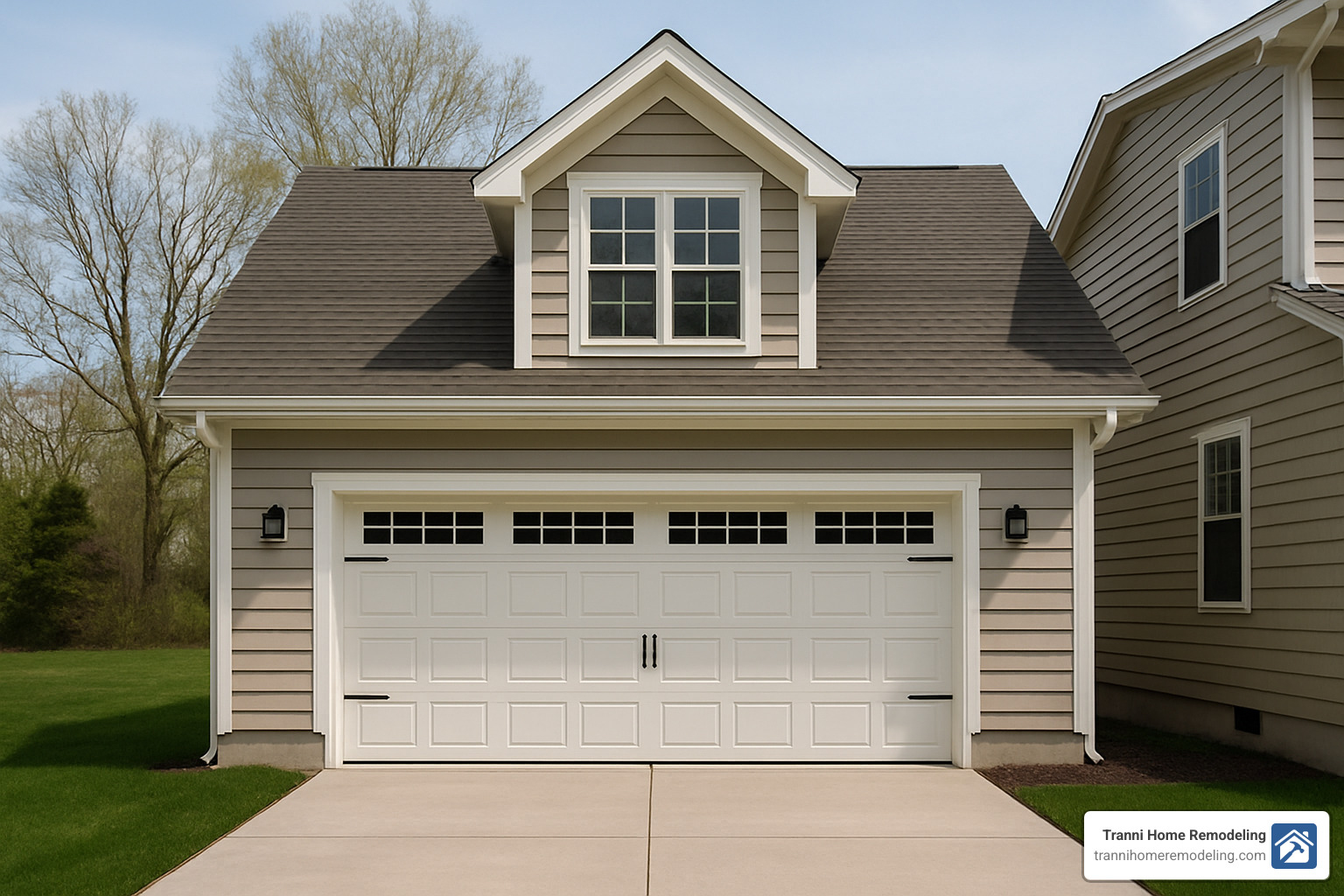
When planning your garage addition for home, thinking beyond today’s needs can save you thousands down the road. I’ve seen many homeowners regret not building with the future in mind—what works for your family now might not in five years.
“I wish we’d gone just four feet wider,” a Billerica homeowner told me recently. “With two growing teenagers and all their sports equipment, we’re already running out of space after just three years.”
Your garage dimensions matter tremendously. For a single car, you’ll want at least 14×20 feet, while a comfortable two-car garage starts at 20×24 feet. If you’re considering a three-car layout, plan for at least 32×22 feet. But here’s a tip from experience: whatever size you’re thinking, add 4-6 extra feet in length if you want space for a workbench or storage shelves.
Ceiling height deserves careful consideration too. Standard 8-9 foot ceilings work for most sedans, but if you drive larger vehicles or might in the future, consider 10-12 feet. And if you’re dreaming of a loft space above (which is becoming increasingly popular), you’ll need at least 12-14 feet to make it comfortable.
As for garage doors, standard single doors run 8×7 feet, but 9×8 or even 10×8 doors provide more flexibility for larger vehicles. Many of my clients in Winchester and Lexington have opted for two single doors rather than one double door—they provide better insulation and let you open just half the garage when needed.
Loft and Living Space Options
One of the smartest ways to maximize your investment is incorporating living space above your garage addition for home. This approach essentially gives you two useful spaces while paying for just one foundation and roof—a real value multiplier.
“The studio apartment over our garage has been a game-changer,” shared a Chelmsford family. “It started as a place for our college student to have some independence, and now that she’s moved out, it’s generating rental income that’s helping pay for the addition itself.”
The possibilities for this upper space are nearly endless. Many families create a simple storage loft for holiday decorations and seasonal items. Others design quiet, separated home offices—especially valuable in today’s remote work environment. Guest suites with a bedroom and bathroom have become increasingly popular, giving visitors privacy while keeping them close.
Some forward-thinking homeowners design the space as a potential rental unit (though always check local zoning laws first). Others create recreation rooms where teenagers can entertain friends without taking over the main house.
For more detailed information about adding living space above your garage, our guide on Adding a Bedroom Over Garage covers everything from structural requirements to finishing touches.
High-Impact Upgrades for Your Garage Addition for Home
The difference between a basic garage and one you’ll truly love often comes down to thoughtful upgrades. While keeping your budget in mind, consider these high-value improvements:
A well-designed workshop area transforms your garage from simple car storage to a functional creative space. Built-in workbenches with tool storage underneath maximize space efficiency. Strategic task lighting positioned to eliminate shadows makes detailed work easier and safer. If woodworking is your passion, consider a dust collection system—your lungs (and your spouse) will thank you.
Flooring upgrades might seem like a luxury, but they dramatically improve both function and appearance. Epoxy coatings create a showroom-quality surface that resists stains and cleans up easily. Interlocking tiles provide comfort underfoot and impact resistance for dropped tools. For year-round comfort in our Massachusetts climate, radiant floor heating keeps the space usable even in February.
Smart storage solutions prevent your new garage from becoming a cluttered catch-all. Overhead racks use often-wasted ceiling space for seasonal items. Wall organization systems keep tools visible and accessible. Custom cabinetry can be designed for specialized equipment from sports gear to gardening supplies.
Don’t overlook technology integration. Smart garage door openers with smartphone control let you verify your garage is closed from anywhere. Security cameras provide peace of mind, while integrated speaker systems make working in the garage more enjoyable. A dedicated Wi-Fi extender ensures strong connectivity throughout the space.
With energy costs continuing to rise, efficiency features pay dividends. Solar-ready roof design makes future panel installation simpler and less expensive. LED lighting throughout uses a fraction of the electricity of traditional bulbs. Extra insulation in walls and ceiling helps maintain comfortable temperatures year-round while reducing energy bills.
Money-Saving Tips & Financing
Building a garage addition for home is a significant investment, but there are smart ways to manage costs without cutting corners on quality.
Timing your project can yield substantial savings. Scheduling construction during off-peak seasons (late fall or winter) often means better availability and potentially lower rates from contractors who want to keep their crews busy during slower periods. I always recommend getting at least three detailed bids from qualified contractors to ensure you’re getting fair pricing.
For those with tight budgets, phased construction offers a practical approach. Build the basic structure now with proper foundations, framing, and weather protection, then finish the interior spaces as finances allow. This strategy gets you the essential garage functionality while spreading costs over time.
When it comes to financing, homeowners have several viable options. A Home Equity Line of Credit (HELOC) typically offers the lowest interest rates and flexible drawing periods. Home Equity Loans provide fixed-rate options with predictable payments if you prefer budget certainty. Construction loans are specifically designed for building projects, while personal loans offer faster approval but usually at higher interest rates. If current mortgage rates are favorable, a cash-out refinance might make financial sense.
The DIY versus professional debate deserves careful consideration. While handling some aspects yourself can save 30-50% on labor costs, structural work like foundations and framing often requires professional expertise. Many homeowners find success with a hybrid approach—hiring professionals for critical structural elements while tackling finishing work themselves.
For guidance on selecting the right contractor for your project, our detailed resource on Contractor to Add Onto House can help you make an informed decision.
One piece of advice I share with every client: always include a 15-20% contingency fund in your budget. In over a decade of building garages throughout Middlesex County, I’ve never seen a project without at least one surprise that required additional funds. Being financially prepared prevents stress and project delays.
Frequently Asked Questions about Garage Additions (3-minute read)
How much does a 24′ × 24′ garage really cost?
When homeowners ask me about garage costs, I always emphasize that a 24′ × 24′ garage (that’s 576 square feet of new space) typically runs between $20,000 and $45,000 for a basic structure here in Massachusetts. But as with any construction project, the final price tag depends on several choices you’ll make along the way.
Think of it like buying a car – there’s the base model, and then there are all the upgrades that can dramatically change the final price. Your foundation choice makes a big difference; a simple concrete slab costs significantly less than a full foundation with frost walls. Exterior finishes vary widely too – vinyl siding might save you thousands compared to brick or stone veneer that matches your home perfectly.
Inside, an unfinished space with exposed studs will cost much less than a fully insulated, drywalled, and climate-controlled garage. Even your roof design impacts costs – a straightforward gable roof is more budget-friendly than complex hip roofs with multiple angles.
For a premium 24′ × 24′ garage addition for home in Middlesex County with quality materials matching your home’s aesthetic, insulation, drywall, electrical service, and higher-end doors, you might be looking at $45,000 to $100,000 or more. These figures reflect industry averages, not specific pricing from Tranni Home Remodeling.
“We initially budgeted for a basic garage,” one Billerica homeowner told me, “but once we started adding the workshop area, extra windows, and the carriage-style doors my wife loved, our costs increased by about 40%. Still worth every penny when we see the finished product.”
How long will construction take from permit to parking?
Building your garage addition for home isn’t an overnight process – patience is definitely required! Most garage projects follow a fairly predictable timeline with two main phases.
The pre-construction phase typically takes 1-3 months, starting with design and planning (2-4 weeks) where you’ll make all those important decisions about size, style, and features. Then comes permit approval, which varies dramatically depending on your town – some Middlesex County municipalities might approve in two weeks, while others could take two months, especially if you need any variances. Finally, contractor scheduling adds another 1-4 weeks, with longer waits during the busy summer season.
Once construction actually begins, you’re looking at 6-12 weeks of active building. We typically break this down into manageable phases: site prep and foundation (1-2 weeks), framing and roofing (1-2 weeks), exterior finishing with siding and doors (1-2 weeks), electrical and plumbing work (1-2 weeks), interior finishing (1-3 weeks), and final detailing (about a week).
A straightforward attached garage might be ready for your vehicles in as little as 6 weeks once construction starts. More elaborate projects with living space above or custom features could extend to 3-4 months of active construction.
And don’t forget our New England weather! As one seasoned contractor put it, “Winter construction in Massachusetts often adds 2-4 weeks to a garage project due to frozen ground, snow delays, and temperature restrictions for concrete and certain materials.”
Is DIY realistic or should I hire a contractor?
This might be the most important question of all! Whether to tackle your garage addition for home yourself or bring in the professionals really comes down to an honest assessment of your skills, time, and comfort level with complex building projects.
DIY can make sense if you have substantial construction experience, understand local building codes, own specialized tools, and can confidently read and implement architectural plans. You’ll also need significant time – typically 2-3 times longer than professional construction – plus the physical capability for demanding labor and the patience to manage the permit process and inspections.
On the flip side, hiring a contractor becomes the clear choice if you lack construction experience, need complex electrical or plumbing work, want to precisely match your existing home’s architecture, have limited time, desire warranty protection, or simply want someone else to handle permit management and ensure code compliance.
Many of my clients in Burlington and Lexington choose a middle path – hiring professionals for the technical aspects like foundation work, framing, roofing, and electrical installation, while taking on painting, basic finishing work, and storage installations themselves.
“I thought I could save money building my garage myself,” admitted one Tewksbury homeowner. “Two weekends in, I realized I was in over my head and called a professional. The peace of mind alone was worth the cost, and surprisingly, they finished the job for less than I had budgeted for materials alone because they have supplier relationships I couldn’t access.”
At Tranni Home Remodeling, we’re always happy to consult with homeowners about which aspects of their garage project might be suitable for DIY and which would benefit from professional expertise. Sometimes saving money upfront leads to costly fixes later – we’ve helped many homeowners finish projects they started but couldn’t complete on their own.
Conclusion
A garage addition for home is more than just a construction project—it’s an investment in your daily comfort, home functionality, and property value. After guiding countless Massachusetts homeowners through this process, I’ve seen how a well-designed garage can transform both properties and lifestyles.
Think about how your morning routine will change when you’re no longer scraping ice off your windshield in February. Or how your weekends might look with a dedicated workshop space for those projects you’ve been putting off. These practical benefits combine with impressive financial returns—with homeowners typically recouping 64-81% of their investment when selling.
The journey to a successful garage addition starts with thoughtful planning. Take time to envision not just what you need today, but what your family might require five or ten years from now. Will you need space for an electric vehicle charging station? Could a teenager’s car be joining your driveway soon? Might you want living space above the garage eventually?
Working with Massachusetts zoning regulations requires patience and expertise. Each town in Middlesex County has its own requirements, and navigating these successfully is crucial to avoiding costly delays. From setback requirements in Lexington to architectural guidelines in Concord, local knowledge makes all the difference.
Your budget deserves careful consideration too. While the typical range for garage additions spans from $20,000 to $100,000, the final cost depends on dozens of decisions you’ll make along the way. Including a 15-20% contingency fund will help you weather any unexpected challenges without compromising your vision.
The choice between attached and detached designs should reflect both your property’s layout and your intended use. Attached garages offer convenient access and generally cost less, while detached structures provide separation that’s ideal for noisy workshops or potential future living spaces.
Quality materials and craftsmanship aren’t areas to compromise. The New England climate demands structures built to withstand everything from summer humidity to winter snow loads. Choosing durable materials and proper insulation will ensure your garage serves you well for decades.
At Tranni Home Remodeling, we’ve helped families throughout Middlesex County transform their properties with thoughtfully designed garage additions. Our team understands the unique challenges of building in Massachusetts—from navigating town-specific zoning requirements to designing structures that stand up to our challenging weather conditions.
Whether you’re just starting to explore the possibility of adding a garage or you’re ready to break ground, we invite you to explore our comprehensive resources on Home Additions and reach out with your questions.
A garage isn’t just an addition to your house—it’s an extension of how you live, work, and play at home. When designed with care and built with quality, it’s an investment that pays dividends in convenience, functionality, and property value for years to come.