




Planning Your Perfect Kitchen
How to budget with contractors on kitchen remodel starts with a solid plan and open communication. A kitchen remodel is a fantastic investment in your home’s value, but costs can spiral without a strategy. Here’s a quick guide:
- Define Your Budget First: Know what you can spend and set aside 10-20% for contingencies.
- Be Upfront with Contractors: Share your budget early to build trust and save time.
- Get Detailed Quotes: Obtain at least three written, itemized estimates.
- Agree on Payments: Use a milestone-based payment schedule.
- Document All Changes: Insist on written change orders before extra work begins.
By following a structured approach, you can take control of your budget before even calling a contractor. I’m Tyler Tranni, and at Tranni Home Remodeling, we’ve helped many homeowners in Billerica and nearby towns steer their kitchen remodel budgets. We believe transparent pricing and clear communication are the keys to a successful project.
How to budget with contractors on kitchen remodel terms to remember:
- how to hire a contractor for kitchen remodel
- why hire a contractor to remodel your kitchen
- what to tell your contractor when remodelling your kitchen
Step 1: Defining Your Budget Before You Talk to Contractors
Before you talk to a contractor, you need to know your financial boundaries. This isn’t about limiting your dreams—it’s about making smart decisions that add value and joy, not financial stress.
Start with a “needs vs. wants” list. On one side, list what must change (e.g., failing cabinets, poor layout). On the other, list your dream features (e.g., a farmhouse sink, a waterfall island). This exercise clarifies your project’s scope. Are you doing a minor refresh or a full gut renovation? Answering this helps shape your budget.
Next, do some homework on general price ranges. Understanding the ballpark costs for different project types prevents the sticker shock of falling for a design that’s double what you can afford.

Understanding Average Kitchen Remodel Costs
Please note: the numbers below are average costs based on internet data and industry standards, not quotes from Tranni Home Remodeling. Your actual project cost will vary based on materials, scope, and other factors. Costs in the Billerica area are also typically 15-25% higher than national averages.
- A small-scale remodel (cosmetic updates like painting cabinets, new backsplash, new countertops) can range from $8,000 to $25,000.
- A mid-range remodel (new semi-custom cabinets, flooring, upgraded appliances, minor layout tweaks) typically runs $30,000 to $90,000.
- A high-end remodel (custom cabinetry, pro-grade appliances, structural changes) can be $80,000 to $250,000 or more.
Costs are driven by material quality (laminate vs. premium granite), layout changes (moving plumbing or gas lines), and the level of customization.
The Importance of a Contingency Fund
Every remodel has surprises. A contingency fund is your financial cushion for the unexpected. We’ve seen it all: water damage under old floors, outdated wiring, or structural issues hidden in walls. These are normal parts of renovating older homes.
Set aside 10-20% of your total budget for contingencies. For a $50,000 remodel, that’s an extra $5,000 to $10,000 in reserve. This fund allows you to handle surprises without panicking or compromising your vision.
Common unexpected costs include:
- Unexpected Repairs: Addressing hidden issues like old plumbing or wiring that isn’t up to code.
- Permit Costs in Massachusetts: Depending on the town and scope, permits can run $500 to $2,000.
- Other Hidden Costs: Delivery fees, increased dining-out expenses, and post-construction cleaning.
Step 2: A Guide on How to Budget with Contractors on a Kitchen Remodel
With a budget in hand, it’s time to find the right contractor. A great contractor is a partner who helps bring your vision to life within your budget.
Start by asking for recommendations from friends, family, and neighbors in communities like Billerica, Woburn, or Chelmsford. Always verify a contractor’s license and insurance—this protects you. At Tranni Home Remodeling, we provide our credentials upfront.
The key to learning how to budget with contractors on kitchen remodel projects is open communication from day one. Honest conversations prevent most problems and ensure the project flows smoothly.

Being Upfront: The First and Most Important Budget Discussion
Being completely upfront about your budget in the first meeting is the smartest move you can make. A good contractor won’t just inflate their price to meet your number. Instead, sharing your budget:
- Builds trust and shows you’re a serious partner.
- Saves time by avoiding designs that are out of reach.
- Aligns expectations so your contractor can guide you to choices that fit your financial reality.
- Ensures project feasibility from the start, shifting the conversation to what’s possible with your funds.
Getting and Comparing Detailed Contractor Quotes
Request at least three detailed quotes. This isn’t about finding the lowest price, but understanding the fair market rate and what you’re getting for your money. A proper quote should include:
- A clear scope of work
- Itemized material and labor costs
- Permit fees
- A project timeline and payment schedule
- Allowances for items not yet selected
When comparing estimates, don’t just look at the total. Dig into the line items. A higher quote might reflect better materials or a more comprehensive plan. A low bid might omit necessary work. Call and ask for clarification on any major differences before finalizing your contractor choice.
Effective Negotiation Tips for Your Kitchen Remodel Budget
Negotiation should be a respectful conversation. Contractors have real costs, so approach it as a partnership.
- Know Your Priorities: If you must have granite countertops, be ready to compromise elsewhere.
- Negotiate for Value: Instead of a lower price, ask for value-added services like appliance installation or an extended warranty.
- Ask About Discounts: Contractors often get material discounts they may be able to pass on.
- Consider Timing: You may get a better price during the off-season (late fall or winter in Massachusetts) when contractors are less busy.
- Be Open to Alternatives: Ask your contractor for creative solutions or comparable products that can save money without sacrificing your vision.
Step 3: Finalizing the Contract and Managing Payments
You’ve found the right partner; now it’s time to put everything in writing. A detailed contract is your insurance policy against misunderstandings and financial surprises, protecting both you and your contractor.
Your contract must be thorough. It should include a detailed scope of work, clear start and end dates, payment terms, a change order process, warranty information, and proof of the contractor’s insurance and licensing. Leave nothing to verbal agreements.
Agreeing on a Fair Payment Schedule
The payment schedule dictates how and when your contractor gets paid. A fair schedule protects everyone. We recommend a milestone-based payment schedule, where payments are tied to completed phases of work (e.g., after demolition, after cabinet installation). This ensures you’re paying for work that has been done.
Most contractors require an initial deposit to book your project and buy materials. A reasonable deposit is typically 10-30% of the total project cost. Be wary of requests for more than 50% upfront.
Finally, always hold back the final payment—usually 5-10% of the total cost—until you’ve done a final walk-through and are completely satisfied with every detail. This is a standard practice that ensures all punch list items are completed.
How to Manage Change Orders and Avoid Budget Creep
Changes happen during a remodel. You might find old wiring or decide to add a feature. These modifications are managed through change orders—formal written agreements that amend your original contract.
The golden rule is simple: get everything in writing. Every change, no matter how small, requires a signed change order before the work begins. This document should detail the new work, the cost adjustment (for materials and labor), and any impact on the timeline.
This disciplined process prevents “budget creep,” where small, undocumented changes add up to thousands in unexpected costs. By requiring written approval for all changes, you maintain complete control over your budget and avoid a surprise bill at the end.
Frequently Asked Questions About Kitchen Remodel Budgeting
What is the biggest expense in a kitchen remodel?
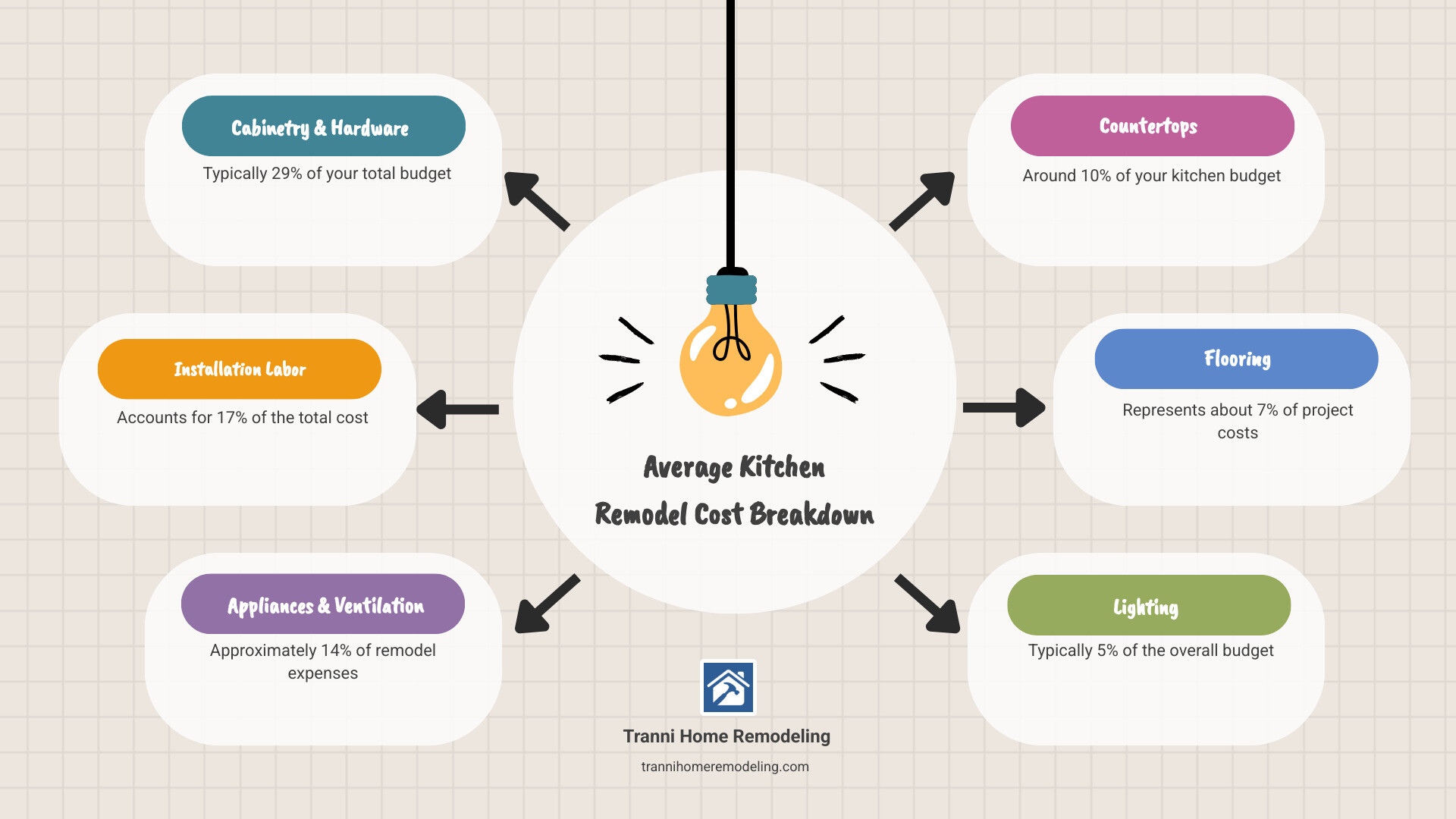
The single biggest expense is typically cabinetry and hardware, which can account for around 29% of the total budget. The price varies dramatically by type:
- Stock Cabinets: The most budget-friendly option, pre-made in standard sizes. ($100-$300 per linear foot).
- Semi-Custom Cabinets: Offer more style and size flexibility. ($250 to $750 per linear foot).
- Custom Cabinetry: Built to your exact specifications for ultimate quality and design freedom. ($700 to $2,100+ per linear foot).
After cabinetry, the next largest costs are installation labor (around 17%), appliances and ventilation (14%), and countertops (10%). At Tranni Home Remodeling, our expertise in fine interior carpentry helps clients find the right balance between quality and cost.
Is $30,000 a realistic budget for a kitchen remodel in the Billerica, MA area?
While $30,000 is a significant sum, it’s important to be realistic about what it covers in the Billerica, Woburn, and Chelmsford areas, where costs are 15-25% higher than national averages. According to internet data, a true mid-range kitchen renovation (120-200 sq ft) in our area typically ranges from $60,000-$180,000, while a smaller project (70-120 sq ft) can range from $25,000-$75,000.
A $30,000 budget in our local market would likely cover a small-scale or cosmetic remodel, such as:
- Refacing existing cabinets.
- New laminate or mid-range countertops.
- New flooring and paint.
- Updated lighting and entry-level appliances.
If your vision includes moving walls, custom cabinetry, or high-end finishes, a larger budget would be necessary.
Why is open communication so important in budget discussions?
Open communication about the budget is the foundation of a successful remodel. It’s crucial because it:
- Prevents Misunderstandings: Ensures everyone is aligned on financial expectations, avoiding costly errors.
- Builds Trust: Fosters a collaborative partnership between you and your contractor.
- Aligns Scope and Cost: Helps your contractor suggest alternatives or prioritize features to keep the project on budget.
- Enables Proactive Problem-Solving: Allows you to address unexpected issues together and make informed decisions.
- Manages Expectations: Leads to a smoother, less stressful experience for everyone involved.
Start Your Billerica Kitchen Remodel with Confidence
You are now equipped to take the next step toward your dream kitchen. Successfully managing how to budget with contractors on kitchen remodel projects boils down to three key practices: plan thoroughly, communicate openly, and vet your contractor carefully.
At Tranni Home Remodeling, we’ve built our reputation in Billerica, Andover, Lexington, and throughout Middlesex County by being straight with people about costs and timelines. We believe in honest conversations and high-quality craftsmanship, turning a potentially stressful process into an exciting one.
Ready to transform your kitchen into the heart of your home? Let’s talk about your vision.