





The Custom Cabinet Contractor Checklist Every Homeowner Needs Before Choosing Materials
Hiring a custom cabinet contractor is one of the most important decisions you’ll make during a kitchen or bathroom remodel — and one of the easiest to get wrong.
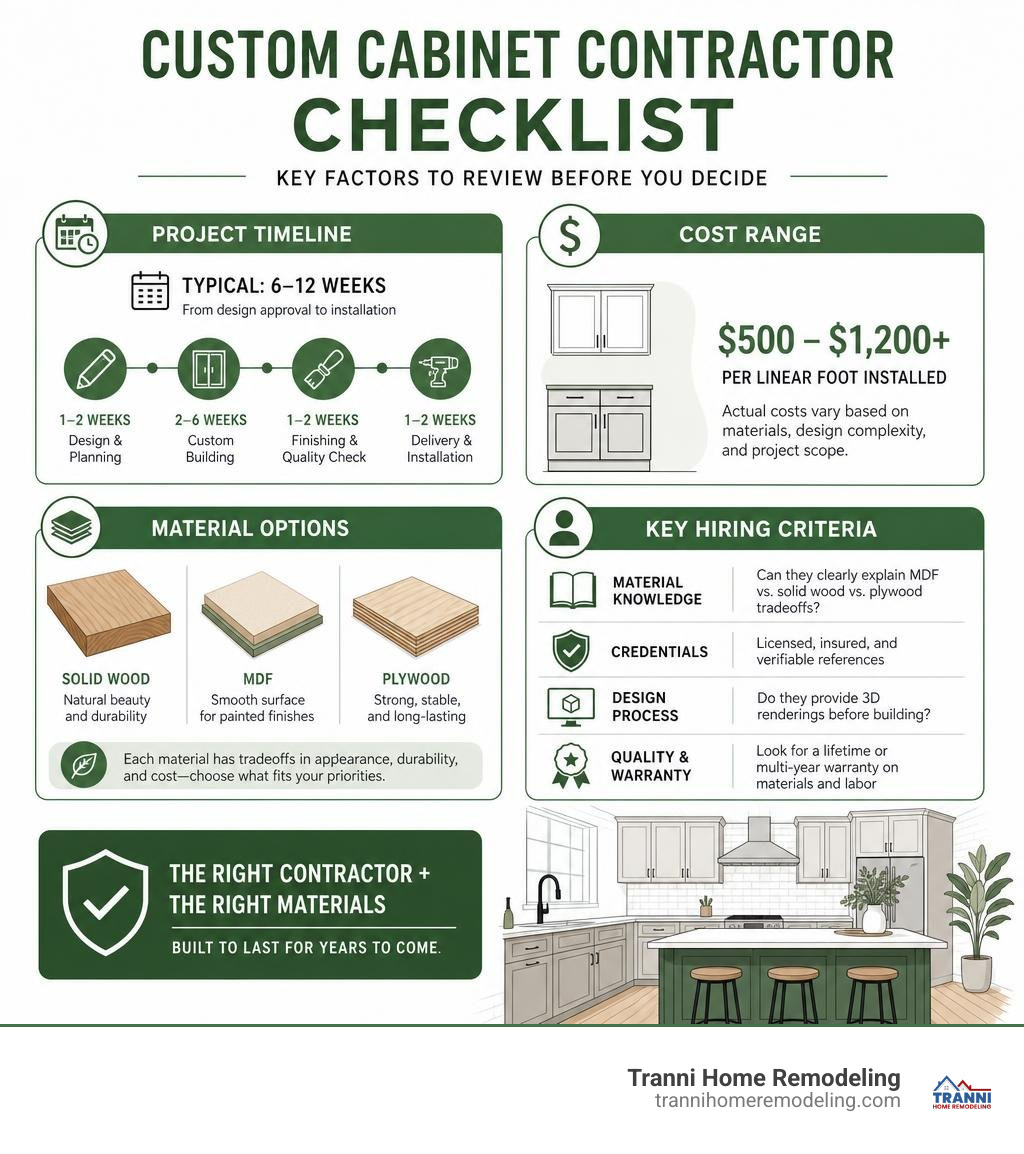
Before you commit to a contractor or pick a single board, here’s what you need to know at a glance:
Quick Answer: What to Look for in a Custom Cabinet Contractor
| Factor | What to Check |
|---|---|
| Material knowledge | Can they clearly explain MDF vs. solid wood vs. plywood tradeoffs? |
| Credentials | Licensed, insured, and verifiable references |
| Design process | Do they provide 3D renderings before building? |
| Timeline | Typical projects run 6–12 weeks from design approval to installation |
| Cost range | Average custom cabinets run $500–$1,200+ per linear foot installed (based on internet average data; actual costs vary widely) |
| Warranty | Look for a lifetime or multi-year warranty on materials and labor |
Over 65% of homeowners remodeling their kitchens choose custom or semi-custom cabinets over stock options. Yet many start the process without knowing the difference between MDF and solid wood — or even what a cabinet contractor actually does versus a cabinet maker.
That gap in knowledge can cost you thousands.
This guide cuts through the confusion. You’ll learn how to evaluate materials, compare cabinet grades, and ask the right questions before signing any contract — so your project runs smoothly and your cabinets last for decades.
I’m Tyler Tranni, owner and operator of Tranni Home Remodeling in Billerica, MA, and I’ve spent years helping homeowners across the region navigate the remodeling process, including working alongside custom cabinet contractors to deliver kitchens and bathrooms that are built right the first time. If you’re ready to make a confident, informed decision, let’s start with the basics.
What Does a Custom Cabinet Contractor Do?
When you begin planning a kitchen or bathroom renovation, the terminology can quickly get confusing. Many homeowners use the terms “cabinet maker,” “general contractor,” and “custom cabinet contractor” interchangeably. However, understanding the distinct role of a custom cabinet contractor is essential to ensuring your project is executed flawlessly.
A custom cabinet contractor acts as the bridge between raw craftsmanship and structural execution. While a traditional cabinet maker focuses almost exclusively on the fabrication of the boxes and doors inside a woodshop, a contractor manages the entire lifecycle of the cabinetry project. This includes:
- In-Depth Site Assessments: Measuring your space with absolute precision, taking into account non-plumb walls, uneven floors, and architectural quirks common in historic Massachusetts homes.
- Comprehensive Custom Design: Working with you to map out storage solutions, select styles, and generate detailed 3D renderings.
- Material and Hardware Procurement: Sourcing premium hardwoods, high-grade plywood, stable engineered woods, and commercial-grade soft-close hardware.
- Seamless Project Coordination: Collaborating with plumbers, electricians, and countertop installers to ensure the cabinetry integrates perfectly with utilities.
- Professional On-Site Installation: Scribing, leveling, and securing the heavy cabinetry to the wall studs so that everything is perfectly aligned and safe.
Cabinet Maker vs. Contractor vs. General Contractor
To put it simply:
- The Cabinet Maker is the artisan in the shop who cuts, joins, and finishes the wood.
- The Custom Cabinet Contractor is the professional who manages the design, ensures the build meets structural codes, coordinates the logistics, and handles the tricky on-site installation.
- The General Contractor oversees the entire house remodel, managing multiple trades (plumbing, drywall, electrical, and flooring) while often hiring the custom cabinet contractor as a specialized subcontractor.
At Tranni Home Remodeling, we work closely with top local cabinet professionals to provide a streamlined experience. If you are looking for localized services and want to explore the design possibilities in your neighborhood, you can read our guide on Dream Kitchens Start Here: Top Custom Cabinet Services in Woburn MA or browse through local directories like the Best 15 Custom Cabinet Makers in Burlington, MA | Houzz to see what styles are trending in nearby homes.
MDF vs. Real Wood: The Material Selection Checklist
Choosing the right material for your cabinetry isn’t just about appearance; it’s about structural integrity, moisture resistance, and how well the material holds up to daily wear and tear. The debate usually comes down to three main contenders: Medium-Density Fiberboard (MDF), Plywood, and Solid Wood.

Medium-Density Fiberboard (MDF)
MDF is an engineered wood product made by breaking down hardwood or softwood residuals into wood fibers, combining them with a wax and resin binder, and forming panels under high pressure and temperature.
- Pros: It is incredibly stable and does not expand or contract with temperature and humidity changes as much as solid wood. Because it has no grain, it offers an incredibly smooth, flawless surface for painted finishes.
- Cons: It is heavier than natural wood, does not hold screws as tightly over time if repeatedly stressed, and is highly susceptible to water damage if the protective outer finish is compromised.
Plywood
High-grade cabinet plywood (typically 3/4-inch multi-ply) is the gold standard for cabinet box construction. It consists of thin layers of wood veneer glued together in alternating directions.
- Pros: It offers exceptional strength, outstanding screw-holding capability, and excellent moisture resistance. It is far less likely to sag under the weight of heavy stoneware than particleboard or MDF.
- Cons: It is more expensive than MDF and can occasionally have minor manufacturing voids inside the layers. To learn more about selecting the right sub-layers for your cabinet boxes, check out our guide on how to Build It Right with the Best Plywood for Cabinets.
Solid Wood
Solid natural wood (such as maple, oak, cherry, or walnut) is typically reserved for cabinet face frames, door frames, and drawer fronts.
- Pros: It features beautiful, natural grain patterns, can be stained to show off its organic character, and is highly durable. It can also be easily sanded down and refinished decades later.
- Cons: Solid wood is prone to warping, shrinking, and expanding as the seasons change. A solid wood door panel can warp if exposed to the high humidity of a bathroom or a drafty kitchen corner.
Here is a side-by-side comparison to help you make your choice:
| Feature | Medium-Density Fiberboard (MDF) | Cabinet-Grade Plywood | Solid Wood (Maple, Oak, Cherry) |
|---|---|---|---|
| Best Use Case | Painted doors, center panels, slab drawers | Cabinet boxes, shelves, structural frames | Face frames, stained doors, drawer fronts |
| Moisture Resistance | Low (swells if water penetrates finish) | High (highly stable in damp conditions) | Moderate (prone to seasonal movement) |
| Surface Finish | Flawless, ultra-smooth paint finish | Wood grain texture (can be painted or stained) | Natural grain (best for stains/clear coats) |
| Warping Risk | Extremely low | Low | High (if exposed to humidity changes) |
| Durability | Moderate (edges can chip under heavy impact) | High (excellent structural integrity) | Extremely High (can be sanded and repaired) |
Custom, Semi-Custom, and Stock Cabinets: Key Differences
When navigating cabinet grades, homeowners are faced with three primary tiers of customization. Knowing when to invest in true custom work versus when semi-custom or stock options will suffice can save you thousands of dollars while protecting your home’s resale value.
1. Stock Cabinets
Stock cabinets are pre-manufactured in standard sizes (usually in 3-inch increments) and kept in stock at big-box home improvement stores or regional distributors.
- Customization: None. What you see is what you get.
- When to use: Budget-conscious rental properties, basic utility rooms, or simple, straight-wall kitchens where standard sizes fit perfectly without requiring filler strips.
2. Semi-Custom Cabinets
Semi-custom cabinets are built to order but utilize pre-set styles and sizing templates. Homeowners can adjust drawer configurations, choose from a set library of finishes, and alter cabinet depths in limited increments.
- Customization: Moderate. You can customize the look but are still bound by the manufacturer’s core dimensional limits.
- When to use: Standard kitchen layouts where you want upgraded storage features (like built-in spice racks or pull-out trash cans) without the premium price tag of a fully custom build.
3. Custom Cabinets
Custom cabinets are built from scratch to your exact specifications. There are no standard sizes, no pre-set templates, and no design limitations.
- Customization: Unlimited. Every cabinet box is built to the exact millimeter of your room’s dimensions.
- When to use: High-end renovations, homes with unique architectural challenges (like sloped ceilings, historic chimney breasts, or bay windows), or when you want to maximize every square inch of your Kitchen Cabinet Layout.
The Step-by-Step Custom Cabinetry Process
Embarking on a custom cabinetry project is an exciting journey, but it requires careful planning and execution. A professional custom cabinet contractor will guide you through a structured, multi-phase process to ensure your vision comes to life exactly as planned.

Phase 1: The Initial Consultation
The process begins with an in-depth meeting. We sit down with you to discuss your lifestyle, cooking habits, aesthetic preferences, and storage pain points. Do you need deep drawers for heavy cast-iron pans? A dedicated pantry cupboard with pull-out shelves? This is where we lay the groundwork.
Phase 2: Precise Measurements & 3D Rendering
An installer or contractor will visit your home to take exact measurements. In older homes across Middlesex County, walls are rarely perfectly plumb and floors are rarely completely level. Once these measurements are secured, we generate detailed 3D designs. This allows you to walk through your virtual kitchen, approving the placement of every door, drawer, and appliance before a single piece of wood is cut.
Phase 3: Material & Hardware Selection
With the layout locked in, you will select your wood species, paint colors or stain finishes, door styles, and hardware. This is the stage where you decide on premium soft-close hinges, undermount drawer slides, and interior organizers.
Phase 4: Fabrication in the Shop
Once the design is approved, fabrication begins. Our partners use state-of-the-art machinery and time-tested joinery techniques (such as interlocking dovetail joints for drawers and tongue-and-groove joints for frames) to build cabinet boxes that are incredibly strong and durable.
Phase 5: Professional Installation
The final phase is the physical installation. This is where the skill of a custom cabinet contractor truly shines. The installation crew will carefully anchor the cabinet boxes, level them perfectly using shims, scribe the trim pieces to fit flush against uneven walls, and hang the doors. For a deeper look at what to expect on site, you can read our detailed breakdown of Kitchen Cabinet Installation.
How to Design Kitchen Cabinets with a Custom Cabinet Contractor
Designing your cabinetry is about finding the perfect intersection of aesthetics and storage solutions. When you work with a professional contractor, you aren’t just picking out door profiles; you are engineering an efficient workspace.
During the design phase, keep these key factors in mind:
- The Work Triangle: Ensure your layout maintains a smooth, unobstructed flow between your sink, refrigerator, and range.
- Storage Optimization: Say goodbye to deep, dark corner cabinets where plastic containers go to die. Incorporate modern accessories like lazy Susans, pull-out spice racks, and vertical tray dividers.
- Aesthetics and Proportions: Decide whether you want classic Shaker-style doors, sleek flat-panel modern designs, or traditional raised-panel cabinet doors.
- Hardware and Accents: Don’t treat hardware as an afterthought. High-quality handles, pulls, and soft-close hinges elevate the daily experience of using your kitchen.
If you are looking for design inspiration or want to learn more about layout planning, we recommend reading our comprehensive guide on How to Design Kitchen Cabinets to kickstart your creative process.
Cost Factors and Budgeting for Custom Cabinets
One of the most common questions homeowners ask is: How much do custom cabinets actually cost?
Because custom cabinetry is tailored specifically to your home, pricing varies widely based on size, wood species, layout complexity, and finish options.
Disclaimer: The pricing figures listed below represent average market costs based on broad internet data. They do not represent actual project pricing for Tranni Home Remodeling. For an accurate, personalized estimate tailored to your home, please contact us directly.
When budgeting for a cabinet project, you will typically see pricing structured by the linear foot. A linear foot measures the horizontal distance along your wall where the cabinets will sit, including both upper and lower units.
- Stock Cabinets: Average $150 to $350 per linear foot installed.
- Custom Cabinets: Typically range from $500 to $1,200+ per linear foot installed. For ultra-premium materials, highly intricate custom carvings, or complex architectural layouts, high-end custom work can reach up to $3,600+ per linear foot.
- Overall Project Investment: While a standard stock cabinet kitchen might cost $5,000 to $12,000, a fully custom kitchen cabinetry project typically ranges from $15,000 to $45,000, with massive, high-end layouts in premium hardwoods reaching up to $135,000+.
Key Factors That Influence Your Estimate
- Materials: Solid hardwoods like cherry, walnut, and quartersawn white oak carry a premium price tag compared to paint-grade MDF or standard maple.
- Finishes: A hand-applied stain with a glaze or a multi-step catalyzed lacquer paint finish requires extensive labor, increasing the overall cost.
- Labor & Installation: Installing cabinetry in a room with complex angles, uneven floors, or structural obstacles requires highly skilled carpenters, which increases labor hours.
- Accessories & Organizers: Built-in trash pull-outs, deep drawer peg systems, and motorized lift-up appliance garages add convenience but also increase the final bill.
If you love your current cabinet layout but want to update the look of your kitchen on a tighter budget, cabinet refacing or refurbishing might be an excellent alternative. You can learn more about these cost-effective options and average pricing in our guide on Kitchen Cabinet Refurbishing Cost.
Evaluating Your Custom Cabinet Contractor Portfolio and Estimates
Before you sign a contract or make a deposit, it is vital to perform due diligence. A reputable custom cabinet contractor will gladly provide detailed estimates and proof of their past work.
When evaluating a contractor, use this checklist:
- Request Detailed Quotes: Avoid vague, single-line estimates. Your quote should break down the cost of materials, labor, finishes, hardware, delivery, and installation. It should also explicitly state whether demolition and disposal of your old cabinets are included.
- Review Their Portfolio: Look for photos of completed installations, paying close attention to the alignment of the doors, the seamlessness of the crown molding, and how they handled awkward spaces or corners.
- Verify Credentials: Ensure the contractor is fully licensed and carries comprehensive general liability and workers’ compensation insurance.
- Check References: Ask to speak with recent clients in your local area. Ask them about the contractor’s communication style, cleanliness, and whether they completed the project on time.
- Visit a Showroom: Seeing cabinet construction in person is the best way to evaluate quality. To find a location near you where you can examine different door styles and drawer boxes, check out our resource on Kitchen Cabinet Showrooms Near Me.
Frequently Asked Questions about Custom Cabinets
How long does a custom cabinet project take from start to finish?
A typical custom cabinetry project takes between 6 to 12 weeks from design approval to final installation. The process is broken down into three main phases:
- Design & Engineering (1–2 weeks): Finalizing measurements, creating 3D models, and securing approvals.
- Fabrication & Finishing (4–8 weeks): Building the cabinet boxes, crafting doors, and applying professional-grade finishes. This phase is heavily influenced by material lead times.
- On-Site Installation (3 days to 2 weeks): Delivering the cabinets, anchoring them securely, leveling, adjusting hardware, and installing trim.
Can a custom cabinet contractor match existing cabinetry or unique layouts?
Yes. One of the greatest benefits of hiring a custom cabinet contractor is their ability to solve architectural challenges. Whether you have a historic home with non-standard wall angles, low ceilings, or a radiator alcove, custom cabinets can be built to fit the space perfectly. Additionally, if you are adding an island or extending your current layout, a skilled contractor can analyze your existing wood species, grain pattern, and paint color to create matching finishes that blend seamlessly.
What warranties and maintenance tips should I expect?
Premium custom cabinetry often comes with a lifetime warranty on functional hardware (like hinges and drawer slides) and multi-year warranties on structural wood components.
To ensure long-term durability, follow these basic cabinet maintenance tips:
- Avoid Excess Moisture: Wipe down any water spills immediately, especially around the sink and dishwasher.
- Clean Gently: Use a soft microfiber cloth dampened with warm water and a mild dish soap. Avoid harsh chemical cleaners, abrasive pads, or silicone-based polishes.
- Control Your Climate: Wood naturally reacts to changes in humidity. Maintaining a stable indoor relative humidity level of 35% to 50% will minimize warping, shrinking, and wood expansion.
Conclusion
Investing in custom cabinetry is one of the most effective ways to elevate the beauty, storage capability, and long-term value of your home. By understanding the roles of your remodeling team, carefully weighing material options like MDF and plywood, and choosing a trustworthy contractor, you can transform your kitchen or bathroom into a highly functional masterpiece.
At Tranni Home Remodeling, based in Billerica, MA, we specialize in high-quality craftsmanship and outstanding service across Middlesex County. Whether you are planning a full kitchen remodel, a bathroom upgrade, or need specialized custom woodworking, we are here to help you build it right.
Ready to bring your dream cabinetry to life? Explore our Tranni Home Remodeling Custom Carpentry Solutions and contact us today to schedule your consultation!
