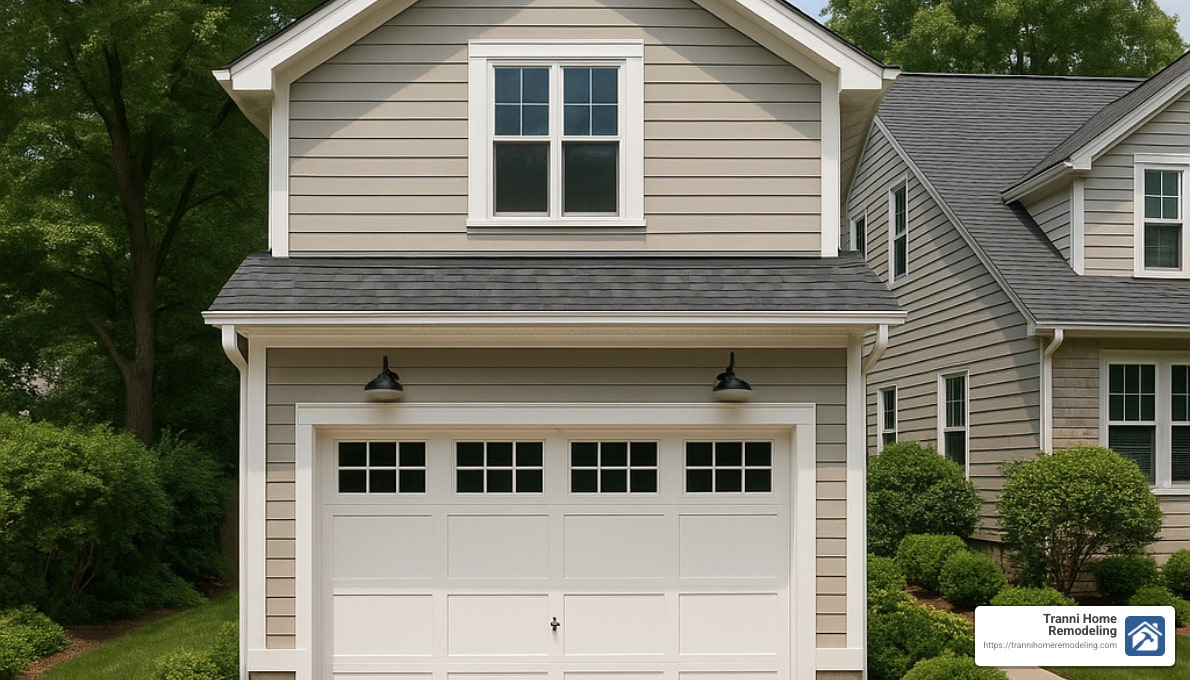





2 story attached garage addition: 7 Powerful Benefits 2025
Transform Your Home with Extra Space and Value
Feeling cramped but love your neighborhood too much to move? A 2 story attached garage addition might be exactly what your family needs. This smart home improvement creates substantial living space without sacrificing your precious yard area.
When you build up instead of out, you’re making a savvy investment in your home’s future. Most homeowners are pleasantly surprised to find they can gain 440-500 square feet of highly functional space—perfect for that home office you’ve been dreaming about, an extra bedroom for growing families, or even a potential rental unit with the right planning.
What makes these additions particularly appealing is their natural sound isolation. The garage below creates a buffer that makes the upper level surprisingly quiet—ideal if you need a peaceful work-from-home space or want to give teenagers their own domain without hearing every footstep.
The financial benefits are impressive too. While the investment is substantial, homeowners typically see a 64-81% return when it’s time to sell. Plus, there’s the daily convenience of having a weather-protected entry to your home, something you’ll appreciate during every New England rainstorm or snowy winter day.
Based on internet averages (not Tranni Home Remodeling prices), a 2 story attached garage addition typically runs between $200,000 and $650,000, depending on size, materials, and design complexity. While this represents a significant investment, the improved functionality and square footage often justify the expense, especially in today’s competitive real estate market.
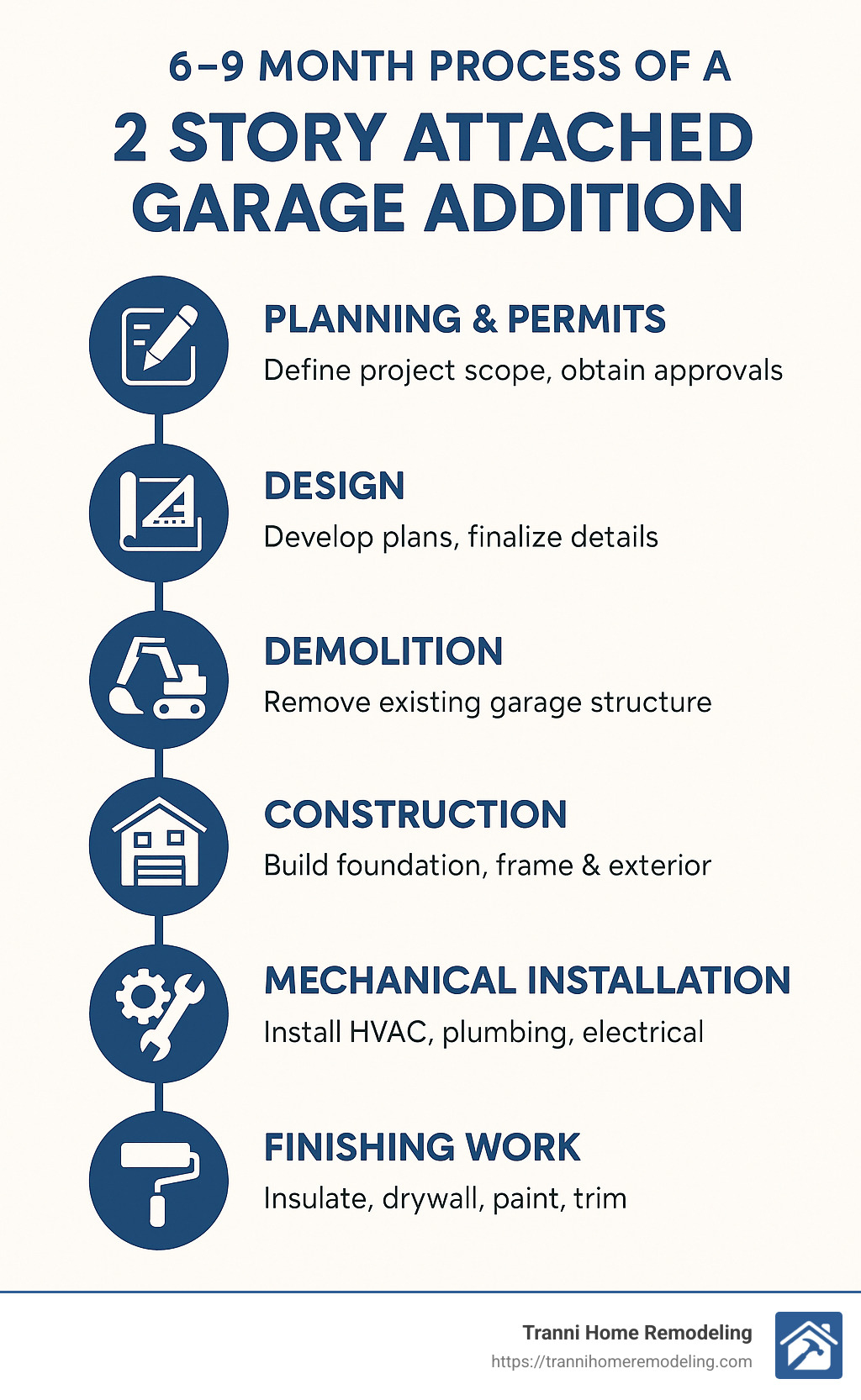
As the timeline above illustrates, these projects typically span 6-9 months from initial planning to final walkthrough. While that might seem lengthy, the change is worth the wait. Many of our clients tell us their 2 story attached garage addition has become their favorite part of the home—a space that perfectly balances function and comfort.
Looking for more information about similar projects? These resources might help:
– Add a garage to a house
– Add bedroom over garage
– Adding an attached garage to a house
At Tranni Home Remodeling, we’ve helped countless homeowners throughout the area transform their properties with custom 2 story attached garage additions that blend seamlessly with their existing homes. Our team takes pride in creating beautiful, functional spaces that maximize your property’s potential while maintaining its architectural character and charm.
Why Build Up? Key Benefits of a Two-Story Garage
When considering home expansion options, many homeowners face a critical decision: build out or build up? A 2 story attached garage addition offers compelling advantages that make it an attractive choice for many Massachusetts families.
Building upward rather than outward is a smart strategy for homeowners who want to maximize their property’s potential without sacrificing outdoor space. Your garage already occupies valuable real estate on your lot—why not make the most of the air space above it?
Maximize Your Property’s Potential
“Building a room above an existing garage appears to be a relatively straightforward way to increase living space,” notes a leading architectural expert, “but the benefits extend far beyond just adding square footage.”
One of the most significant advantages is preserving your yard space. Instead of consuming more of your property with a ground-level addition, you’re utilizing existing footprint. This is especially valuable for homeowners with smaller lots or those who cherish their outdoor living areas.
The space above a garage also offers natural soundproofing benefits. Garages tend to be the quietest spaces in homes, making the area above ideal for a home office where you can take Zoom calls without interruption, a peaceful primary bedroom, or even a music studio where budding musicians can practice without disturbing the household.
Practical Benefits for New England Living
For Massachusetts homeowners, the weather-protected connection between your home and garage becomes particularly valuable during those harsh New England winters. Imagine bringing in groceries without braving the elements or having a covered pathway when moving between spaces.
Multigenerational living options become possible with a well-designed garage addition. You can create semi-private living quarters for aging parents who need to be close but still want independence, or for adult children saving for their own homes.
From a financial perspective, garage additions typically deliver strong returns. With an ROI between 64% and 81%, adding an estimated $20,000 to $35,000 to a home’s value, this improvement makes sense for your lifestyle now and your investment future.
Daily convenience shouldn’t be overlooked either. Attached garages are used more frequently than detached structures, increasing the utility of the space above. The proximity to your main living area makes the bonus room more likely to be regularly used rather than becoming forgotten storage space.
One homeowner in Billerica shared: “After the pandemic hit and we both started working from home, our house felt impossibly small. Adding a home office above our garage gave us the separation we needed without sacrificing our backyard where the kids play.”
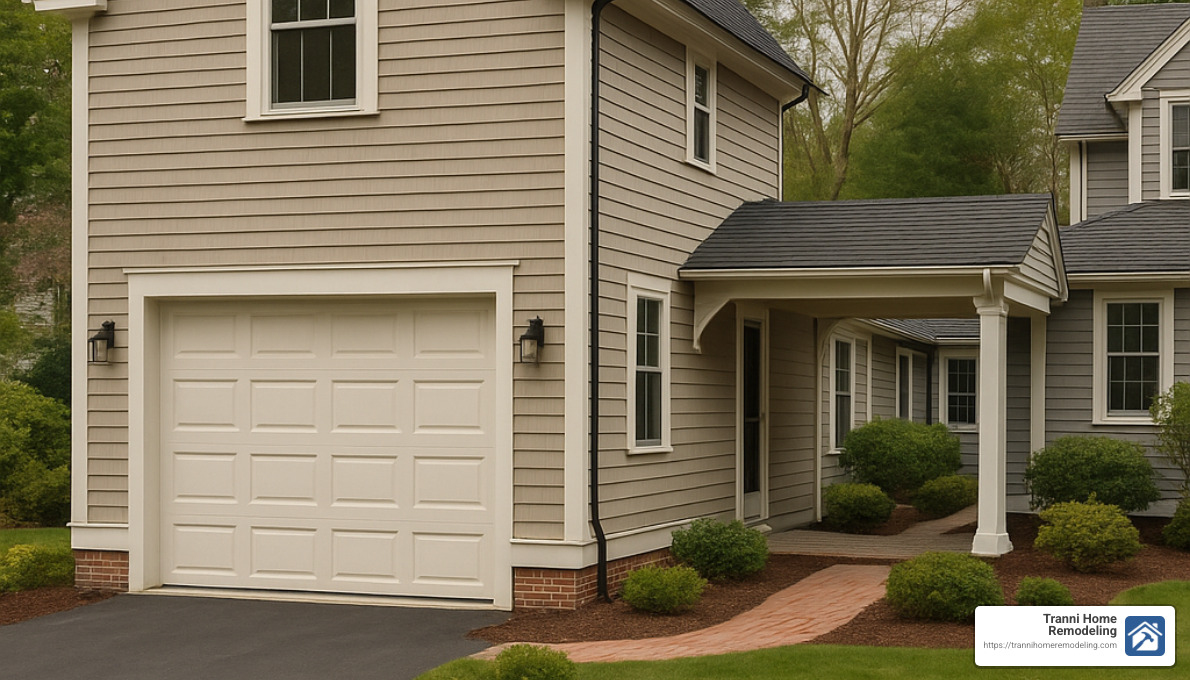
The versatility of a 2 story attached garage addition is perhaps its greatest strength. Whether you need a soundproof office for focused work, extra bedrooms for a growing family, or flexible space that can evolve with your needs over time, building up provides solutions while maintaining your property’s footprint and character.
Space Above the Garage: Popular Uses & Layouts
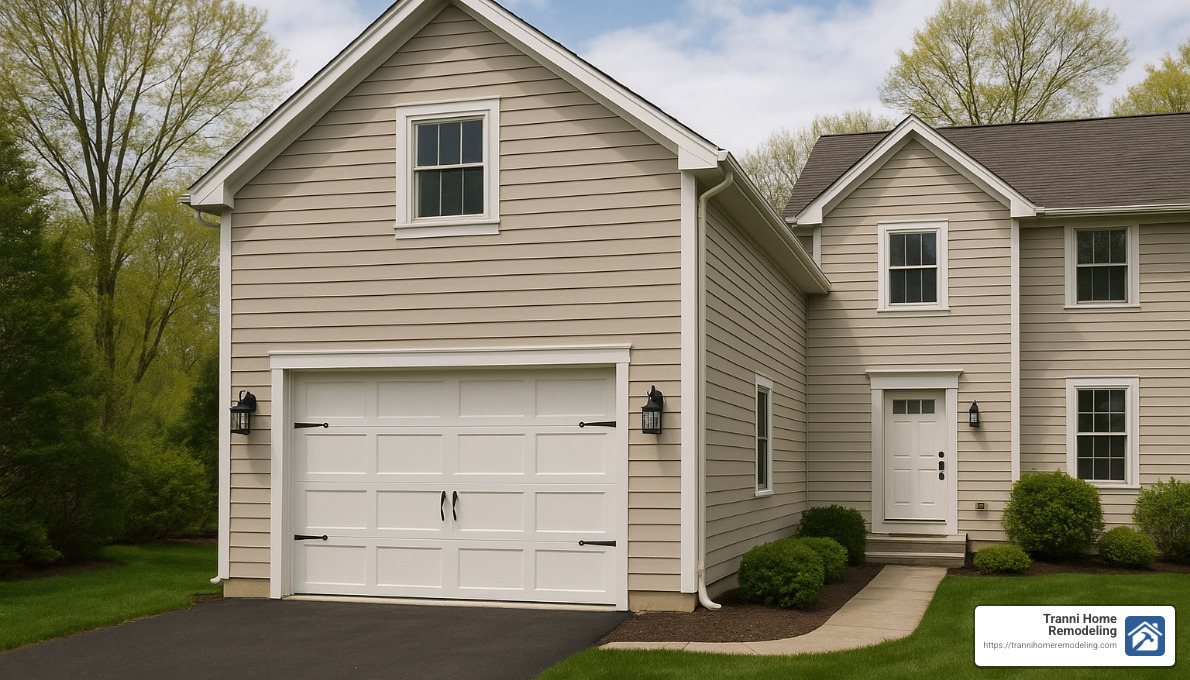
The beauty of a 2 story attached garage addition lies in its versatility. With approximately 440-500 square feet of new living space (based on a standard two-car garage footprint), homeowners have numerous options for utilizing this area.
Ever dreamed of having that perfect retreat away from the hustle and bustle of your main living space? Many homeowners create a luxurious primary suite above their garage, complete with an ensuite bathroom and walk-in closet. It’s like having your own private oasis just steps from the rest of your home.
Growing families often convert this bonus space into children’s bedrooms with a shared bathroom. I’ve seen many parents breathe a sigh of relief when siblings finally get their own rooms!
“Adding over a two-car garage yields roughly 440–500 sq ft—enough for two bedrooms and a bath or a primary suite and office,” explains a construction professional with experience in Massachusetts home additions.
The work-from-home revolution has made home offices one of the most popular uses for above-garage spaces. Imagine having a dedicated workspace where family distractions fade away and you can focus on your productivity. Many remote workers tell me this separation has been crucial for their work-life balance.
For those looking to generate income, designing an Accessory Dwelling Unit (ADU) with a separate entrance, kitchenette, and bathroom creates rental opportunities or perfect accommodations for in-laws or adult children. One Billerica homeowner told me, “The rental income from our above-garage apartment helps pay for the addition itself!”
Fitness enthusiasts love converting this space into a personal gym or yoga studio, complete with proper flooring and ventilation. No more monthly membership fees or waiting for equipment!
Some families create the ultimate entertainment room – a place for movie nights, gaming, or pursuing hobbies without taking over the main living areas. The natural sound separation from the rest of the house makes this especially appealing.
Don’t overlook practical options like a spacious laundry hub with storage. Moving these functions from your main living space can free up valuable square footage where you need it most.
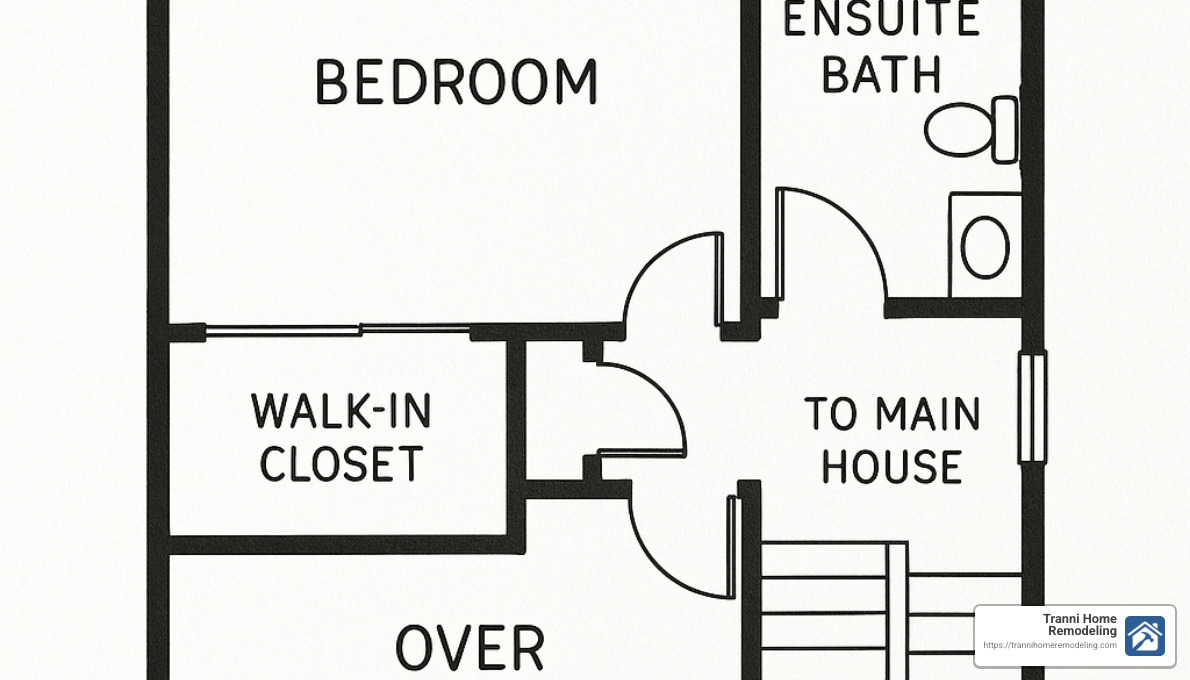
Aligning Floors in a 2 Story Attached Garage Addition
One of the most significant challenges in creating a 2 story attached garage addition is aligning the new floor with your existing second story. This alignment is crucial for both structural integrity and aesthetic cohesion.
“I prefer matching floor levels, so it does not feel or look like an addition,” notes a respected Massachusetts architect who specializes in residential additions.
The right floor alignment approach depends on your specific situation. Adjusting wall height creates perfect alignment but may require rebuilding garage walls completely. For minor height differences of just 1-3 inches, adding a wall plate offers a simple, cost-effective solution.
When moderate adjustments are needed, building up the subfloor preserves your existing structure while slightly reducing ceiling height. Homes with garage door height constraints often benefit from flush beam installation, which maintains headroom despite more complex framing.
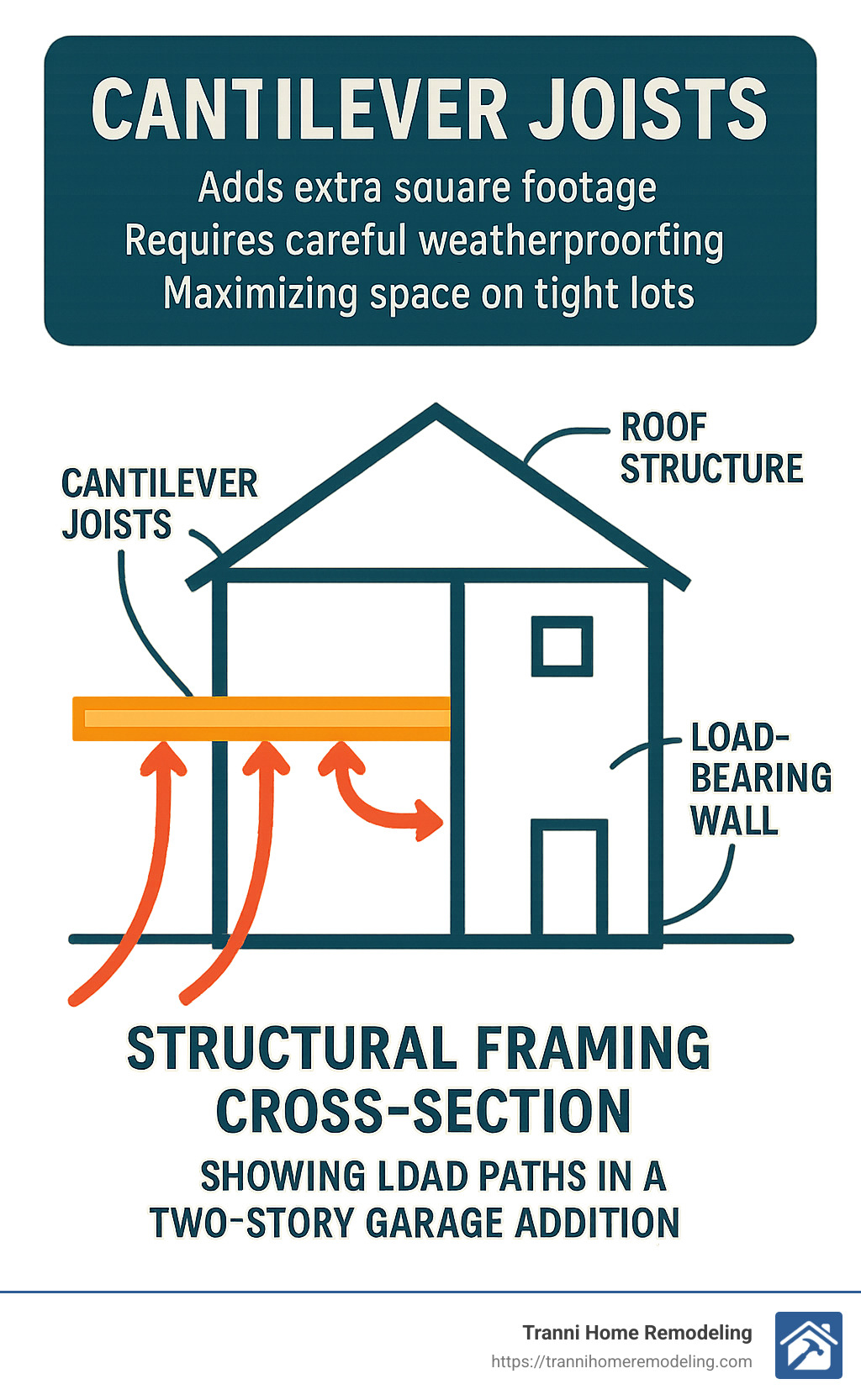
Budget-conscious homeowners might consider a mid-span beam approach, which allows the use of smaller joists, though the visible beam may affect your interior design. For those looking to maximize space on tight lots, cantilevered joists can add extra square footage, though they require careful weatherproofing.
Floor Alignment Methods Comparison
| Method | Pros | Cons | Best For |
|---|---|---|---|
| Adjust Wall Height | Creates perfect alignment | May require complete garage wall rebuild | New construction or full remodels |
| Add Wall Plate | Simple, cost-effective | Slight height difference possible | Minor adjustments (1-3 inches) |
| Build Up Subfloor | Preserves existing structure | Reduces ceiling height slightly | Moderate adjustments (3-5 inches) |
| Install Flush Beam | Maintains headroom | More complex framing | Garages with door height constraints |
| Mid-span Beam | Works with smaller joists | Visible beam may affect design | Budget-conscious projects |
| Cantilever Joists | Adds extra square footage | Requires careful weatherproofing | Maximizing space on tight lots |
Your staircase location is another critical consideration. Will it be inside your existing home, within the garage space, or exterior to the structure? Each option affects how you’ll connect and use your new space.
At Tranni Home Remodeling, we carefully assess all these factors to determine the optimal solution for each project, ensuring your new addition feels like it was always meant to be part of your home.
Design & Structural Essentials for a 2 Story Attached Garage Addition
Creating a safe, durable, and beautiful 2 story attached garage addition requires careful attention to structural details and design elements. This isn’t something you should tackle as a weekend project—professional engineering and construction expertise are absolutely essential for success and safety.
Critical Structural Components
When you’re looking at a typical two-car garage (usually 20′ to 24′ in each direction), you’re dealing with significant spans that need proper support for adding that second story. Here’s what you need to know about the structural backbone of your addition:
Your existing garage foundation might have been designed just to hold up a simple roof and walls—not a fully furnished living space with people, furniture, and plumbing. A structural engineer will need to assess whether reinforcement is necessary before adding all that extra weight.
Load-bearing walls do the heavy lifting in your addition, transferring the weight down to the foundation. These aren’t just any walls—they’re specifically designed and positioned to handle structural loads safely.
“Typical garage spans create long unsupported distances requiring special beam solutions,” explains a structural engineer who specializes in these projects. “Those existing ceiling joists in your garage? They were never meant to be floor joists for living space.”
You’ll need engineered floor systems with proper I-beams or specially designed floor joists to create a safe, stable floor above your garage. This is where many DIY projects go wrong—underestimating the structural requirements for livable space.
Fire safety is non-negotiable when building above a garage. Building codes require ⅝” Type X drywall on ceilings and ½” on walls to create proper fire separation between your garage and living space. This special drywall slows the spread of fire, giving you precious extra minutes in an emergency.
Finally, your roof structure needs careful design to integrate with your existing house while providing proper support and drainage. A poorly designed roof junction can lead to leaks and structural problems down the road.
Design Integration Essentials
Beyond just making your addition structurally sound, you want it to look like it belongs—like it was always part of your home’s original design. This aesthetic integration is crucial for maintaining curb appeal and property value.
Your new roofline should complement the existing roof in both pitch and style. A mismatched roof immediately signals “addition” to anyone looking at your home. Working with a skilled designer helps ensure the rooflines flow together naturally.
Exterior materials need careful selection to blend with your existing home. Even if your original siding is no longer available, a good contractor can help you find complementary materials that maintain visual harmony.
Strategic window placement serves multiple purposes—bringing in natural light, providing ventilation, and maintaining visual balance across your home’s exterior. Windows shouldn’t look randomly placed but should follow the rhythm and proportions of your existing windows.
Consider adding a breezeway connection between your home and garage to create an neat transition between spaces. This can transform a utilitarian garage into an integrated part of your home’s architecture.
A homeowner in Chelmsford shared this experience: “We were worried our addition would look ‘tacked on,’ but our designer suggested stepping back the second story slightly and matching our existing dormers. Now it looks like it was always part of our home’s design.”
HVAC Strategies for a Comfortable 2 Story Attached Garage Addition
Creating a comfortable living environment above a garage presents unique climate control challenges. The space over a garage is particularly vulnerable to temperature swings—it sits above an unheated area and typically has more exterior wall exposure than other rooms in your home.
Creating an Energy-Efficient Envelope
The foundation of comfort starts with proper insulation. You’ll want R-30 to R-38 floor insulation between the garage ceiling and new floor to prevent heat loss and block cold air from rising into your living space.
Spray foam insulation has become increasingly affordable and creates an air-tight seal with higher R-values per inch than traditional fiberglass. “Spray foam costs have declined significantly,” notes an industry expert. “It creates an energy-efficient envelope that dramatically improves comfort and reduces utility costs.”
Don’t forget the vapor barrier—essential for preventing moisture migration from the garage below. Without it, humidity can lead to mold, mildew, and deterioration of your new living space.
If you’re planning a home office or bedroom, consider sound attenuation insulation to minimize noise transfer from the garage. Nothing ruins a Zoom call faster than someone opening the garage door below you!
HVAC Solutions
Your existing home HVAC system might not effectively serve above-garage spaces. Here are your best options:
Mini-split heat pumps provide dedicated zone control without extensive ductwork. They’re energy-efficient and give you the flexibility to heat or cool just the addition when needed. This is often our recommended approach for Massachusetts homes, as they handle both heating and cooling needs in our variable climate.
If your current HVAC system has capacity to spare, you might consider extending your existing system with properly sized supply and return ducts. This works best when the addition is relatively small and your current system is newer.
For bathroom areas especially, radiant floor heating provides luxurious comfort underfoot and helps maintain consistent temperatures. There’s nothing quite like stepping onto a warm floor on a cold Massachusetts morning!
Plumbing & Electrical Considerations Above the Garage
Adding bathrooms, laundry facilities, or kitchenettes to your 2 story attached garage addition requires thoughtful planning of plumbing and electrical systems.
Plumbing Challenges and Solutions
The location of your existing plumbing infrastructure significantly impacts how complex and costly it will be to extend services to your addition.
Your drain tie-in location is particularly crucial. As one plumbing contractor cautions: “If the sewer tie-in is mid-house, dramatic demolition (drywall, framing, cabinetry) may be required. Otherwise, luckier homeowners face minimal disturbance.” This is something to investigate early in your planning process.
Vent stack routing needs careful planning to comply with code requirements. These pipes must properly vent sewer gases while maintaining the waterproof integrity of your roof.
Hot and cold water supply lines will need to be extended from your existing plumbing, potentially requiring access to existing walls. Planning this routing early can minimize disruption to your current living space.
If you’re adding laundry facilities, pay special attention to washer drains and dryer vents. Improper installation can lead to water damage or even fire hazards.
Electrical Requirements
Modern living spaces need robust electrical systems to support our technology-filled lives:
Start with an electrical service assessment to determine if your home’s panel can support additional circuits. Many older homes may need a service upgrade to safely power new living space.
Plan for dedicated circuits for bathrooms, laundry equipment, and kitchen appliances. These high-demand areas need their own circuits to prevent overloads and tripped breakers.
Develop a comprehensive lighting plan with appropriate ambient, task, and accent lighting. Good lighting transforms a space from merely functional to truly livable.
All electrical penetrations through fire-rated assemblies must be properly sealed to maintain fire safety.
Consider pre-wiring for technology needs like internet, entertainment systems, and home automation. As a Massachusetts electrical contractor advises: “Plan your electrical needs comprehensively before construction begins. Adding outlets or lighting fixtures after walls are closed is exponentially more expensive.”
Budget, Cost Drivers & ROI
When planning a 2 story attached garage addition, understanding the financial side is just as important as the design itself. Let’s break down what you can expect to invest and what you’ll get in return.
Investment Range and Value
Home additions aren’t small projects, and the costs reflect that reality. Based on construction industry averages (not Tranni Home Remodeling specific pricing):
A typical 2 story attached garage addition investment ranges from $200,000 to $650,000, depending on size, complexity, and finishes. On a per-square-foot basis, you’re looking at approximately $500-$650 for high-end finishes and quality construction.
“A simple fit and finish above a garage might start around $500-$525 per square foot,” explains a seasoned construction estimator, “but most homeowners should budget $600-$650 per square foot to account for the complications that inevitably arise during these projects.”
The good news? These additions typically recoup between 64-81% of their costs at resale, potentially adding $20,000 to $35,000 to your home’s market value. That’s a significant return on a space that dramatically improves your daily living experience.
Major Cost Drivers
What makes one addition cost more than another? Several key factors influence your bottom line:
Structural requirements often become the first major expense. Your existing garage may need foundation reinforcement or additional support to carry the weight of a second story. This foundational work isn’t glamorous, but it’s essential.
Exterior finishes play a huge role too. Matching your existing home’s materials—especially if you have custom stonework, specialized siding, or architectural details—can significantly impact costs.
The level of interior finishes you choose makes a substantial difference. Basic drywall, carpet, and simple fixtures cost far less than custom cabinetry, hardwood flooring, and designer lighting.
One element homeowners often underestimate is the staircase. A basic builder-grade staircase might cost a few thousand dollars, while an architectural statement piece with custom railings can easily run $15,000-$25,000.
Site access challenges can also drive up labor costs. If equipment and materials can’t easily reach your garage, expect to pay more for the additional labor required.
Smart homeowners include a 10-20% contingency in their budget. As one contractor put it, “In 25 years of building, I’ve never seen a renovation project without at least one surprise hiding in the walls.”
Financing Options
Few homeowners can write a check for a six-figure addition. Fortunately, several financing options can help make your project possible:
A cash-out refinance replaces your current mortgage with a larger one, giving you the difference in cash. This option often offers the lowest interest rates but requires a complete mortgage refinance.
A Home Equity Line of Credit (HELOC) provides flexible borrowing against your home’s equity, allowing you to draw funds as needed during construction and only pay interest on what you use.
Renovation loans like the FHA 203(k) or Fannie Mae HomeStyle loans are specifically designed for major improvements, allowing you to finance both the purchase/refinance and renovation costs in a single loan.
Construction loans provide short-term financing during the building phase, typically converting to a permanent mortgage upon completion.
For more information about financing and planning your addition, visit our Home Addition Contractor page.
Cost Breakdown for a 2 Story Attached Garage Addition
Understanding how your budget gets allocated helps you make informed decisions about where to splurge and where to save:
| Category | Percentage of Total Cost | What It Includes |
|---|---|---|
| Permits & Fees | 2-5% | Building permits, inspections, impact fees |
| Design & Engineering | 8-12% | Architectural plans, structural engineering, interior design |
| Demolition & Site Prep | 5-8% | Removing existing roof, preparing structure |
| Foundation & Framing | 20-25% | Structural reinforcement, new framing, sheathing |
| Roofing & Exterior | 12-15% | Roofing materials, siding, windows, doors |
| Mechanical Systems | 15-20% | HVAC, plumbing, electrical |
| Insulation & Drywall | 8-10% | Thermal and acoustic insulation, fire-rated drywall |
| Finishes | 15-25% | Flooring, paint, trim, cabinetry, fixtures |
| Overhead & Profit | 10-15% | Contractor management, insurance, profit |
A Massachusetts project manager with decades of experience shared this wisdom: “I’ve watched countless homeowners fixate on saving money on framing or mechanical systems, only to blow their budget on finishes. Structural elements are largely invisible once the project is complete, while the finishes you choose are what you’ll see and touch every day.”
The most successful 2 story attached garage addition projects balance solid construction fundamentals with thoughtful design and finishes that match your lifestyle. It’s not just about adding space—it’s about creating space that improves your daily life and adds lasting value to your home.
Permits, Pros & Common Questions
Navigating the permitting process might seem daunting, but it’s a crucial step in your 2 story attached garage addition journey. While each town in Massachusetts has its own specific requirements, all share the common goal of ensuring your new space is safe and properly built.
Permitting Process Overview
Your local building department isn’t trying to complicate your life—they’re actually there to help ensure your family’s safety. When you submit your application, you’ll typically need detailed plans showing everything from zoning compliance to structural details.
“I always tell homeowners to think of building inspectors as allies, not adversaries,” explains a Middlesex County building inspector. “We’re here to make sure your investment is safe and built to last, not to create unnecessary problems.”
Most municipalities will review your plans for height restrictions, side-yard setbacks, fire-code egress requirements, and energy-code compliance. This review process typically takes 2-6 weeks, depending on your town’s workload and the complexity of your project.
Once approved, you’ll undergo several inspections throughout construction—from foundation work to the final walkthrough. Each inspection represents a quality checkpoint to ensure everything is progressing according to code.
Timeline Expectations
Be realistic about your timeline—a 2 story attached garage addition isn’t a weekend project. Here’s what most homeowners can expect:
Planning and design typically takes 1-2 months as you work with professionals to create your perfect space. After plans are finalized, permitting adds another 2-6 weeks to the timeline. The actual construction phase usually spans 4-6 months, bringing the total project duration to approximately 6-9 months from concept to completion.
Here’s an interesting tidbit: according to a national survey by Gladiator GarageWorks, almost 1 in 4 Americans say their garage is too cluttered to fit their car! This statistic highlights just how valuable that extra organized space above your garage could be for your family.
Want to learn more about the entire home addition process? Visit our Home Additions page for a comprehensive overview.
Who Should You Hire for a Two-Story Garage Project?
Creating your dream space requires assembling the right team. Your 2 story attached garage addition will benefit from these key professionals:
A licensed architect will design a space that’s not only beautiful but functional and code-compliant. Working alongside them, a structural engineer will ensure your addition has proper support—calculating loads and designing appropriate structural systems.
Many homeowners find that working with a design-build firm simplifies the process by providing end-to-end service from concept through construction. You’ll also need specialized professionals for mechanical systems—HVAC pros for comfortable temperatures, licensed plumbers for water systems, and electrical contractors for safe, modern wiring.
“After interviewing three contractors, we chose the one we trusted most—not the cheapest,” shares a recent Billerica homeowner. “That decision paid dividends throughout our project. The peace of mind was worth every penny.”
At Tranni Home Remodeling, we coordinate all these professionals for a seamless experience. Learn more about our approach on our Best Home Addition Company page.
Frequently Asked Questions about 2 Story Attached Garage Additions
FAQ #1: How long does construction usually take?
The construction phase typically spans 4-6 months, though this varies based on project complexity, weather conditions (especially important in New England!), and material availability. The entire process—including planning, design, and permitting—usually takes 6-9 months from start to finish.
“Living through our garage addition wasn’t always easy,” admits a Chelmsford homeowner, “but having regular updates from our contractor made a huge difference. Just knowing what to expect each week helped us manage our daily lives around the construction.”
FAQ #2: Will my existing slab and footings support a second story?
This is a question that requires professional evaluation of your specific garage. Most single-story garages weren’t built with the intention of supporting living space above. Your existing foundation, footings, and walls need assessment by a structural engineer to determine if reinforcement is necessary.
“In Massachusetts, we have to account for frost heave,” explains a structural engineer with decades of local experience. “A typical garage slab that works fine for parking cars simply isn’t designed to support a second floor with people living in it. In most cases, we need to add footings similar to what’s under the main house.”
This is definitely not an area to cut corners—proper structural support is essential for both safety and long-term performance.
FAQ #3: Is an attached or detached two-story garage better for resale?
While both options add value, attached garages typically offer better return on investment for several practical reasons. The direct, weather-protected access to your home is a significant convenience, especially during those snowy Massachusetts winters. The integrated design creates a seamless flow between spaces, and shared walls help reduce energy costs.
“I use my attached garage every single day,” shares a homeowner who previously had a detached structure. “The convenience factor can’t be overstated—especially when you’re carrying groceries in a rainstorm!”
There are situations where detached garages make more sense—historic homes where preserving architectural integrity is paramount, properties with specific zoning restrictions, or when you need complete noise separation for a workshop or music studio. However, for most homeowners looking to maximize both usability and resale value, an attached design is usually the better investment.
Seamless Integration & Curb Appeal Tips
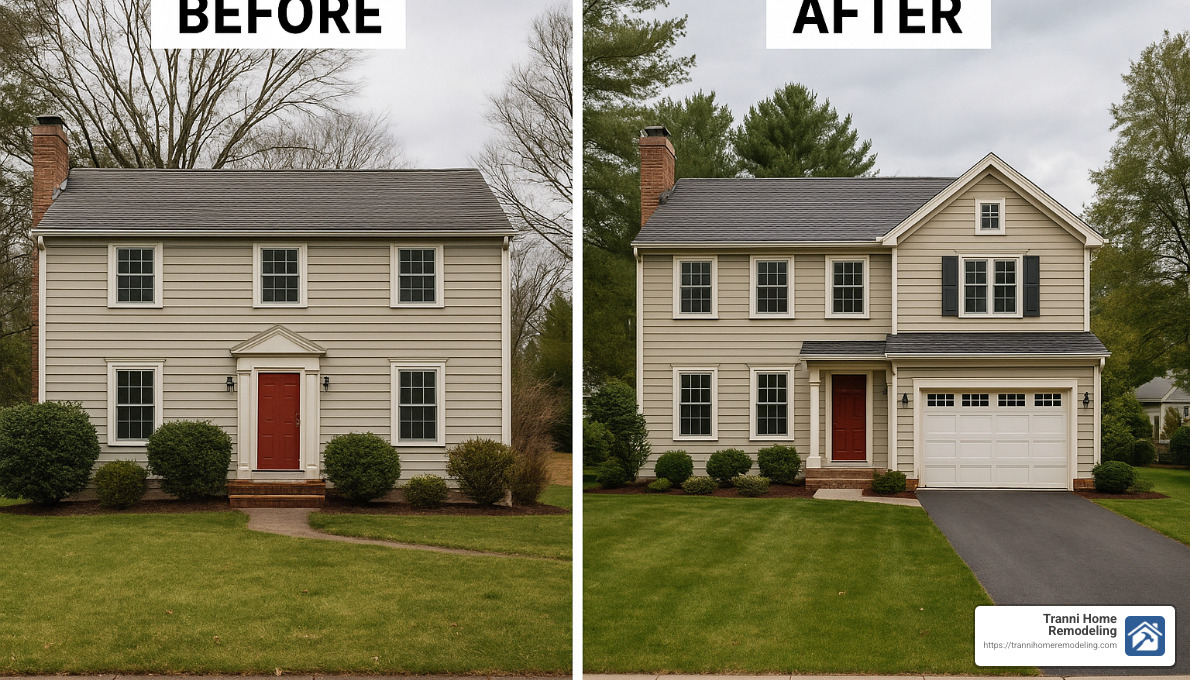
Creating a 2 story attached garage addition that looks like it was always part of your home requires thoughtful design and attention to detail. When done right, your addition should improve your home’s appearance rather than looking like an afterthought.
Design Strategies for Visual Harmony
The secret to a beautiful garage addition lies in respecting your home’s existing architectural language. Step-back massing can work wonders by setting the garage addition slightly back from the main facade, which preserves your home’s original presence and creates visual interest.
Matching your roof pitch is another essential element that many homeowners overlook. When your new roofline mirrors the slope of your existing roof, it creates a natural visual flow that makes the addition feel intentional.
“Whatever you do, don’t plunk a box on top of your garage,” a Massachusetts architectural designer told me recently. “The addition should respect and improve your home’s original character, not fight against it.”
Consider adding dormers and gables that echo features on your main house. These architectural elements not only create character but also increase usable space inside while maintaining proportional balance outside.
Many of our clients in Billerica and surrounding towns have found that a small breezeway connection between the main house and garage creates an neat transition. Whether open-air or enclosed with glass, these connectors soften what might otherwise be an abrupt junction.
Window consistency plays a huge role in visual harmony. Select windows for your addition with similar style, proportion, and placement as those in your existing home. Even if the windows aren’t identical, maintaining consistent proportions creates a cohesive look.
Material Selection for Cohesive Appearance
Matching materials exactly can be challenging, especially with older homes where original products may be discontinued. Don’t panic! There are several approaches that create beautiful results:
If exact matches aren’t available, choose complementary siding in coordinating colors. Sometimes, a slight variation actually looks more intentional than a near-match that’s just slightly off.
Accent materials like stone, brick, or decorative trim can create intentional contrast that looks designed rather than mismatched. This strategy often turns a potential problem into a design feature.
Don’t underestimate the impact of upgraded garage doors with architectural details that improve your home’s overall style. As one of the largest visual elements of your addition, quality doors with thoughtful details make a significant difference.
Thoughtful lighting placement highlights architectural features while improving safety and usability. Well-chosen fixtures that complement your home’s style provide both function and beauty.
A homeowner in Burlington shared her experience: “We couldn’t match our 1960s brick exactly, so we used the original brick on the first floor and complementary siding above. The transition looks intentional and actually gives the addition more character than if we’d tried to force an exact match.”
Landscaping Integration
Landscaping is the finishing touch that ties your addition to the existing property. Even the most beautifully designed addition can look disconnected without proper landscaping to ground it.
Plant foundation shrubs around the new structure to soften harsh lines and create visual continuity. Creating unified pathways between your home and garage improves both functionality and appearance. Consider how views from new windows will look—both what you’ll see from inside and how the windows will appear from your yard or street.
Using similar landscape elements throughout your property creates a cohesive outdoor space that makes your addition feel like it was always there. Something as simple as extending existing garden beds or repeating plant varieties can make a remarkable difference.
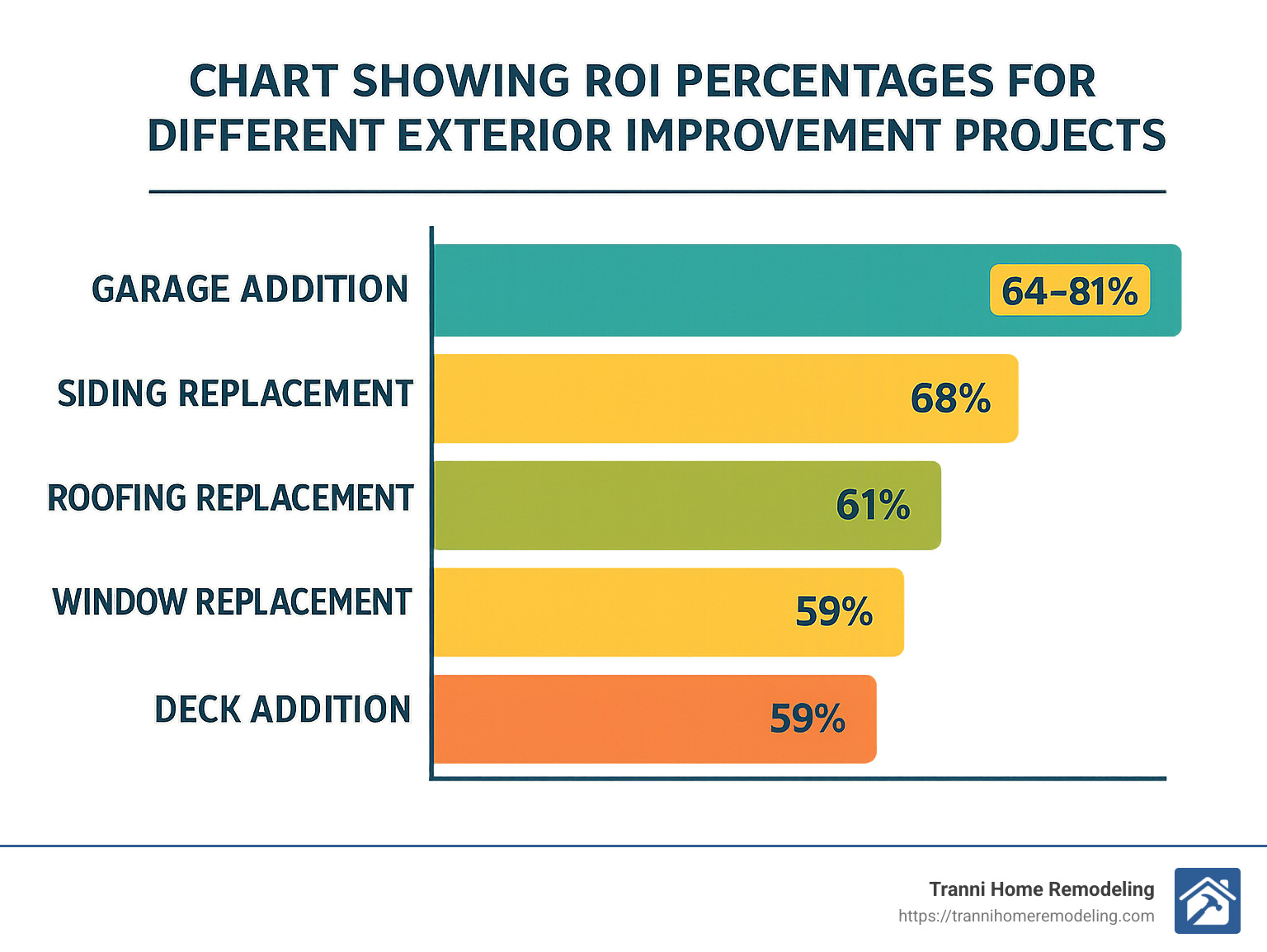
The effort you put into seamless integration pays off in both enjoyment and investment return. As the ROI chart shows, garage additions that improve curb appeal can recoup 64-81% of their cost at resale. More importantly, a thoughtfully integrated addition improves your daily experience of your home, creating spaces that feel natural, welcoming, and designed with purpose.
Conclusion
A 2 story attached garage addition transforms your home in ways that few other renovations can match. By building upward instead of outward, you’re making a smart investment that preserves your outdoor living space while creating 440-500 square feet of versatile new indoor space. Whether you envision a tranquil primary suite retreat, a productive home office away from household distractions, a potential income-generating rental unit, or simply a flexible space that grows with your family’s needs—the possibilities are truly exciting.
The journey to creating this valuable addition requires thoughtful planning and professional execution. From initial concept to final touches, every decision impacts both the functionality and aesthetic appeal of your finished space. While the process might seem daunting, the results can completely transform how you experience your home.
Many homeowners tell us their garage addition became their favorite part of their home—a space that feels both connected to and separate from the main living areas, offering just the right balance of integration and privacy. That perfect balance doesn’t happen by accident; it comes from careful design and skilled craftsmanship.
Based on internet averages (not Tranni Home Remodeling prices), homeowners typically invest between $200,000 and $650,000 for a quality two-story garage addition. While this represents a significant commitment, the return on investment typically ranges from 64-81% of project costs, making it one of the more financially sound home improvements you can make. Beyond the numbers, though, is the daily value of having space that truly works for your lifestyle.
At Tranni Home Remodeling, we’ve helped countless Middlesex County homeowners create beautiful, functional garage additions that look like they’ve always been part of the original home. Our team brings years of experience in navigating the unique challenges these projects present—from structural engineering considerations to seamless exterior integration to interior design that maximizes the new space’s potential.
We understand that your home is more than just a building—it’s where your life happens. A 2 story attached garage addition should improve that life, not complicate it. That’s why we handle every aspect of your project with care, from initial design through final walkthrough.
Ready to explore how a 2 story attached garage addition could transform your property and lifestyle? We’d love to help you bring your vision to life. Our team is ready to guide you through the design, permitting, and construction process with the craftsmanship and service that have made us a trusted name in home remodeling.
For more information about our approach to home additions, visit our home additions page or contact us today to schedule a consultation.