





What Does Mini Split AC Installation Cost Near Me in 2026?
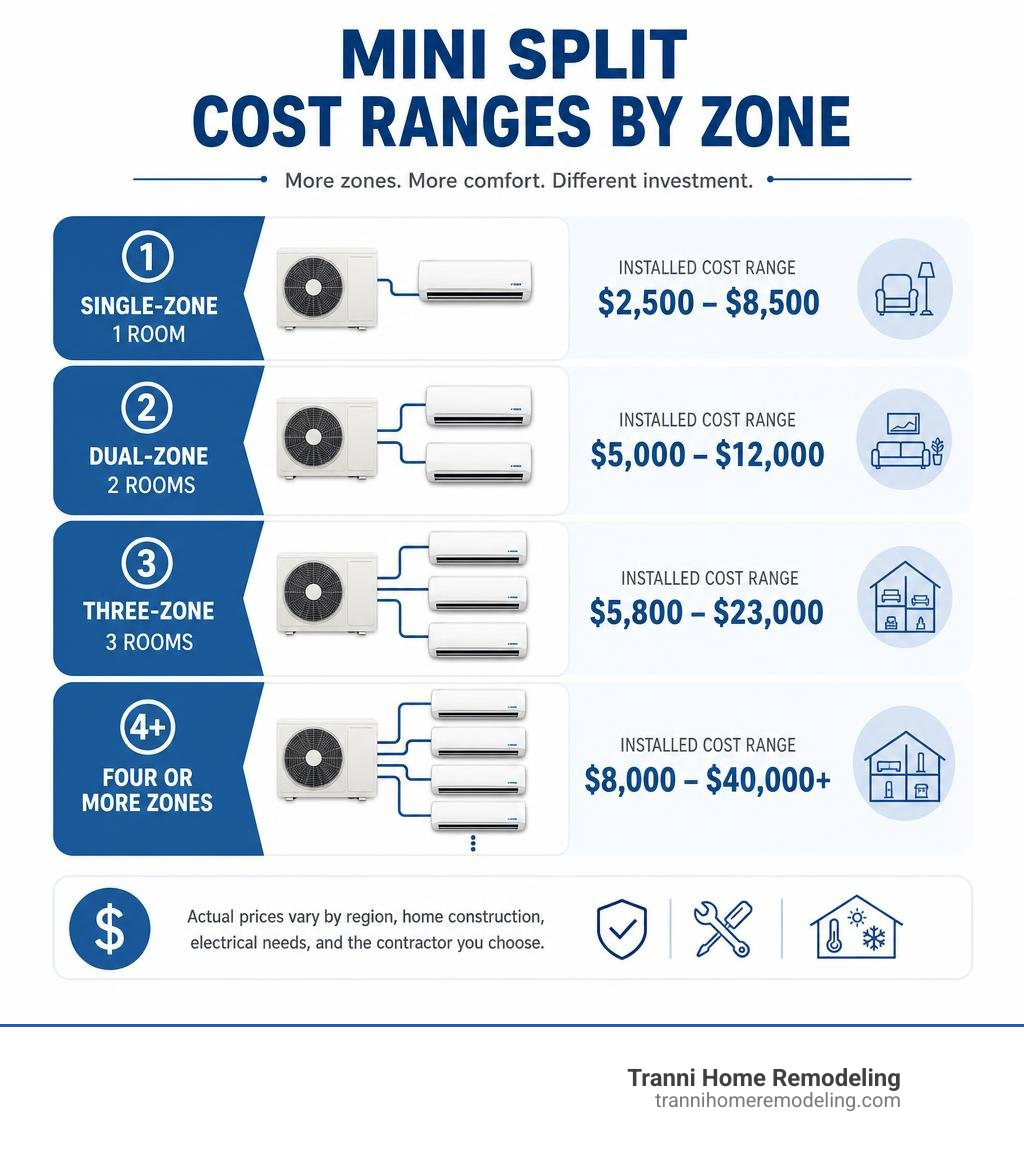
If you’re researching mini split ac installation cost near me, here’s a quick answer based on average internet pricing data:
| System Type | Average Installed Cost (National Estimates) |
|---|---|
| Single-zone (1 room) | $2,500 – $8,500 |
| Dual-zone (2 rooms) | $5,000 – $12,000 |
| Three-zone (3 rooms) | $5,800 – $23,000 |
| Four or more zones | $8,000 – $40,000+ |
Note: These are average cost ranges based on national internet data. Actual prices vary by region, home construction, electrical needs, and the contractor you choose. They do not represent specific pricing from Tranni Home Remodeling.
Thinking about adding a mini split to your home? You’re not alone. More homeowners are turning to ductless systems to cool and heat individual rooms — without the hassle of ductwork. But when the quotes start arriving, the numbers can feel all over the map. A single-zone system might cost $3,000. A whole-home multi-zone setup could run $15,000 or more. That’s a wide range — and it’s completely normal, because a lot of variables are in play.
This guide breaks down exactly what drives those costs, what to watch out for, and how to make a smart decision for your home.
I’m Tyler Tranni, owner of Tranni Home Remodeling in Billerica, MA, and I’ve helped many Massachusetts homeowners navigate the real mini split ac installation cost near me question — not just the sticker price, but everything that affects the final number. Let’s walk through it together.
Related content about mini split ac installation cost near me:
What is the Mini Split AC Installation Cost Near Me?
When homeowners in Billerica, Burlington, or Wilmington search for the average mini split ac installation cost near me, they often find conflicting numbers. Based on broad internet pricing data, the typical cost to install a ductless mini split system ranges from $2,500 to $15,000 or more.
However, to truly understand the market, we must look at a much wider range of possibilities. Depending on the complexity of the project, the brand of equipment, and your home’s existing infrastructure, a real-world project can range from $2,000 to over $45,000 for high-end, multi-zone residential HVAC setups. This high-end figure is at least three times the average cost of a standard installation, reflecting how quickly costs can scale when you add multiple indoor zones, premium equipment, and complex electrical routing.
To help you visualize where your budget might fall, we have compiled a cost breakdown based on standard industry averages. These figures are based on national internet data and do not reflect the actual project costs or specific pricing structures of Tranni Home Remodeling.
For a deeper dive into how these budgets are structured, check out our More info about mini split pricing.
| Number of Zones | Average Internet Cost | High-End / Complex Cost Range |
|---|---|---|
| 1 Zone (Single Room) | $3,000 | $2,000 – $9,000+ |
| 2 Zones (Dual Room) | $7,000 | $5,000 – $21,000+ |
| 3 Zones (Multi-Room) | $9,500 | $5,800 – $28,500+ |
| 4+ Zones (Whole Home) | $15,000 | $8,000 – $45,000+ |
Average Mini Split AC Installation Cost Near Me by Zone
The number of zones—meaning the number of indoor blower units connected to a single outdoor condenser—is the single largest driver of your total project cost.
- Single-Zone Systems: If you are looking to heat or cool a single home addition, a finished basement, or a master bedroom, a single-zone system is your most cost-effective path. According to general internet data, these installations typically average around $3,000, but complex line runs can push prices higher. For more on single-room setups, read our guide on Ductless installation details.
- Dual-Zone Systems: Perfect for split-level homes or adjacent living spaces, a dual-zone setup utilizes one outdoor compressor to power two indoor heads. Internet pricing averages hover around $7,000, but can easily scale past $21,000 for premium brands or difficult installations.
- Multi-Zone Systems (3 to 8 Zones): If you want a complete ductless solution for a larger home, you will need a multi-zone system. These systems require larger outdoor condensers with higher capacity and complex refrigerant line routing. While average internet estimates sit around $9,500 to $15,000, a comprehensive whole-home setup can easily reach $40,000 to $45,000.
For a realistic look at how these numbers translate into actual project invoices, you can view this external Ductless cost analysis.
Sizing and Capacity: Mini Split AC Installation Cost Near Me by BTU
An under-sized mini split will run constantly, driving up your electric bills while failing to keep you comfortable. An over-sized system will short-cycle, turning on and off rapidly, which ruins the system’s ability to dehumidify the air and wears out the compressor prematurely.
System capacity is measured in BTUs (British Thermal Units) or tons (one ton of cooling equals 12,000 BTUs). Here is how average internet pricing scales by system size:
- 0.75 Ton (9,000 BTU): Best for small bedrooms or home offices up to 450 sq ft. Average internet equipment-only cost: ~$1,805.
- 1.0 Ton (12,000 BTU): Ideal for spaces up to 550–600 sq ft. Average internet equipment-only cost: ~$2,035.
- 1.5 Ton (18,000 BTU): Great for mid-sized living rooms or open-concept spaces up to 1,000 sq ft. Average internet equipment-only cost: ~$2,910.
- 2.0 Ton (24,000 BTU): Designed for large master suites or family rooms up to 1,200 sq ft. Average internet equipment-only cost: ~$3,330.
- 3.0 Ton (36,000 BTU): Built for substantial multi-room areas or open floor plans up to 2,000 sq ft. Average internet equipment-only cost: ~$4,435.
To see how these sizing requirements affect the physical placement and mounting of the equipment, take a look at our guide on Ductless unit setup.
Key Factors That Influence Ductless HVAC Pricing

When you look at the physical equipment online, the prices seem incredibly reasonable. You might see a highly rated single-zone system for $1,200 and wonder why your professional installation quotes are significantly higher. The truth is, the equipment is only one piece of the puzzle. The physical layout of your home, the age of your electrical system, and the complexity of the labor involved dictate the final cost.
Here are the primary factors that influence your overall investment:
- Line Set Distance and Elevation: The refrigerant lines and control wires must travel from each indoor unit to the outdoor condenser. If an indoor unit is on the second or third floor of a home, the “line-set run” is much longer and more difficult to route cleanly. Extra line-set length typically adds $15 to $30 per foot in materials and labor.
- Home Construction Type: Drilling a three-inch hole through a standard wood-framed wall is relatively straightforward. However, if your home features historic brick, stone, or masonry, the installer must perform specialized diamond-core drilling. This added complexity can easily add $500 to $1,500 to the project.
- Indoor Unit Type: Wall-mounted units are the most popular and affordable option. However, if you prefer a flush-mount look, you might opt for ceiling cassettes (which cost around $3,000 per unit before labor) or floor-mounted consoles ($1,300 to $4,000+).
System Efficiency and SEER2 Ratings
Mini split efficiency is measured by its SEER2 (Seasonal Energy Efficiency Ratio 2) and HSPF2 (Heating Seasonal Performance Factor 2) ratings. Higher ratings mean the system uses less electricity to keep your home comfortable.
While standard systems with SEER2 ratings of 16 to 18 are highly efficient, premium systems can reach ratings of 25 to 30 SEER2. These ultra-efficient units cost more upfront, but they dramatically reduce your monthly utility bills.
For Massachusetts homeowners, choosing a cold-climate heat pump is particularly important. Standard heat pumps lose efficiency when the temperature drops below freezing. Cold-climate models, however, are engineered to provide efficient, reliable heat even when outdoor temperatures plunge to -13°F. While these specialized systems cost $1,000 to $2,000 more upfront, they are highly recommended for our New England winters. For more information on how municipal programs view these technologies, you can explore the Concord MA heat pump resources.
Labor, Electrical Upgrades, and Permitting
A successful mini split installation requires highly specialized trade skills. It is not just about mounting a plastic box to the wall; it requires licensed electrical work and precise refrigeration techniques.
- Labor Costs: Based on broad internet data, labor rates for licensed HVAC technicians typically range from $18.93 to $35.23 per hour, though highly competitive local markets in Middlesex County often see higher rates for certified master technicians. A standard single-zone installation takes 5 to 10 hours, while multi-zone systems can take several days.
- Electrical Upgrades: Mini splits require a dedicated 240V circuit run directly from your main electrical panel to the outdoor condenser. If your home’s electrical panel is already at maximum capacity, you may need a panel upgrade. An electrical service or panel upgrade typically costs between $500 and $2,000.
- Permits: Local building and electrical permits are required for residential HVAC installations in Massachusetts. Permit costs generally range from $250 to $400 depending on your specific town’s regulations.
For a complete breakdown of the step-by-step physical installation process, check out our Complete installation guide.
Comparing Mini Splits to Central Air and Other HVAC Options
If your home does not have existing ductwork, choosing between central air conditioning and a ductless mini split system is a major financial decision.
Installing a traditional central AC system in a home without ducts requires cutting open walls, sacrificing closet space, and building bulkheads to house massive metal duct runs. The cost of retrofitting ductwork throughout a two-story home can easily run $10,000 to $20,000 on top of the cost of the central AC unit itself. In this scenario, a multi-zone ductless mini split is almost always more cost-effective and far less invasive.
However, if your home already has a functional ducted heating system (such as a forced hot air furnace), installing a central AC condenser can sometimes be cheaper upfront than installing a multi-zone mini split system.
Here is a quick comparison of how these residential HVAC services stack up:
- Zoning Flexibility: Central AC is an “all-or-nothing” system. If you want to cool your upstairs bedroom, you have to cool the entire house. Mini splits offer true zoned comfort, allowing you to turn off units in unoccupied rooms, saving up to 30% to 40% on your monthly energy bills.
- Aesthetics: Some homeowners dislike the visual presence of wall-mounted mini split heads. Central AC utilizes discrete, flush-mounted ceiling registers. If aesthetics are your primary concern, concealed ducted mini splits or ceiling cassettes offer a middle ground, though they come with higher installation costs.
- Air Quality: Traditional ductwork can accumulate dust, pollen, and pet dander over time, circulating these allergens throughout your home. Ductless systems utilize multi-stage filtration systems in each individual indoor unit, which are incredibly easy to slide out and clean.
Frequently Asked Questions About Ductless AC Systems
Navigating residential HVAC can feel overwhelming. Here are some of the most common questions we hear from homeowners in Billerica and surrounding Middlesex County towns.
How long does a typical mini split installation take?
For a straightforward, single-zone system, a professional team can typically complete the installation in 4 to 8 hours (often within a single morning or afternoon).
Multi-zone systems are much more complex. Running multiple lines through walls, routing drain lines, and mounting several indoor units requires careful planning. A typical 3-to-4-zone system usually takes 1 to 3 days to complete, depending on the layout and construction of your home.
Are there rebates or tax credits available for ductless systems?
Yes! Because ductless mini splits are incredibly energy-efficient, there are substantial financial incentives available to help offset your installation costs.
- Federal Tax Credits: Under the Inflation Reduction Act, homeowners can qualify for a federal tax credit of up to 30% of the total cost of a qualifying heat pump installation, up to a maximum of $2,000.
- Mass Save Rebates: For our local clients in Massachusetts, the Mass Save program offers some of the most aggressive energy-efficiency rebates in the country. Depending on your current heating source and the efficiency of the system you install, you could qualify for thousands of dollars in whole-home heat pump rebates or partial-home rebates.
Can I install a mini split system myself to save money?
While there are “DIY-friendly” mini split kits available online, we strongly advise against attempting a self-installation.
First, handling refrigerant requires specialized EPA certification. If you release refrigerant into the atmosphere, you are violating federal law. Second, improper installation can easily void the manufacturer’s warranty. If a connection leaks six months down the road, the manufacturer will not cover the cost of replacement parts if the system wasn’t installed by a licensed professional. Finally, a professional installer ensures the system is correctly sized, vacuum-tested for leaks, and electrically safe, protecting your home and your investment for the long haul.
Conclusion
Investing in a ductless mini split system is one of the smartest upgrades you can make for your home’s comfort and energy efficiency. Whether you are looking to cool a newly finished basement, add comfort to a home addition, or transition your entire home away from outdated heating systems, understanding the factors behind the mini split ac installation cost near me helps you budget with confidence.
At Tranni Home Remodeling, based in Billerica, MA, we bring over a decade of high-quality craftsmanship and outstanding service to home renovations throughout Middlesex County. While we specialize in transforming homes through additions, kitchen and bathroom remodeling, and finished carpentry, we understand that a comfortable home requires a seamless blend of beautiful spaces and reliable climate control.
If you are planning a renovation or looking to upgrade your home’s comfort, we are here to help design a space that fits your lifestyle perfectly. Ready to take the next step? Schedule residential HVAC services or reach out to us today to discuss your next home improvement project!
