





Why Choosing the Right Kitchen Remodel Contractor Makes or Breaks Your Project
Knowing how to choose a contractor for a kitchen remodel is one of the most important decisions you’ll make as a homeowner. Get it right, and your renovation runs smoothly, stays on budget, and transforms your space. Get it wrong, and you’re looking at delays, cost overruns, and serious stress.
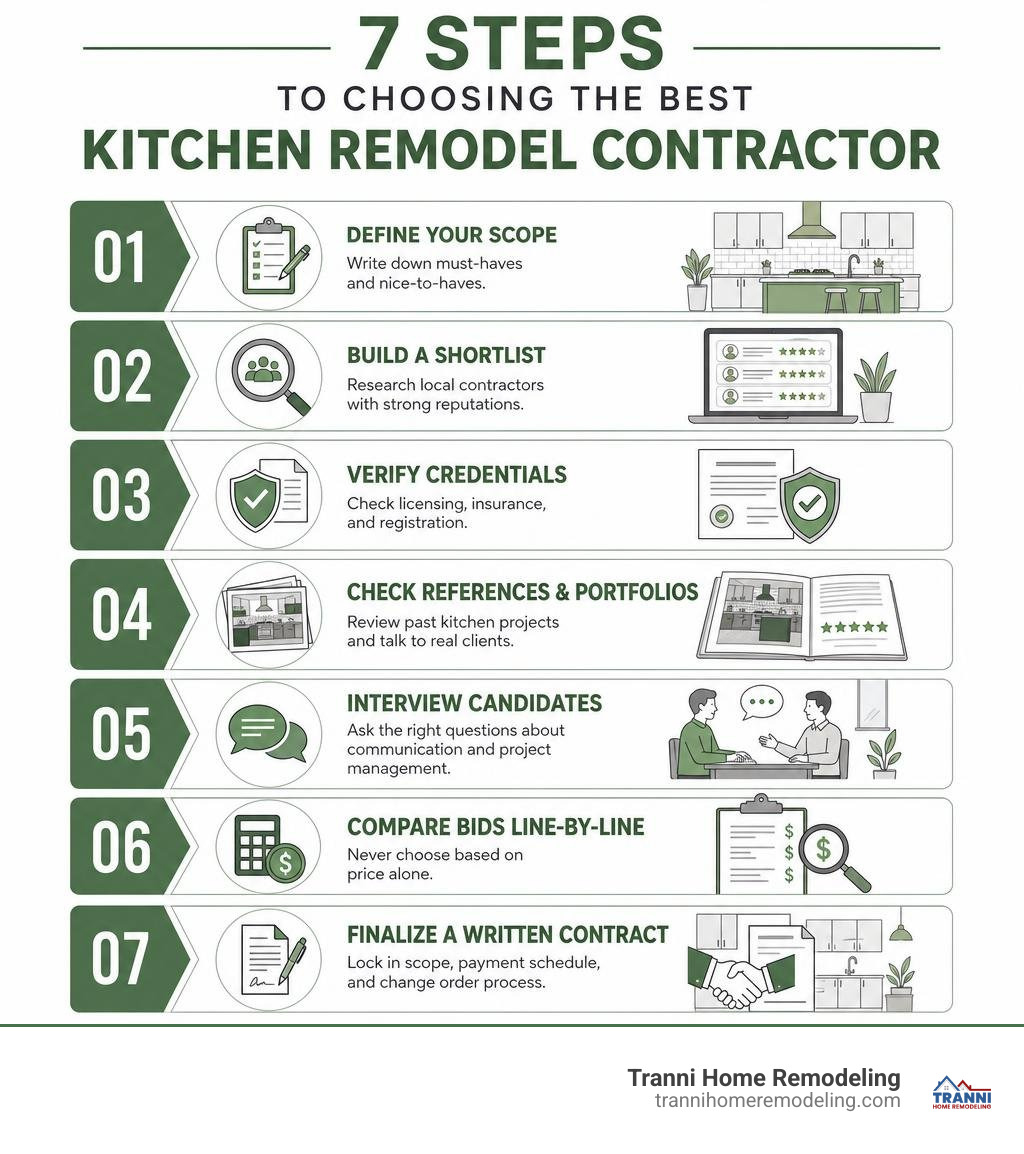
Here’s a quick overview of the 7 steps to choose the right contractor:
- Define your scope — Write down must-haves and nice-to-haves before calling anyone
- Build a shortlist — Research local contractors with strong reputations in your area
- Verify credentials — Check licensing, insurance, and registration
- Check references and portfolios — Review past kitchen projects and talk to real clients
- Interview candidates — Ask the right questions about communication and project management
- Compare bids line-by-line — Never choose based on price alone
- Finalize a written contract — Lock in scope, payment schedule, and change order process
The stakes are real. Research shows homeowners who follow a structured vetting process report 73% higher satisfaction with their finished kitchen compared to those who hire based on price alone. And with the average kitchen project generating $3,500–$7,000 in change orders, a little preparation upfront saves a lot of headaches later.
I’m Tyler Tranni, owner of Tranni Home Remodeling in Billerica, MA, and I’ve spent years helping homeowners across Middlesex County navigate exactly how to choose a contractor for a kitchen remodel without second-guessing every decision. In this guide, I’ll walk you through every step so you can hire with confidence.
Similar topics to how to choose a contractor for kitchen remodel:
- how much does a contractor charge for a kitchen remodel
- how to budget with contractors on kitchen remodel
- why hire a contractor to remodel your kitchen
How to Choose a Contractor for Kitchen Remodel: The 7-Step Framework
Vetting a contractor isn’t just about finding someone who can swing a hammer. It’s about finding a professional partner who will respect your home, manage your budget, and deliver flawless craftsmanship.
To help you navigate this journey, we have designed a comprehensive 7-step vetting process. By following this structured framework, you can filter out the unreliable operators and pinpoint the true craftsmen in your area. Let’s walk through how to execute this vetting process step-by-step.

For a deeper dive into the logistics of hiring, check out our guide on How to Hire a Contractor for Kitchen Remodel.
Step 1: Define Your Scope Before Learning How to Choose a Contractor for Kitchen Remodel
Before you pick up the phone to call a single remodeler, you need to have a clear idea of what you actually want to achieve. If you approach contractors with a vague idea like, “I want to update my kitchen,” you will receive wildly different bids that are impossible to compare fairly.
Start by creating a comprehensive design brief. This doesn’t need to be a professional blueprint, but it should clearly outline:
- The Layout: Are you keeping your existing footprint (a “pull-and-replace” remodel), or are you knocking down walls to create an open-concept space?
- Must-Haves vs. Nice-to-Haves: Make two distinct lists. Your must-haves might include custom cabinetry, a double wall oven, or a central island. Your nice-to-haves might be high-end quartz countertops or a built-in wine cooler.
- Infrastructure Needs: Do you plan to relocate the sink or gas range? Moving plumbing and gas lines increases labor costs significantly compared to keeping appliances in their original locations.
- Style Preferences: Gather visual inspiration. Create a Pinterest board or compile physical magazine clippings showing the cabinet styles, color palettes, and lighting fixtures you love.
By presenting the same detailed design brief to every contractor you speak with, you ensure that everyone is bidding on the exact same scope of work. For advice on what to discuss during your initial consultation, read our article on What to Tell Your Contractor When Remodelling Your Kitchen.
Step 2: Research and Build a Shortlist of Local Pros
Once you have defined your scope, it’s time to find reputable local professionals who specialize in kitchen renovations. Kitchen remodeling is a highly specialized trade that requires precise plumbing, electrical, and finish carpentry work—it is not a job for a general handyman.
To build a strong shortlist of candidates in your specific area:
- Ask for Referrals: Reach out to friends, family, and neighbors in your town. If someone in Woburn or Winchester recently had their kitchen remodeled, ask them about their experience. Did the contractor stay on schedule? Was the job site kept clean?
- Utilize Local Directories: Check trusted online platforms to find highly-rated professionals nearby. Directories like the Best 15 General Contractors in Chelmsford, MA – Houzz or the Best 15 General Contractors in Concord, MA – Houzz are excellent places to view portfolios and read local reviews.
- Focus on Local Expertise: Look for contractors who frequently work in your specific municipality, whether that is Billerica, Bedford, or Dracut. Local contractors will be highly familiar with municipal building departments, town-specific permit processes, and local inspectors. For example, if you reside in Dracut, you can explore specialized regional services like Home Remodeling In Dracut, MA | Kitchens & Bathrooms.
Aim to identify 3 to 5 licensed, highly-rated contractors to form your initial shortlist. You can start your search by reviewing our curated list of Kitchen Remodeling Contractors Near Me.
Step 3: Verify Credentials, Licensing, and Insurance
Never take a contractor’s word when it comes to their qualifications. Verifying credentials is a non-negotiable step that protects you from legal liability and subpar workmanship.
In Massachusetts, legitimate remodeling contractors must hold two distinct credentials:
- Construction Supervisor License (CSL): This license is issued by the state and proves the individual has passed rigorous exams demonstrating their knowledge of the Massachusetts State Building Code.
- Home Improvement Contractor (HIC) Registration: This registration is required for any contractor performing reconstruction, alterations, or remodeling on existing residential properties. It also grants homeowners access to the state’s Guaranty Fund in the event of an unresolved dispute.
You can easily verify both credentials by visiting the official Massachusetts state database at mass.gov.
Additionally, you must request proof of insurance directly from the contractor’s insurance agency. Ensure they carry:
- General Liability Insurance: A minimum of $1 million in coverage to protect your property from accidental damage during construction.
- Workers’ Compensation Insurance: This is mandatory in Massachusetts. If a worker is injured on your property and the contractor does not carry workers’ comp, you could be held financially liable for their medical expenses.
For more insights on protecting your home through proper credential verification, read the guide on How to Choose the Right Contractor for Your Kitchen Remodel.
Step 4: Check References and Portfolios
A professional contractor should be proud to showcase their past work. When reviewing a contractor’s portfolio, look for projects that match the style and complexity of your planned remodel.
Look closely at the details in their portfolio photos:
- Are the cabinet doors perfectly aligned?
- Does the tile backsplash meet the countertop with clean, consistent grout lines?
- Is the lighting design balanced and functional?
Next, ask each contractor for a list of at least three references from projects completed in the past 12 to 18 months. When you call these past clients, don’t just ask if they like their kitchen. Ask targeted questions to understand the contractor’s daily work ethic:
- Did the crew show up on time every day?
- How did they handle unexpected issues or structural surprises?
- Was the final cost aligned with the initial estimate?
- Would you hire them again without hesitation?
Checking online reviews on Google and Facebook is also helpful, but speaking directly with past clients provides the most honest, unfiltered feedback. To find trusted professionals with proven track records, check out our guide to the Best Kitchen Remodelers Near Me.
Step 5: Interview Candidates (Essential Questions on How to Choose a Contractor for Kitchen Remodel)
Once you have verified credentials and reviewed portfolios, schedule in-person consultations with your top candidates. Treat this meeting like a job interview. You are hiring a project manager to oversee a major investment in your home, so clear communication is essential.
Here are the key questions you should ask during the interview process:
- “Who will be our day-to-day point of contact on-site?” You need to know if the business owner, a dedicated project manager, or a lead carpenter will be managing the daily workflow.
- “How do you manage your subcontractors?” Ensure they only work with licensed and insured plumbers and electricians who have long-standing relationships with the firm.
- “What is your preferred communication rhythm?” Will you receive weekly email updates, daily text messages, or scheduled phone calls?
- “How do you handle change orders when unexpected issues arise?” A professional contractor will always document and price change orders in writing before any extra work begins.
- “Will you obtain all necessary municipal permits?” Your contractor should always pull the permits. If a contractor asks you to pull the permits as the homeowner, it is a massive red flag.
For a complete checklist of questions to bring to your interviews, read Kitchen Remodel SOS: How to Track Down a Trustworthy Contractor.
Step 6: Compare Bids and Estimates Line-by-Line
After the consultations, the contractors will present their formal proposals. This is where many homeowners make the critical mistake of simply looking at the bottom-line price and choosing the cheapest option.
To make a true comparison, you must analyze the bids line-by-line. A professional, thorough kitchen estimate for a major project should be detailed and highly specific. Beware of “lump-sum” estimates that offer a single price with very little breakdown.
| Estimate Component | Detailed Itemized Bid (The Professional Standard) | Lump-Sum Estimate (The Risk) |
|---|---|---|
| Demolition & Prep | Specific costs for wall removal, debris disposal, and subfloor prep. | “Demolition and clean up.” |
| Cabinetry | Brand name, material type, semi-custom vs. custom, and linear footage. | “Install new cabinets.” |
| Plumbing & Electrical | Rerouting lines, installing specific fixtures, and panel updates. | “Rough plumbing and electrical.” |
| Allowances | Clear, realistic dollar limits for countertops, tile, and hardware. | Vague or unrealistically low material allowances. |
| Permits & Fees | Exact cost of building, electrical, and plumbing permits. | Not mentioned or listed as “homeowner responsibility.” |
A significantly lower bid is often a warning sign. It usually indicates that the contractor is using lower-quality materials, has omitted necessary permits, or plans to hit you with expensive change orders later. To learn how to decode these proposals without the stress, read our guide No Sticker Shock Here: Estimating Costs for Your Kitchen Remodel Contractor.
Step 7: Finalize a Rock-Solid Written Contract
Never let construction begin without a fully executed, written contract. This document protects both you and the contractor, serving as the official roadmap for the entire project.
A professional kitchen remodeling contract must include:
- A Detailed Scope of Work: A complete list of all materials, brands, colors, and installation methods.
- A Clear Payment Schedule: Payments should always be tied to specific, verifiable physical milestones (e.g., “15% upon completion of demolition, 20% upon rough-in inspection approval”) rather than calendar dates.
- Start and Target Completion Dates: Include reasonable allowances for material lead times or weather delays, especially during New England winters.
- The Change Order Process: A clause stating that any changes to the scope of work or price must be approved in writing by both parties before the work is performed.
- Warranty Information: A clear outline of the contractor’s workmanship warranty (the industry standard is at least one year) in addition to manufacturer warranties on appliances and cabinetry.
For advice on setting up a fair agreement with your contractor, check out Finding Your Kitchen Contractor Soulmate Without Losing Your Mind.
Understanding Kitchen Remodeling Costs and Payment Structures
When planning a kitchen remodel, setting a realistic budget is the first step toward project success. It is important to understand that kitchen remodeling costs vary widely depending on the size of your kitchen, the materials you select, and whether you are making structural changes like removing load-bearing walls.
Based on internet data, the average cost of a kitchen remodel can range from $25,000 to $150,000+. Please note that these are average costs based on internet data and do not represent actual costs for Tranni Home Remodeling.
- Minor/Cosmetic Remodel ($25,000 – $45,000): Typically includes painting existing cabinets, installing new laminate or entry-level stone countertops, replacing the backsplash, and upgrading appliances without changing the layout.
- Mid-Range Remodel ($45,000 – $90,000): Often involves new semi-custom cabinetry, quartz or granite countertops, a new tile backsplash, updated hardwood or tile flooring, and professional installation of mid-range appliances in the same layout.
- High-End / Custom Remodel ($90,000 – $150,000+): Involves a complete layout redesign, removing walls, installing fully custom cabinetry, premium stone countertops (such as quartz or quartzite), high-end professional-grade appliances, custom task lighting, and extensive structural, plumbing, and electrical updates.

To protect your finances, never agree to a payment structure that demands a massive upfront deposit. In Massachusetts, home improvement laws protect consumers by regulating payment terms. A standard, safe payment structure typically involves:
- Initial Deposit: 10% to 30% of the total project cost to secure your spot on the schedule and cover initial administrative costs.
- Progress Payments: Tied to specific milestones, such as cabinet delivery or rough-in inspection approvals.
- Final Payment: 10% held back until the entire project is completed, the final municipal inspections have passed, and you have completed a final walkthrough with your contractor.
To explore how these costs break down in detail, read our comprehensive article on How Much Does a Contractor Charge for a Kitchen Remodel?.
Red Flags to Avoid When Selecting a Contractor
As you navigate the process of how to choose a contractor for a kitchen remodel, you must remain vigilant. While there are many outstanding, highly professional craftsmen in Middlesex County, there are also unreliable operators.
Watch out for these critical warning signs during your vetting process:
- Demanding a Large Upfront Deposit: If a contractor asks for more than 33% of the total project cost before any work begins or materials are delivered, walk away. Legitimate businesses have the cash flow to initiate a project without relying entirely on your deposit.
- Asking You to Pull the Permits: When a contractor asks you to apply for the building permit as an “owner-builder,” they are trying to avoid liability. The party that pulls the permit is responsible for ensuring the work meets building codes. If the contractor pulls the permit, they are accountable to the town inspector. If you pull it, you are responsible for any code violations or failed inspections.
- Vague, One-Page Estimates: An estimate that simply says “Remodel kitchen: $45,000” leaves you completely unprotected. Without itemized specifications, a contractor can easily claim that essential items—like cabinet hardware, sink installation, or painting—were not included in the original price.
- High-Pressure Sales Tactics: If a contractor pressures you to sign a contract immediately to take advantage of a “today-only discount,” take it as a major red flag. A reputable professional will give you the time you need to review the proposal, compare bids, and make an informed decision.
- No Physical Business Address: Contractors operating solely out of a cell phone and a P.O. box present a higher financial risk. Ensure your contractor has a verifiable physical office or showroom where you can reach them.
For a deeper look at the risks of hiring the wrong professional, read our article To Contractor or Not to Contractor: That is the Kitchen Remodel Question.
Frequently Asked Questions about Kitchen Remodeling Contractors
How long does a typical kitchen remodel take?
A standard kitchen remodel typically takes 6 to 12 weeks from the start of demolition to the final walkthrough. A minor cosmetic update can often be completed in 3 to 5 weeks, while a major custom renovation involving layout changes, wall removals, and custom cabinetry lead times can take 12 to 16 weeks or more.
What is the safest payment schedule for a kitchen remodel?
The safest payment schedule is one that is strictly tied to physical project milestones rather than calendar dates. For example, a common structure is 10-20% down, 20% after demolition and rough carpentry, 20% after plumbing and electrical rough-ins, 20% after cabinet and countertop installation, 15% after finish trim and paint, and the final 5-10% upon successful final inspection and punch list completion.
Should I hire a general contractor or a design-build firm?
It depends on your project’s complexity and your personal preferences. A general contractor is ideal if you already have completed architectural drawings or a highly defined design and want a professional to execute the build. A design-build firm manages the entire process under one roof—from initial 3D design renderings to the final coat of paint—offering a single point of accountability and a more streamlined communication process.
Conclusion
Your kitchen is the heart of your home, and remodeling it is a major investment that should bring you joy for decades to come. By taking a methodical approach to how to choose a contractor for a kitchen remodel, you can protect your investment and enjoy a rewarding renovation experience.
At Tranni Home Remodeling, based in Billerica, MA, we have spent more than a decade delivering high-quality craftsmanship and outstanding service to homeowners across Middlesex County—including Andover, Bedford, Burlington, Carlisle, Chelmsford, Concord, and Woburn. We pride ourselves on clear communication, transparent pricing, and beautiful results.
Ready to bring your kitchen vision to life with a local partner you can trust? Explore our Kitchen Remodeling Services and reach out to us today to schedule your consultation.
