




Why Electrical Panel Safety Could Save Your Home — and Your Family
Electrical panel safety is one of the most important — and most overlooked — aspects of owning a home. Here’s what every homeowner should know at a glance:
Quick Answer: Electrical Panel Safety Essentials
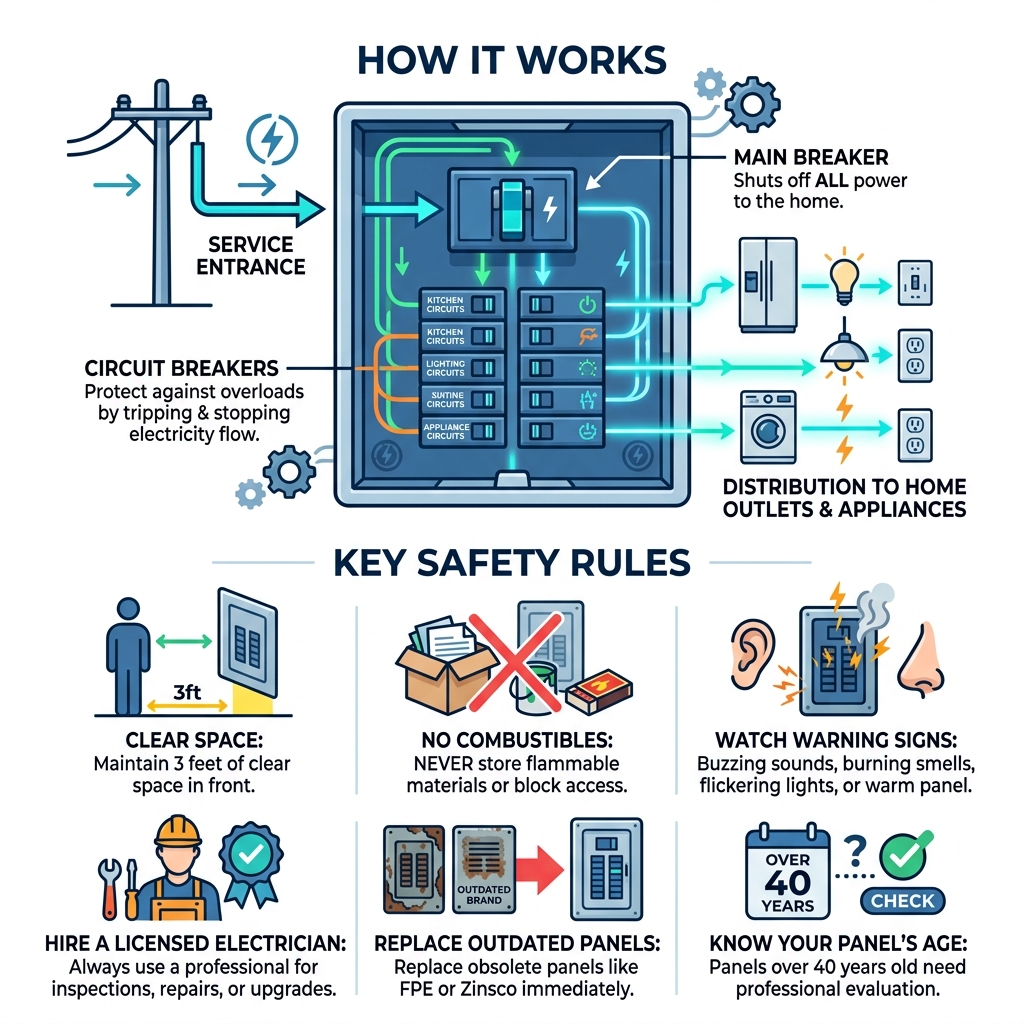
- Keep at least 3 feet of clear space in front of your panel at all times
- Never store combustibles or block access to the panel
- Watch for warning signs: buzzing sounds, burning smells, flickering lights, or warm panels
- Outdated brands like Federal Pacific Electric (FPE) and Zinsco should be replaced
- Always hire a licensed electrician for inspections, repairs, or upgrades
- Panels over 40 years old likely need professional evaluation
Most homeowners never think about the metal box tucked in the basement or utility closet — until something goes wrong. But that box controls every circuit in your home. When it fails, the consequences can be serious.
The numbers tell a sobering story. According to the U.S. Consumer Product Safety Commission (CPSC), there are roughly 46,000 fires involving home electrical distribution systems every year. Those fires result in approximately 440 deaths, 1,420 injuries, and $434 million in property damage annually.
And a big part of the problem? Panels that are outdated, overloaded, or simply ignored.
Your electrical panel isn’t just a box of switches. It’s the safety system standing between your home’s wiring and a potential fire.
I’m Tyler Tranni, owner of Tranni Home Remodeling in Billerica, MA. Through years of hands-on home renovation work — including kitchens, basements, and full home upgrades — I’ve seen how electrical panel safety issues can quietly put families at risk. In this guide, I’ll walk you through everything you need to know to keep your home safe and up to code.
Electrical panel safety glossary:
Understanding Your Home’s Electrical Heart
Think of your electrical panel as the heart of your home. If the wiring is the “veins and arteries” carrying power to your rooms, the panel is the heart that pumps that energy through. In technical terms, it is the service panel or load center where the external power from the utility grid enters your home and is divided into individual branch circuits.
Every panel contains a main breaker, which can shut off power to the entire house in one flip. Beneath it are smaller circuit breakers. These are safety devices designed to “trip” or shut off if too much electricity flows through a circuit, preventing the wires from overheating.
We often find that homeowners in older areas like Reading or Winchester are still using systems that were never designed for the modern load of high-tech appliances, EV chargers, and multiple HVAC units. If you aren’t sure about the state of your system, a home wiring inspection is the best place to start. For a deeper dive into what can go wrong with your wiring, the CPSC Guide to Home Wiring Hazards is an excellent resource for spotting hidden dangers.
Essential Rules for Electrical panel safety in the Home
In our work across Middlesex County, from Bedford to Chelmsford, we often see electrical panels buried behind stacks of holiday decorations or hidden in laundry rooms behind piles of clothes. This is a major violation of electrical panel safety standards.

To stay compliant with the National Electrical Code (NEC) and OSHA standards, you must follow the “Working Space” requirements:
- The 3-Foot Rule: There must be at least 3 feet (36 inches) of clear space in front of the panel. This ensures an electrician has enough room to work safely and provides a quick escape path if a spark or arc occurs.
- Width Clearance: You need a minimum of 30 inches of width in front of the panel. The panel doesn’t have to be centered in this space, but the space must be clear.
- Headroom: There should be at least 6.5 feet of vertical headroom around the panel.
- No Storage: Never store combustible items—like cleaning supplies, paint thinner, or cardboard boxes—near the panel. An electrical spark can quickly turn into a fast-moving fire if fuel is sitting right next to it.
We recommend using floor marking tape to create a visual “no-go zone” around your panel. It’s a simple trick we use in professional settings that works wonders for keeping the basement clutter from creeping into dangerous territory. Before starting any major home project, it’s a good idea to perform a special risk assessment for electrical hazards according to the National Fire Protection Association (NFPA).
Recognizing the Hazards: Shock, Arc Flash, and Fire Risks
Why are these clearance rules so strict? Because the hazards associated with a faulty or blocked panel are life-threatening.
- Electric Shock: Touching a live component in a panel can cause severe burns, internal injuries, or death. Even a small “tingle” when you touch the panel door is a sign of a major grounding issue.
- Arc Flash: This is a massive release of energy caused by an electrical fault. Temperatures can exceed 3,500°F—hot enough to melt metal and ignite clothing instantly.
- Thermal Runaway: This occurs when a connection is loose or corroded. The resistance creates heat, which causes more corrosion, which creates even more heat, eventually leading to a fire.
Circuit Overload vs. Short Circuit
| Feature | Circuit Overload | Short Circuit |
|---|---|---|
| Cause | Too many appliances running at once. | A hot wire touches a neutral or ground wire. |
| Danger Level | High (Wiring can melt over time). | Extreme (Immediate fire or shock risk). |
| Panel Response | Breaker should trip to stop flow. | Breaker must trip instantly. |
| Prevention | Better load management. | Home wiring replacement or repair. |
Statistics from the U.S. Fire Administration (USFA) show that approximately 24,000 residential electrical fires each year are attributed specifically to electrical distribution and lighting equipment failures. These aren’t just “accidents”; they are often the result of ignoring the National Electrical Code 2023 Edition standards that protect our homes.
Warning Signs of a Dangerous or Faulty Electrical Panel
Your home will usually try to tell you when something is wrong. Listening to these warning signs is the cornerstone of electrical panel safety.
Identifying Warning Signs for Electrical panel safety
- Buzzing or Sizzling: Your panel should be silent. If you hear a hum, buzz, or a sizzling sound (like frying bacon), it indicates an “arcing” condition where electricity is jumping through the air.
- Burning Smells: If you smell ozone or burning plastic near the panel, shut off the main breaker immediately and call us. This is often a sign that wire insulation is melting.
- Warm to the Touch: While some warmth is normal if the house is under heavy load, the panel cover should never feel hot.
- Flickering Lights: If your lights dim every time the refrigerator or microwave kicks on, your panel is likely struggling to handle the load. You can check an appliance amp reference chart to see how much power your devices are pulling.
- Frequent Breaker Trips: If you are constantly resetting a breaker, it’s not a nuisance—it’s a warning. The breaker is doing its job, but the circuit is either overloaded or failing.
If you have an older home in Dracut or Billerica, you might still be dealing with 100 amp breaker box wiring, which is often insufficient for modern life.
Dangerous Outdated Brands and Components
Not all electrical panels were created equal. Several brands manufactured between the 1950s and 1980s have been found to have significant design flaws.
- Federal Pacific Electric (FPE): These are famous for their “Stab-Lok” breakers. Testing has shown that FPE breakers fail to trip in as many as 60% of overload cases. Instead of shutting off, they stay on, allowing wires to overheat and start fires. If you have one, you should replace your Federal Pacific panel as soon as possible.
- Zinsco: These panels often have bus bars that corrode or breakers that melt to the bus bar. This means even if you flip the switch to “off,” the power might still be flowing.
- Pushmatic: While not as dangerous as FPE, these are very old and use a “push” button style that becomes stiff and fails to trip over time.
- Fuse Boxes: If your home still uses screw-in fuses, it’s time for an upgrade. Fuse boxes are often “over-fused” (using a 30-amp fuse on a 15-amp wire), which is a major fire hazard.
Safe Interaction and Maintenance for Homeowners
While you should never take the cover off your panel yourself, there are things you can do to ensure electrical panel safety.
- Conduct Visual Inspections: Every few months, look at your panel. Do you see rust? Is there moisture nearby? Are there any unsealed openings (missing knockouts)?
- Verify the Dead Front: The “dead front” is the flat metal plate that prevents you from touching live wires while operating the breakers. Ensure it is securely fastened and has no gaps.
- Accurate Labeling: Every breaker should be clearly labeled. In an emergency, you don’t want to be guessing which switch kills the power to the kitchen.
- Resetting Breakers Safely: If a breaker trips, stand to the side of the panel when you flip it back on. Never look directly at the panel while flipping a breaker—this protects your eyes in the rare event of an arc flash.
For those in the workplace, OSHA requires specific Personal Protective Equipment (PPE) for anyone working on live panels, including arc-rated face shields and shock-resistant gloves. While you don’t need this to flip a breaker at home, it highlights just how much energy is behind that metal door. If you’re planning a major renovation, residential electrical panel upgrades are often the first step in ensuring your new space is safe.
Professional Inspections and Electrical panel safety
We recommend a professional inspection every 3 to 5 years. A licensed electrician doesn’t just look at the switches; they use advanced tools like infrared thermography to find “hot spots” that aren’t visible to the naked eye. They will also check for:
- Loose wire connections (which cause heat)
- Proper grounding and bonding
- Signs of internal corrosion or pest damage (mice love chewing on wire insulation!)
If you are upgrading electrical in an old home, these inspections are non-negotiable.
When to Invest in an Electrical Panel Upgrade
How do you know when it’s time to stop repairing and start replacing?
- Age: If your panel is over 40 years old, it has likely reached the end of its reliable lifespan.
- Capacity: Most modern homes require at least a 200-amp service. If you are still running on 100 amps, you are likely overloading your system.
- Renovations: If you are planning a kitchen remodel in Burlington or a basement finish in Woburn, your current panel may not have enough space for the new circuits required by modern code.
- Physical Damage: Any sign of moisture, rust, or charring means the panel must go.
Upgrading your system is an investment in your home’s value and your family’s safety. Many homeowners choose to change 100 amp panels to 200 amp to future-proof their homes for solar panels or electric vehicles.
Average Costs: Based on internet data, the cost to change an electrical panel can range from $1,500 to $12,000. The lower end typically covers a simple 100-amp to 100-amp swap, while the high end involves a full service upgrade to 400-amps with new mast heads and extensive rewiring. Please note these are average internet estimates and not actual quotes for our services. For more detailed pricing info, check our guide on the cost to change electrical panels.
Frequently Asked Questions about Electrical Panel Safety
How often should my electrical panel be inspected?
For most homes in the Middlesex County area, we recommend a professional inspection every 3 to 5 years. However, if you live in a home built before 1970, or if you notice any flickering lights or buzzing, you should have it checked immediately.
Can I replace a circuit breaker myself?
We strongly advise against DIY breaker replacement. Even with the main breaker off, the “bus bars” and the incoming service lines are still live and carry enough current to be fatal. Furthermore, using the wrong brand of breaker (even if it fits) can lead to a failure to trip, creating a fire hazard.
Why is my electrical panel box warm?
A slight warmth can be normal if you are running heavy appliances like an electric dryer or air conditioner. However, if any part of the panel is hot to the touch, or if you see any discoloration on the breakers, it indicates a loose connection or an overload that requires immediate professional attention.
Conclusion
At Tranni Home Remodeling, we believe that a beautiful home must first be a safe home. Whether we are working on a high-end kitchen remodel in Lexington or a home addition in Tewksbury, we always prioritize the “unseen” systems that keep your family protected.
Electrical panel safety isn’t just about following codes; it’s about peace of mind. By keeping your panel clear, watching for warning signs, and replacing outdated equipment, you are preventing the most common cause of house fires.
If you live in Billerica, Chelmsford, Dracut, or any of our surrounding service areas and have concerns about your home’s electrical system, don’t wait for a spark to act. Our team of experts is dedicated to providing high-quality craftsmanship and outstanding service for every aspect of your home renovation.
Schedule an electrical panel upgrade today and ensure your home’s heart keeps beating safely for years to come.