





Basement Drywall Installation Cost: Smart 2025 Guide
Understanding the True Cost of Changing Your Basement
Basement drywall installation cost ranges from $1.50 to $7.00 per square foot depending on materials, labor, and finishing level. Here’s what you can expect to pay:
- Standard drywall installation: $1.50 – $3.50 per sq ft
- Moisture-resistant drywall: $2.00 – $4.50 per sq ft
- High-end finishes: $3.00 – $7.00 per sq ft
- 1,000 sq ft basement project: $1,500 – $10,500 total
Note: These are average costs based on internet data and not actual costs for Tranni Home Remodeling.
Your unfinished basement holds tremendous potential. With smooth drywall walls, proper insulation, and quality finishing, that cold concrete space can become a cozy family room, home office, or entertainment area. But before you start dreaming about movie nights downstairs, you need to understand what it really costs to get there.
Drywall – those flat panels of gypsum plaster between paper sheets – forms the foundation of any finished basement. It’s what transforms rough framing into smooth, paintable walls ready for your personal touch. The catch? Multiple factors affect your final bill, from the type of drywall you choose to the complexity of your basement’s layout.
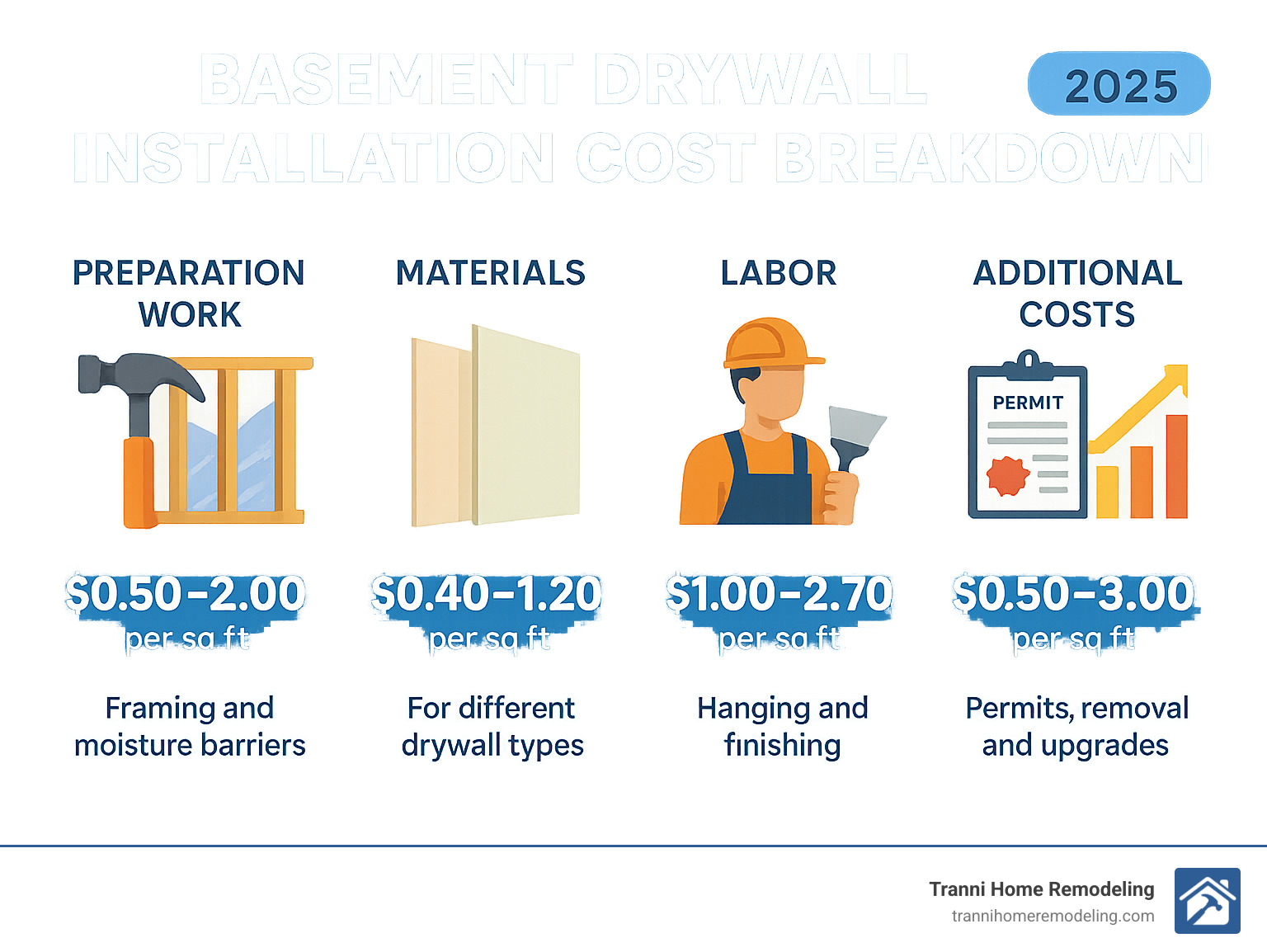
Labor costs typically make up 65-75% of your total project expense. Material choices like moisture-resistant green board versus standard drywall can double your per-square-foot price. And finishing levels – from basic taping to mirror-smooth surfaces – create dramatic cost differences.
As Tyler Tranni, owner of Tranni Home Remodeling in Billerica, MA, I’ve helped countless homeowners steer basement drywall installation cost decisions over the years. My experience with basement finishing projects has shown me that understanding these costs upfront prevents surprises and helps homeowners make informed choices for their space.
Relevant articles related to basement drywall installation cost:
The Average Cost to Drywall a Basement
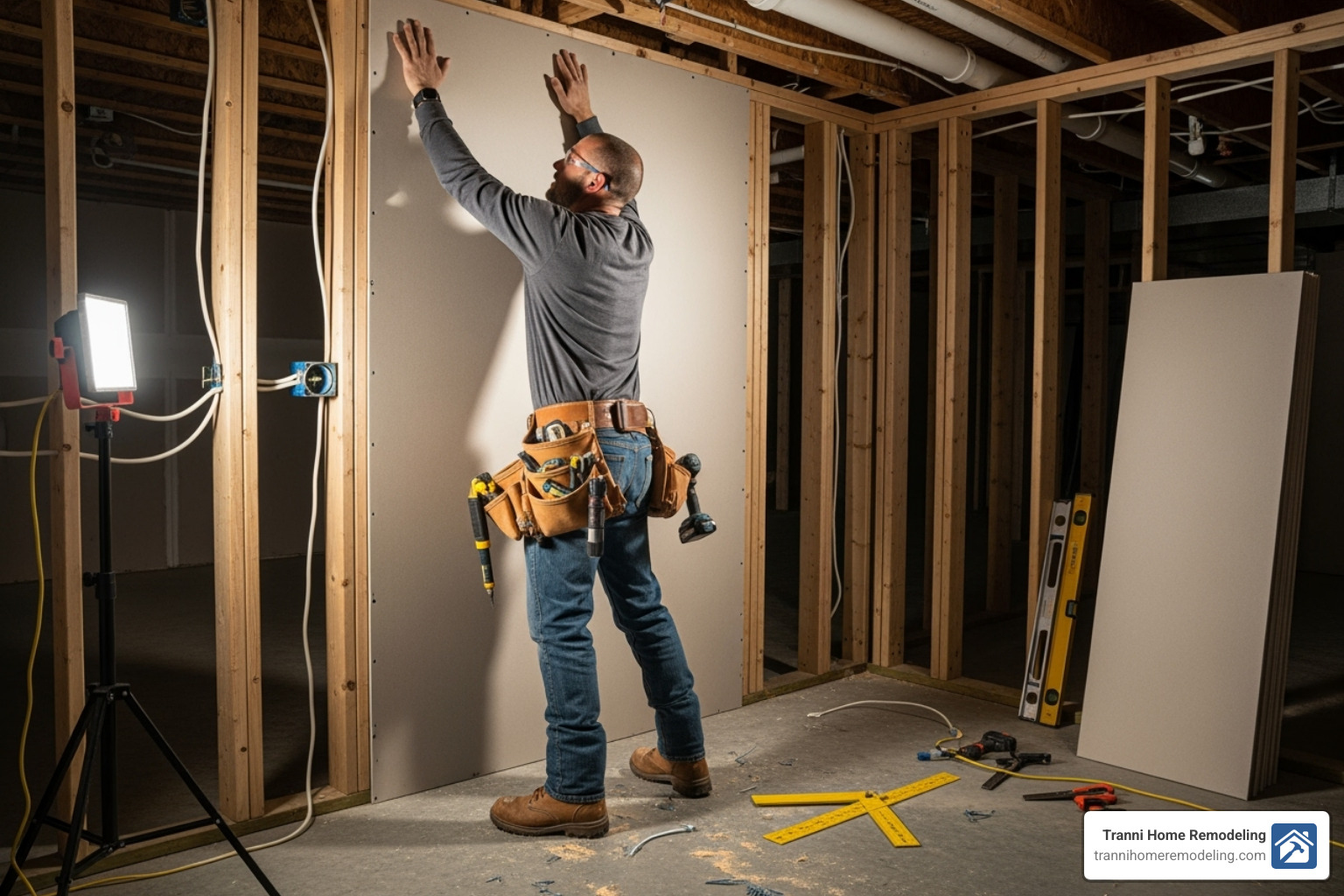
Nationally, the basement drywall installation cost typically runs between $1.50 and $7.00 per square foot, though premium projects can push well beyond that range.
These are average costs based on internet data and not actual costs for Tranni Home Remodeling.
For a typical 1,000 square foot basement, you can expect to pay anywhere from $1,500 to $10,500 for a complete installation. High-end projects with premium materials and finishes can easily reach $18,500 or more for the same space.
However, regional variations play a big role in pricing. Here in Massachusetts, particularly in towns like Billerica, Chelmsford, Andover, and Woburn, local labor rates and material costs can shift these numbers. What costs $3,000 in one area might run $4,500 in another.
That’s why we tell homeowners in Reading, Tewksbury, and our other service areas that these national averages are just a starting point. Your final cost depends on many factors we’ll explore throughout this guide.
More info about basement remodeling cost per square foot
Breaking Down the Basement Drywall Installation Cost: Hanging vs. Finishing
Your basement drywall installation cost breaks into two distinct jobs: hanging and finishing. Each requires different skills and time commitments.
Hanging drywall is the physical labor of measuring, cutting, and securing 4×8 sheets to wall studs and ceiling joists. Expect to pay $0.85 to $1.90 per square foot for this phase. It’s heavy work but relatively straightforward for experienced installers.
Finishing drywall is the artistic part that transforms rough seams into smooth, paintable walls. This process includes:
- Taping the joints where drywall sheets meet, costing $0.35 to $1.10 per square foot.
- Mudding by applying multiple coats of joint compound over tape lines and screw holes.
- Sanding each coat to create a perfectly smooth surface.
All told, finishing work ranges from $0.85 to $3.50 per square foot, depending on the desired level of perfection. Finishing is what separates a professional job from a DIY one.
The reality is that labor typically accounts for 65% to 75% of your total basement drywall installation cost. Those perfectly smooth walls are the result of hours of skilled craftsmanship that justifies the expense.
Key Factors Influencing Your Basement Drywall Installation Cost
Understanding what drives your basement drywall installation cost helps you plan better and avoid surprises. The three biggest cost drivers are project complexity, labor rates, and material choices. Your basement’s layout, local labor rates in towns like Chelmsford or Reading, and the type of drywall you choose all significantly impact the final price.
How Material Choices Impact Your Basement Drywall Installation Cost
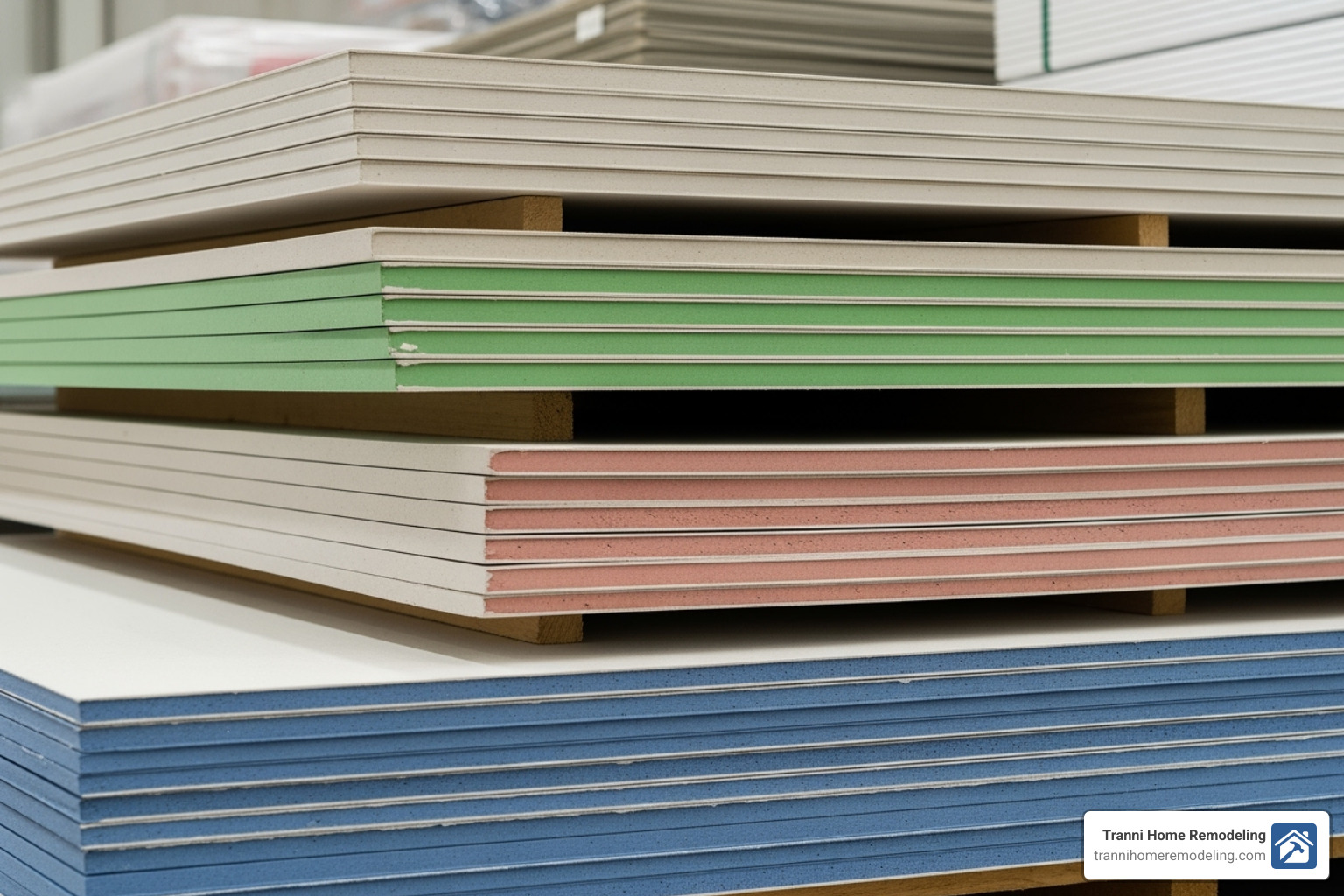
The drywall you select creates dramatic differences in your basement drywall installation cost. While standard drywall is cheapest, basements often justify a higher upfront investment.
- Standard drywall costs $1.50 to $2.50 per square foot installed. It works for dry, well-ventilated basements.
- Moisture-resistant drywall (green board) is better for damp areas like bathrooms or laundry rooms, costing $2.00 to $4.50 per square foot installed.
- Mold-resistant drywall (purple board) actively fights mold growth, which is crucial in basements. Installation runs $2.50 to $3.50 per square foot.
- Fire-resistant drywall (Type X) is thicker and often required by building codes near furnaces. It costs $2.25 to $3.75 per square foot installed.
- Soundproof drywall is ideal for home theaters or reducing noise between floors, costing $3.50 to $5.00 per square foot installed.
These are average costs based on internet data and not actual costs for Tranni Home Remodeling.
Investing in moisture or mold-resistant options often saves money by preventing future damage.
Labor and Finish Level: The Price of Perfection
The finish quality you want dramatically affects your basement drywall installation cost. Smoother walls require more skilled labor, which is graded on a standardized scale from Level 0 to Level 5.
- Level 0-2: Basic finishes suitable for unseen areas or garages, with minimal taping and one coat of compound. Labor costs range from $0.20 to $1.40 per square foot.
- Level 3: Two coats of compound, ready for medium textures. This is a good choice for many basement living spaces, with labor at $0.80 to $1.75 per square foot.
- Level 4: The residential standard. Three coats of compound create a smooth surface ready for flat paint. Expect labor costs of $0.80 to $2.00 per square foot.
- Level 5: A perfect, skim-coated finish for glossy paints and critical lighting. This is the most expensive option, with labor at $1.00 to $2.50 per square foot.
The jump from Level 3 to Level 5 can add thousands to your project. For most basements, Level 4 provides excellent results.
Project Complexity and Your Basement’s Layout
Your basement’s layout significantly influences your basement drywall installation cost. A simple rectangular room costs far less than a maze of small spaces.
- Ceiling Height: Taller ceilings require scaffolding, increasing labor time and cost. Ceiling work generally runs $1.50 to $3.80 per square foot compared to $1.50 to $3.50 for walls because it’s more difficult.
- Complex Layouts: Multiple rooms, odd angles, and numerous corners can increase costs by 20% to 30% due to the extra cutting and finishing required.
- Obstructions: Exposed ductwork, support columns, or pipes require custom framing and precise cuts, taking significantly more time than working on open walls.
We have experience with all types of layouts throughout Middlesex County, from simple open spaces in Billerica to complex multi-room layouts in Tewksbury and Woburn. Understanding these complexity factors helps you budget accurately.
Professional Basement Renovations
Beyond the Boards: Additional Project Costs to Budget For
When planning your basement project, the basement drywall installation cost is just one piece of the puzzle. Other costs for preparation and finishing can catch homeowners off guard. Renovating an existing space versus finishing bare concrete walls involves different considerations, from demolition to new framing and insulation.
Preparing the Space: Framing, Insulation, and Moisture Control
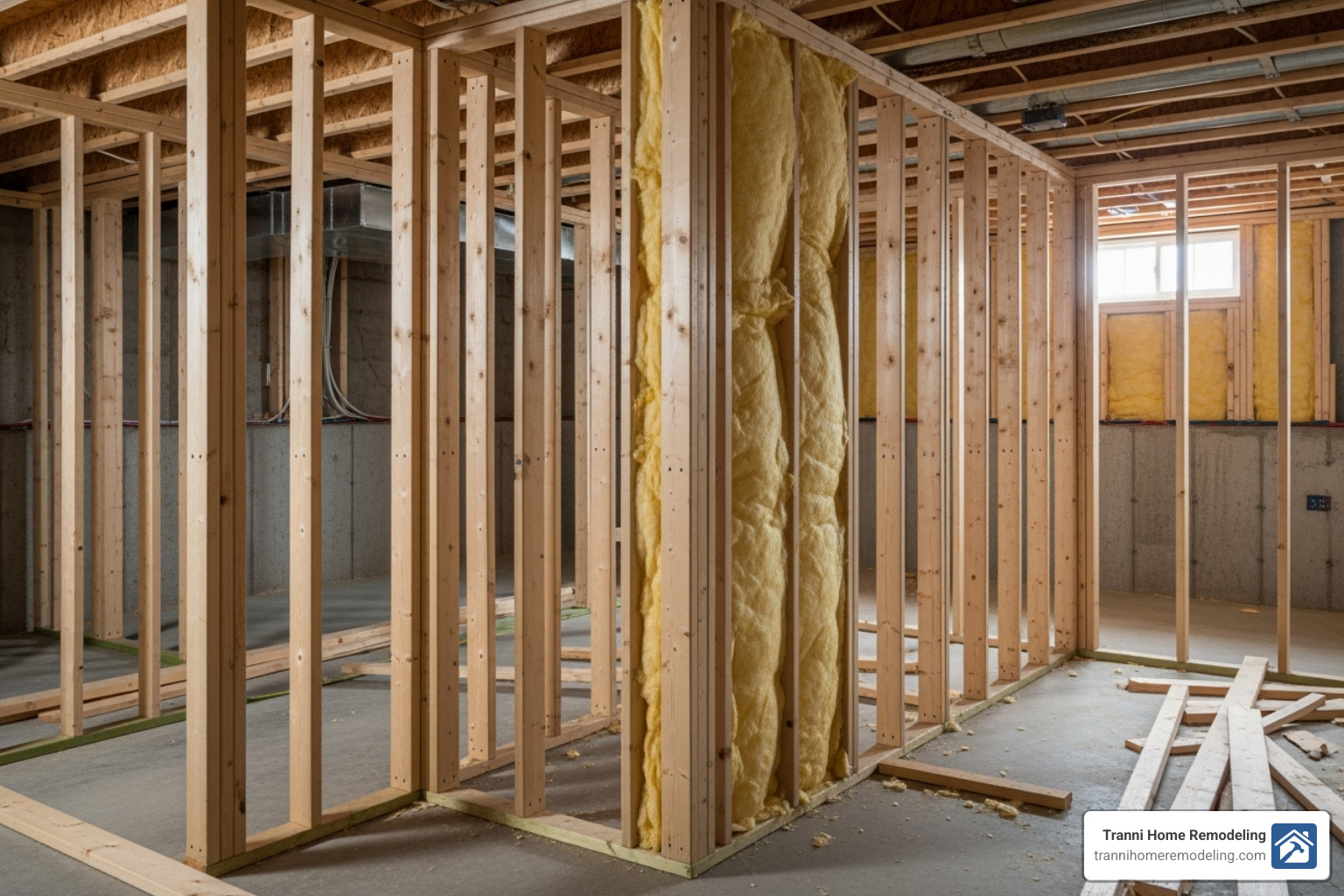
Before drywall can be installed, your basement needs a proper structure.
Framing creates the skeleton for your new walls. In an unfinished basement, framing new walls typically costs $2.40 to $5.00 per square foot of floor area, including labor. We primarily use cost-effective and reliable wood studs.
Insulation is installed after framing and is essential for a comfortable, energy-efficient basement. It’s a critical step before any drywall goes up.
Moisture control is non-negotiable in a basement. A vapor barrier is your first line of defense, costing $1.70 to $3.50 per square foot installed. This investment is minor compared to the cost of tearing out moldy drywall later. We also recommend using treated lumber for the bottom plate of the wall framing, as it sits on the concrete and resists moisture and rot.
Basement Waterproofing Solutions
Demolition, Permits, and Other Essential Expenses
Renovating an existing finished basement may require demolition first. Removing old drywall or paneling can add $0.50 to $2.50 per square foot to your project.
For older homes, especially in towns like Concord or Lexington, be aware of potential hazards. Homes built before 1986 may have asbestos, while homes built before 1978 could have lead paint.
- Asbestos testing costs $250 to $850, with removal at $7 to $14+ per square foot.
- Lead paint testing costs $300 to $600, with removal at $8 to $15 per square foot.
These steps are necessary for your family’s safety. Finally, permit and inspection fees vary by town but typically range from $50 to $400, though they can exceed $1,900 for complex projects. We always check with local building departments in Billerica, Woburn, and Tewksbury to ensure compliance, which is crucial for avoiding fines and issues when selling your home.
At Tranni Home Remodeling, we handle all these details, from demolition and testing to securing permits and passing inspections.
Note: These are average costs based on internet data and not actual costs for Tranni Home Remodeling.
Contractors to Finish a Basement
Exploring Drywall Alternatives for Your Basement
While drywall is the standard for finishing basements, it’s not your only option. Some homeowners prefer a different aesthetic or need a more robust solution for moisture. Let’s explore how alternatives stack up against the traditional basement drywall installation cost.
| Material | Average Cost (Installed) | Durability | Moisture Resistance | Notes |
|---|---|---|---|---|
| Drywall | $1.50 – $7.00/sq ft | Moderate | Low (Standard) / High (Specialty) | Most common, paintable, versatile. |
| Veneer Plaster | Higher than drywall | High | Good | Durable, smooth, requires specialized skill. |
| Plywood | Moderate | High | Low (Unless Treated) | Rustic look, can warp with moisture. |
| Wood Paneling | Moderate to High | Moderate | Varies | Warm, decorative, can hide imperfections. |
| Cement Board | Moderate | High | Excellent | Best for high-moisture areas, typically tiled. |
| Textured Panels | Moderate | Moderate | Low | Decorative, easy install, less durable. |
Wood paneling provides a warm, traditional look and hides imperfections. However, it’s vulnerable to moisture and can warp or mold without proper sealing, a concern in our Massachusetts basements.
Plywood offers a modern, industrial look and is very durable. Like wood paneling, it’s susceptible to moisture and requires sealing to prevent warping, especially in local basements around Billerica or Woburn.
Veneer plaster creates a highly durable, seamless, and moisture-resistant finish. It’s more expensive than drywall and requires specialized skills, significantly increasing your project cost.
Cement board is ideal for high-moisture areas like bathrooms or laundry rooms. It’s water and mold-proof, serving as an excellent base for tile rather than a final finish itself.
Textured wall panels are decorative, easy-to-install panels in styles like faux brick or stone. They lack the insulation and soundproofing of drywall, and their durability in humid basements can be a concern.
While alternatives exist, drywall remains popular for its versatility and cost-effectiveness. With moisture-resistant varieties, it’s ideal for New England basements. At Tranni Home Remodeling, we help homeowners weigh these options to find the perfect solution for their space.
Frequently Asked Questions about Basement Drywall
Here are answers to common questions about basement drywall installation cost and best practices we hear from homeowners throughout Middlesex County.
What drywall thickness is best for a basement?
For basement walls, we recommend 1/2-inch drywall. It offers a good balance of durability and manageability for installation.
For basement ceilings, 5/8-inch drywall is essential. The extra thickness is crucial for preventing sagging over time, which can ruin the look of a finished basement. It also provides better soundproofing benefits. Always check your local building codes, as some municipalities have specific requirements for fire separation between floors.
Should I use mold-resistant drywall in the basement?
Yes, absolutely use mold-resistant drywall in your basement. We’ve seen too many renovations in Carlisle and surrounding towns compromised by preventable moisture issues.
Basements are high-humidity environments where standard drywall can fail. Mold-resistant drywall (often called “purple board”) has a fiberglass mat and special additives that inhibit mold growth. While it adds to your initial basement drywall installation cost (typically $2.50 to $3.50 per square foot installed), the long-term protection against costly mold remediation is invaluable.
Basement Ventilation Solutions
How much can I save with a DIY installation?
DIY can offer significant labor savings, as professional installation runs $1.00 to $2.70 per square foot. For a basic 12’x12′ room, materials might cost only $200-$400 versus $800-$2,000 for a professional job.
However, drywall work is physically demanding and requires special tools (like a drywall lift) and skills to achieve smooth joints. The risks of improper installation can be costly to fix. We often see DIY projects with visible seams and cracks that require professional repair.
To manage your basement drywall installation cost, suitable DIY tasks include demolition, hauling materials, and painting. Some handy homeowners also tackle the hanging phase.
We strongly recommend hiring a professional for the finishing work. The taping, mudding, and sanding is an art form where experience shows, and the quality difference is immediately visible.
Conclusion: Bringing Your Basement Vision to Life
Understanding the basement drywall installation cost is just the beginning of your basement change journey. As we’ve explored throughout this guide, your final investment will depend on several key factors: the type of drywall you choose, the level of finish you desire, and how complex your basement’s layout happens to be.
You’re looking at costs ranging from $1.50 to $7.00 per square foot for most projects, with a typical 1,000 square foot basement running anywhere from $1,500 to $10,500 or more. But these numbers only tell part of the story. The real magic happens when you factor in all those “beyond the boards” expenses – framing, insulation, moisture control, and permits – that transform your cold, concrete space into a warm, inviting part of your home.
The importance of professional installation cannot be overstated, especially when it comes to achieving that flawless finish. While hanging drywall might seem straightforward, the taping, mudding, and sanding require genuine skill and experience. Getting these steps right the first time saves you money and headaches down the road.
A properly finished basement adds tremendous value to your home – both in terms of actual square footage and your family’s quality of life. Whether you’re dreaming of a cozy family room for movie nights, a home office for remote work, or a playroom where the kids can be kids, that investment in quality drywall installation forms the foundation of it all.
At Tranni Home Remodeling, we’ve been helping homeowners across communities like Chelmsford, Andover, Burlington, and Wilmington turn their basement visions into reality for over a decade. We understand that every basement is unique, every family’s needs are different, and every budget has its considerations. That’s why we work closely with each client to steer these decisions and deliver results that exceed expectations.
Your basement holds so much potential – let’s open up it together.
Get a professional estimate for your Basement Finishing project
Like us on Facebook!
