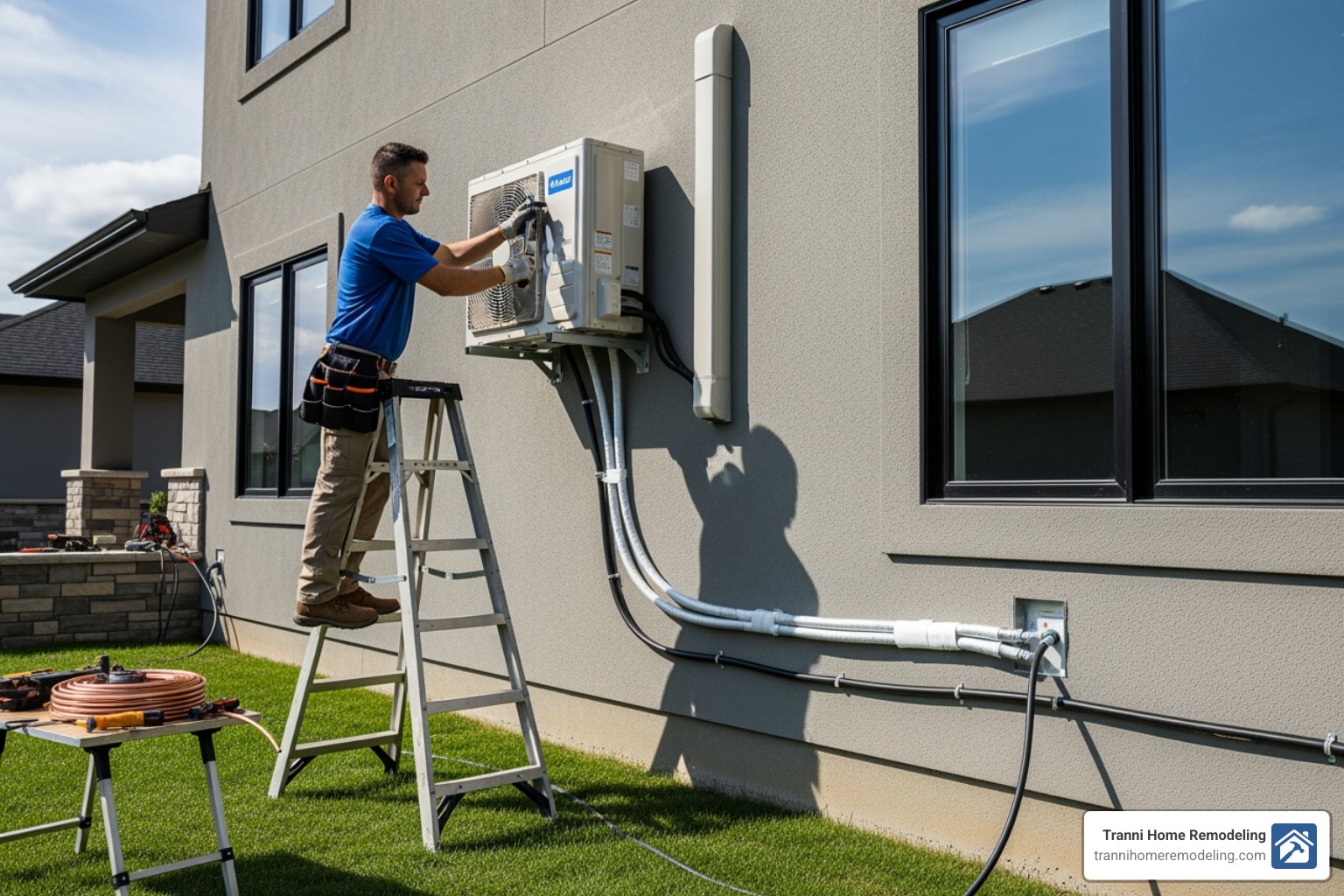





Why Understanding Ductless AC Installation Matters
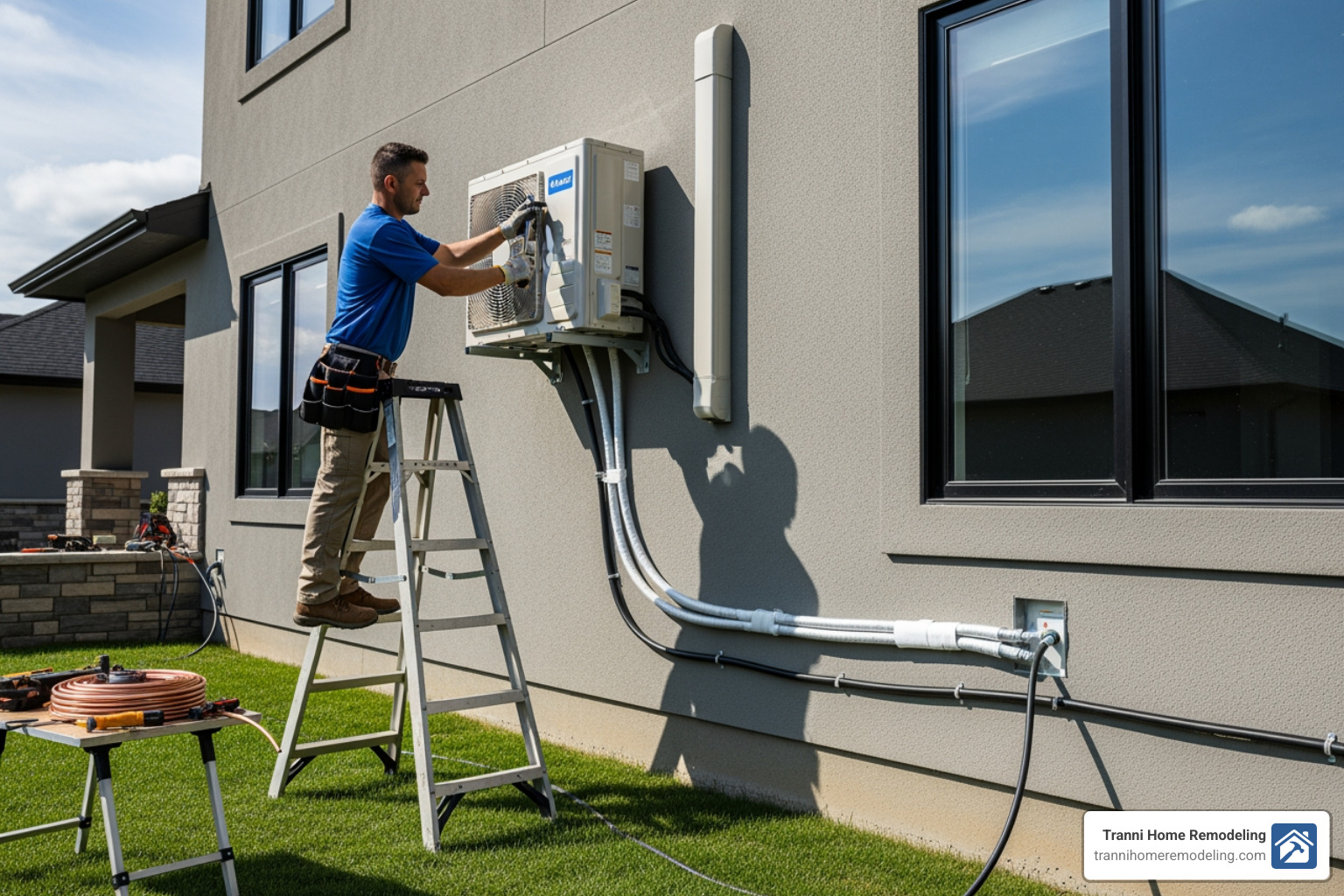
Ductless AC Installation involves connecting an outdoor compressor unit to one or more indoor air handlers using refrigerant lines and electrical wiring, without the need for traditional ductwork. Here’s what you need to know:
Key Steps in the Installation Process:
- Mount the indoor unit high on an interior or exterior wall
- Drill a hole (2-3 inches) through the wall for connections
- Run refrigerant lines and electrical cables through the hole
- Install the outdoor condenser on a level pad or bracket
- Connect all lines and test the system for proper operation
- Professional completion includes pressure testing, vacuuming, and refrigerant charging
Average Installation Costs:
- Single-zone systems: $2,000 to $10,500
- Multi-zone systems: $10,000 to $20,000+
- Professional labor typically adds $3,000 to $14,500 depending on complexity
Many homeowners love the idea of tackling this as a DIY project to save money. However, most areas require certified professionals for refrigerant handling and electrical connections. You can do some prep work yourself—like mounting brackets and drilling holes—but the technical work must be completed by licensed technicians.
The good news? Ductless systems are 30% more efficient than conventional central air, eliminating energy losses from leaky ductwork and offering individual room control. They’re perfect for older homes without existing ducts, room additions, or spaces where you want precise temperature control.
I’m Tyler Tranni, owner of Tranni Home Remodeling, and I’ve guided countless homeowners through Ductless AC Installation projects across Massachusetts. My team specializes in helping busy homeowners understand their options and connecting them with the right professionals to ensure flawless, code-compliant installations.
Ductless AC Installation glossary:
Introduction to Ductless Comfort
Welcome to ductless heating and cooling, where comfort meets efficiency! When we talk about Ductless AC Installation, we’re referring to setting up a mini-split system. Unlike traditional central air that uses extensive ductwork, these systems offer a flexible and energy-efficient solution for your home.
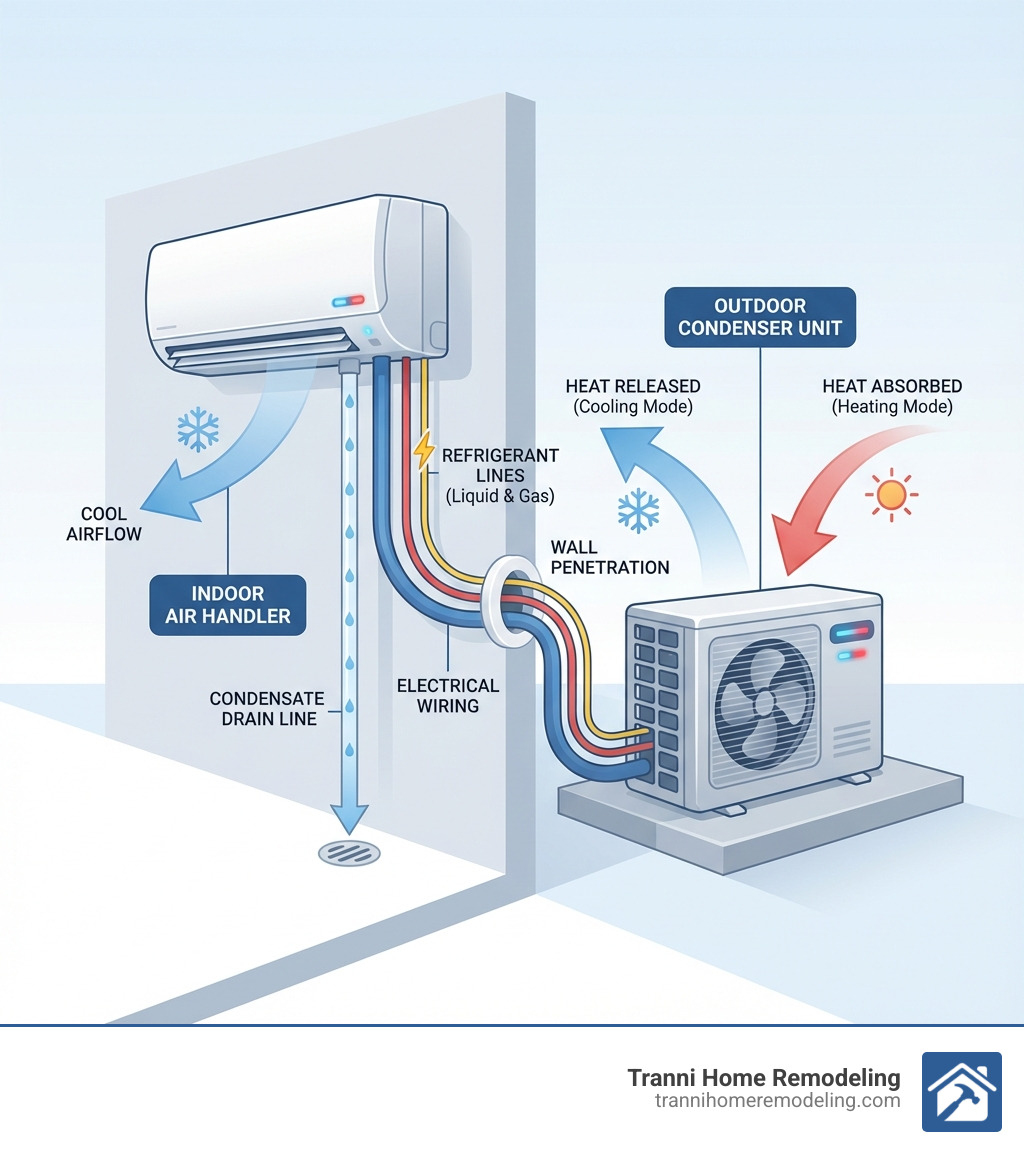
A ductless mini-split system consists of two main components: an outdoor condenser/compressor and one or more indoor air handlers. These are connected by a slim conduit containing refrigerant lines and wiring. The indoor units distribute conditioned air directly into your living spaces, eliminating bulky, leaky ducts.
The advantages over traditional central air are compelling. Ductless systems avoid the energy loss common in ductwork—which can be up to 30%—leading to lower energy bills. They also offer zoned cooling and heating, allowing you to set different temperatures in different rooms for personalized comfort and further savings. Finally, since the noisy components are outdoors, your home remains quiet and peaceful.
Pre-Installation Planning: Setting Yourself Up for Success
Before any Ductless AC Installation begins, careful planning is essential to ensure optimal performance and efficiency. This stage involves making informed decisions about system sizing, unit types, and placement.

Sizing Your System
Determining the correct size for a ductless system is crucial. An undersized unit runs constantly and inefficiently, while an oversized unit cycles too frequently, causing uneven temperatures and wear. We use guidelines from accredited organizations like the Air Conditioning Contractors of America (ACCA) to calculate the right BTU (British Thermal Unit) capacity. Factors include:
- Room size
- Insulation quality
- Window exposure and size
- Ceiling height
- Occupancy
- Heat-generating appliances
For a general idea, here’s a quick reference:
| BTU/Hour | Room Size (Square Feet) |
|---|---|
| 5,000 | 100 to 150 |
| 6,000 | 151 to 250 |
| 7,000 | 251 to 300 |
| 8,000 | 301 to 350 |
| 9,000 | 351 to 400 |
| 10,000 | 401 to 450 |
| 12,000 | 451 to 550 |
| 14,000 | 551 to 700 |
| 18,000 or more | 701 to 1000 |
For a precise calculation, we recommend consulting with our professionals.
Choosing the Right Type
Ductless systems offer great versatility. Your options include:
- Single-zone systems: One indoor unit connected to one outdoor unit, ideal for a single area like a home addition or garage.
- Multi-zone systems: A single outdoor unit connects to several indoor units (up to eight), providing customized comfort in multiple rooms.
- Wall-mounted units: The most common type, installed high on a wall for efficient air distribution.
- Ceiling-cassette systems: Tucked into the ceiling, these are ideal for large spaces where wall space is limited.
- Floor-mounted units: Installed near the ground, these are great for rooms with low or slanted walls, like attics or sunrooms.
We can help you explore all these Ductless Heating and Cooling Systems to find the perfect fit.
Optimal Unit Placement
Strategic placement is key. The indoor unit is typically mounted about 7 feet from the floor, clear of obstructions and heat sources, to ensure good air circulation. The outdoor unit needs a flat, stable surface with adequate clearance for airflow. In colder climates, we lift outdoor units to prevent snow and ice buildup, which can damage the system.
Energy Efficiency Ratings
Understanding energy ratings helps predict operating costs:
- SEER2 (Seasonal Energy Efficiency Ratio 2): Measures seasonal cooling efficiency. Higher is better.
- EER2 (Energy Efficiency Ratio 2): Measures efficiency at a peak temperature (95°F).
- HSPF2 (Heating Seasonal Performance Factor 2): Measures seasonal heating efficiency for heat pumps.
We rely on guidance from organizations like the Air Conditioning Contractors of America to ensure proper system selection.
Understanding the Cost of Ductless AC Installation
The cost of Ductless AC Installation varies based on several factors:
- System size and number of zones: A single-zone system costs less than a multi-zone system with several indoor units.
- Brand and quality: Premium brands like Mitsubishi may have a higher initial cost but often provide superior efficiency and warranties.
- Installation complexity: Factors like the distance between units, necessary electrical work, and accessibility can impact the final price.
For a comprehensive breakdown, see our Mini Split Installation Cost Guide.
Average cost range:
Based on internet data, a single-zone system installation typically ranges from $2,000 to $10,500. Multi-zone systems can cost from $10,000 to $20,000 or more. Please keep in mind these are average costs and not actual quotes from Tranni Home Remodeling. We provide personalized estimates after a thorough assessment.
Essential Tools and Materials for the Job
While we strongly recommend professional installation, understanding the tools involved highlights the job’s complexity. A professional installation requires:
- Basic Hand Tools: Drill, hole saw, level, wrenches, and screwdrivers.
- HVAC Specific Tools:
- Vacuum Pump: To remove air and moisture from refrigerant lines.
- Manifold Gauge Set: To monitor refrigerant pressure.
- Flaring Tool & Torque Wrench: To create leak-proof connections tightened to precise specifications.
- Tube Cutter and Bender: For cutting and bending copper lines without kinking.
- Nitrogen Tank: For pressure testing lines to find leaks.
- Micron Gauge & Refrigerant Scale: To ensure a deep vacuum and accurate refrigerant charging.
- Installation Materials:
- Condenser Pad or Wall Bracket: A stable base for the outdoor unit.
- Line Set Cover Kit: To protect and conceal exterior lines.
- Refrigerant Lines, Electrical Wiring, and Drain Line.
- Disconnect Box and Wall Sleeve.
The 7 Key Steps of a Ductless AC Installation
Performing a Ductless AC Installation is a precise process. While we handle the complexities, here’s a general overview of the steps involved:
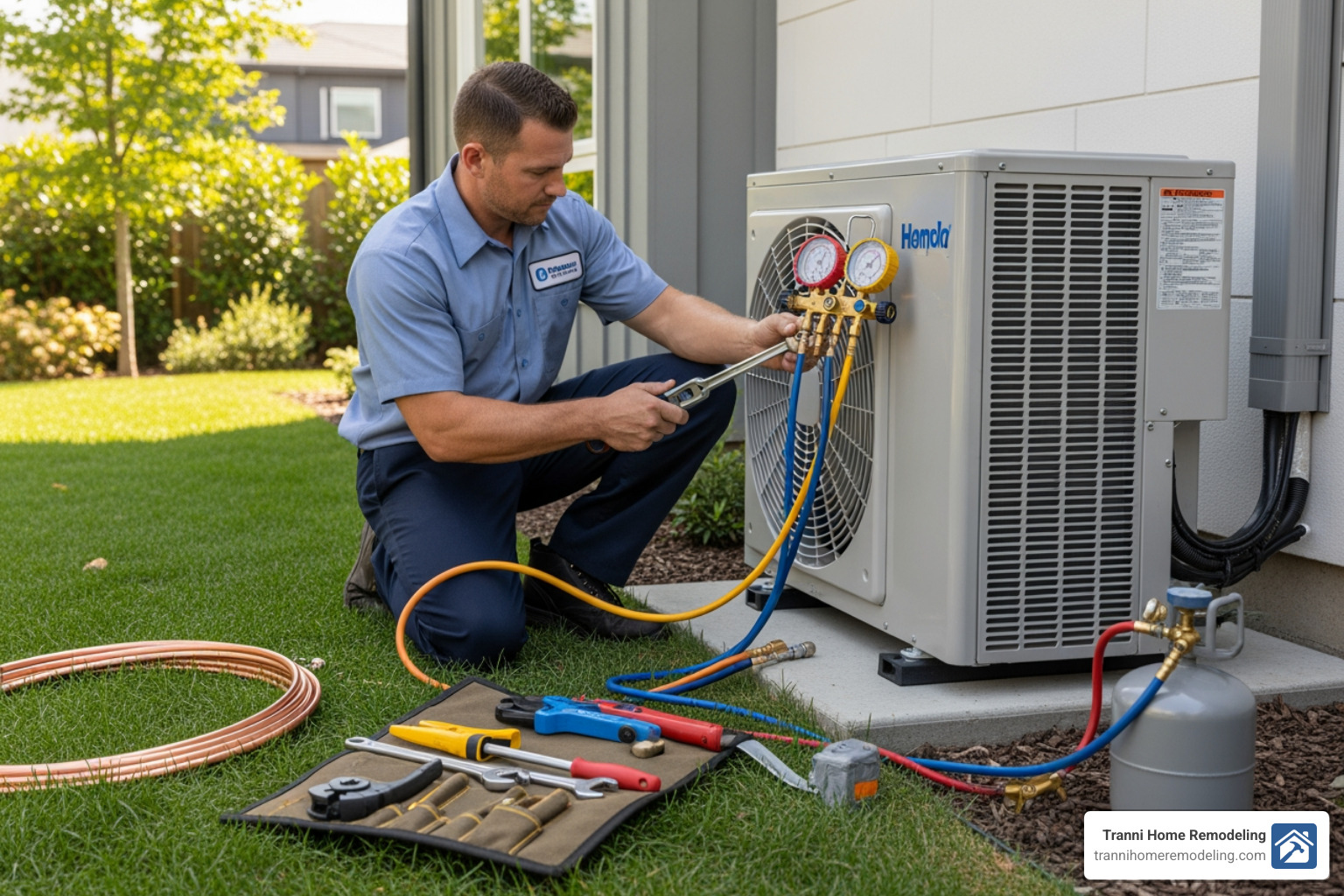
Step 1: Mount the Indoor Unit
First, we securely fasten the indoor unit’s mounting bracket to wall studs. The unit is typically positioned about 7 feet from the floor, ensuring it’s level for proper drainage and placed for optimal air circulation.
Step 2: Drill the Hole for the Line Set
We drill a 2.5 to 3-inch hole through the exterior wall, sloped slightly downward to the outside. This allows the line set to pass through and ensures proper condensate drainage.
Step 3: Run the Lines and Cables
Through the hole, we carefully feed the insulated refrigerant lines, electrical cable, and condensate drain line, taking care not to kink the copper piping.
Step 4: Mount the Outdoor Condenser
The outdoor unit is installed on a level pad or wall bracket. We ensure it has adequate clearance for airflow and, in our Massachusetts climate, is raised to avoid snow and ice.
Step 5: Connect the Refrigerant Lines
This is a critical step. We use a flaring tool and torque wrench to create perfect, leak-proof seals connecting the refrigerant lines between the indoor and outdoor units, tightening them to the manufacturer’s exact specifications.
Step 6: Connect the Electrical Wiring
This work requires a licensed electrician to run a dedicated power line from the breaker panel to a disconnect switch near the outdoor unit, ensuring safety and code compliance in areas like Billerica, Burlington, and Lexington.
Step 7: Test the System
Once connected, we perform crucial tests. We pressurize the lines with nitrogen to check for leaks, then use a vacuum pump to evacuate all air and moisture. Finally, we release the refrigerant and test the system in both cooling and heating modes to ensure proper operation.
Common challenges like hidden wall obstructions or improper line connections are why professional expertise is vital. For more details, see our Mini Split Installation Complete Guide.
A Closer Look at a Professional Ductless AC Installation
The intricacies of a Ductless AC Installation demand professional expertise for safety and precision.
- Safety Precautions: Handling refrigerants and high-voltage electricity is dangerous. Our licensed technicians are trained to mitigate these risks, ensuring a safe process.
- Leak Testing: We perform a nitrogen pressure test to guarantee a leak-free system. Even a tiny leak can reduce efficiency and damage your unit over time.
- Vacuuming the System: We use a vacuum pump and micron gauge to remove all air and moisture from the refrigerant lines. This vital step prevents the formation of corrosive acids and ensures the system’s longevity.
- Final Commissioning: After testing, we power up the system and verify that every component is functioning correctly before considering the job complete. This is especially important for HVAC Installation for Older Homes.
DIY Ductless AC Installation: What Are the Limits?
While some “DIY-friendly” kits with pre-charged lines exist, there are significant limitations and risks.
- Electrical Work: Most ductless systems require a dedicated 220-volt circuit, which legally must be installed by a licensed electrician in Massachusetts.
- Refrigerant Handling: Traditional systems require EPA-certified technicians for charging and testing due to environmental and safety regulations.
- Warranty Risks: Many manufacturers will void the warranty if the system is not installed by a certified HVAC professional. Initial DIY savings can be quickly lost to uncovered repair costs.
- Performance Issues: Incorrect sizing or placement can lead to poor performance and higher energy bills.
Given the complexities and risks, especially with electrical work, professional installation is the most reliable and safest choice. A DIY mini split system may seem cheaper, but the potential for costly mistakes is high.
Professional vs. DIY: Why Expertise Matters
When it comes to Ductless AC Installation, the choice between professional and DIY is significant. While the allure of cost savings with DIY is strong, the benefits of hiring a professional often outweigh the perceived advantages of doing it yourself.
Comparing DIY vs. Professional Ductless AC Installation
| Feature | DIY Installation (with DIY-friendly kits) | Professional Installation (Tranni Home Remodeling) |
|---|---|---|
| Cost | Lower initial equipment cost, but requires hiring a licensed electrician (~$500+) and purchasing tools. | Higher upfront cost that includes labor, but provides peace of mind and long-term value. |
| Time | Can take a full day or more, depending on skill level. | Typically completed efficiently, often in one day for single-zone systems. |
| Warranty | Often voided if not installed by a certified professional. | Full manufacturer warranty coverage. Access to extended warranties (e.g., as a Mitsubishi Ductless System Contractor). |
| Safety | High risk of electrical shock, refrigerant burns, and property damage. | Adherence to all safety protocols by certified technicians. |
| Performance | Risk of improper sizing, inefficient operation, and premature failure. | Optimal system sizing, placement, and charging for peak performance and longevity. |
| Code Compliance | High risk of not meeting local building and electrical codes. | Guaranteed compliance with all local codes in Massachusetts communities like Acton, Bedford, and Concord. |
| Long-term Savings | Potential for higher energy bills and costly repairs due to improper installation. | Maximized energy efficiency and reduced risk of breakdowns lead to greater long-term savings. |
Benefits of hiring a professional:
When you choose Tranni Home Remodeling for your Ductless AC Installation, you’re investing in peace of mind.
- Proper Sizing: We perform precise load calculations to ensure your system is perfectly sized, maximizing comfort and efficiency.
- Code Compliance: Our licensed technicians ensure every aspect of the installation adheres to local building and electrical codes.
- Safety: We handle all high-voltage electrical work and refrigerants with the utmost care, eliminating safety risks.
- System Longevity & Efficiency: Professional installation guarantees your system operates at peak efficiency from day one, extending its lifespan and lowering energy bills.
- Access to Expertise: Our team receives continuous training from leading manufacturers to stay current with the latest ductless technologies and installation best practices.
Life After Installation: Maintenance and Care
Once your Ductless AC Installation is complete, proper maintenance is key to ensuring your system runs efficiently and lasts for years.
Required maintenance homeowners can do:
- Clean indoor unit filters: Regularly wash the indoor unit’s filters (usually monthly) to maintain airflow and efficiency. Clogged filters can reduce performance and cause damage.
- Wash the outdoor unit: Gently rinse the outdoor condenser coil with a garden hose to remove dirt and debris. Ensure the surrounding area is clear of obstructions.
- Check for obstructions: Regularly inspect both indoor and outdoor units for anything blocking airflow, such as furniture or overgrown plants.
Professional annual tune-up:
We recommend scheduling a professional annual tune-up. Our Air Conditioning Services Near Me include comprehensive checks:
- Inspect refrigerant levels: We check for proper refrigerant charge, which is crucial for efficiency, and repair any leaks.
- Clean coils: We deep clean both indoor and outdoor coils to ensure maximum heat transfer.
- Check electrical connections: We inspect and tighten all wiring to prevent malfunctions and ensure safety.
- Inspect condensate drain: We ensure the drain line is clear to prevent water leaks and mold growth.
- Test overall system operation: We verify that all components are functioning correctly to ensure your system is ready for the season.
Regular maintenance ensures optimal performance and helps identify potential issues before they become costly repairs.
Frequently Asked Questions about Ductless AC Installation
How long does a ductless AC installation take?
A single-zone system can often be installed in one day, while multi-zone systems may take longer depending on complexity.
Can a ductless system both heat and cool my home?
Yes, most modern mini split heat pump systems provide both efficient air conditioning and heating, making them a year-round solution.
Where is the best place to install the indoor unit?
The best place is high on an exterior wall, away from direct sunlight and heat sources, with clear space around it for optimal airflow.
Your Partner for a Perfect Climate in Your Home
Choosing a ductless mini-split system for your home in Massachusetts is a smart investment in comfort and energy efficiency. You’ll enjoy the benefits of significant energy savings (up to 30% more efficient than conventional central air), personalized zoned comfort, and quiet operation.
However, as we’ve discussed, a flawless Ductless AC Installation is paramount to realizing these benefits. That’s where Tranni Home Remodeling comes in. With over a decade of experience in home renovation and a commitment to high-quality craftsmanship and outstanding service, we are your trusted partner. Our expertise ensures your system is perfectly sized, safely installed, and fully compliant with all local codes.
We proudly serve homeowners across numerous Massachusetts communities, including Woburn, Winchester, Wilmington, Waltham, Tewksbury, Reading, North Reading, Lexington, Concord, Chelmsford, Carlisle, Burlington, Billerica, Bedford, and Acton.
For expert guidance and a flawless installation of your Ductless HVAC System, trust the professionals at Tranni Home Remodeling. Contact us today for your HVAC installation services!