




The Best Mini Split AC Units 2026: What Homeowners Need to Know Before Buying
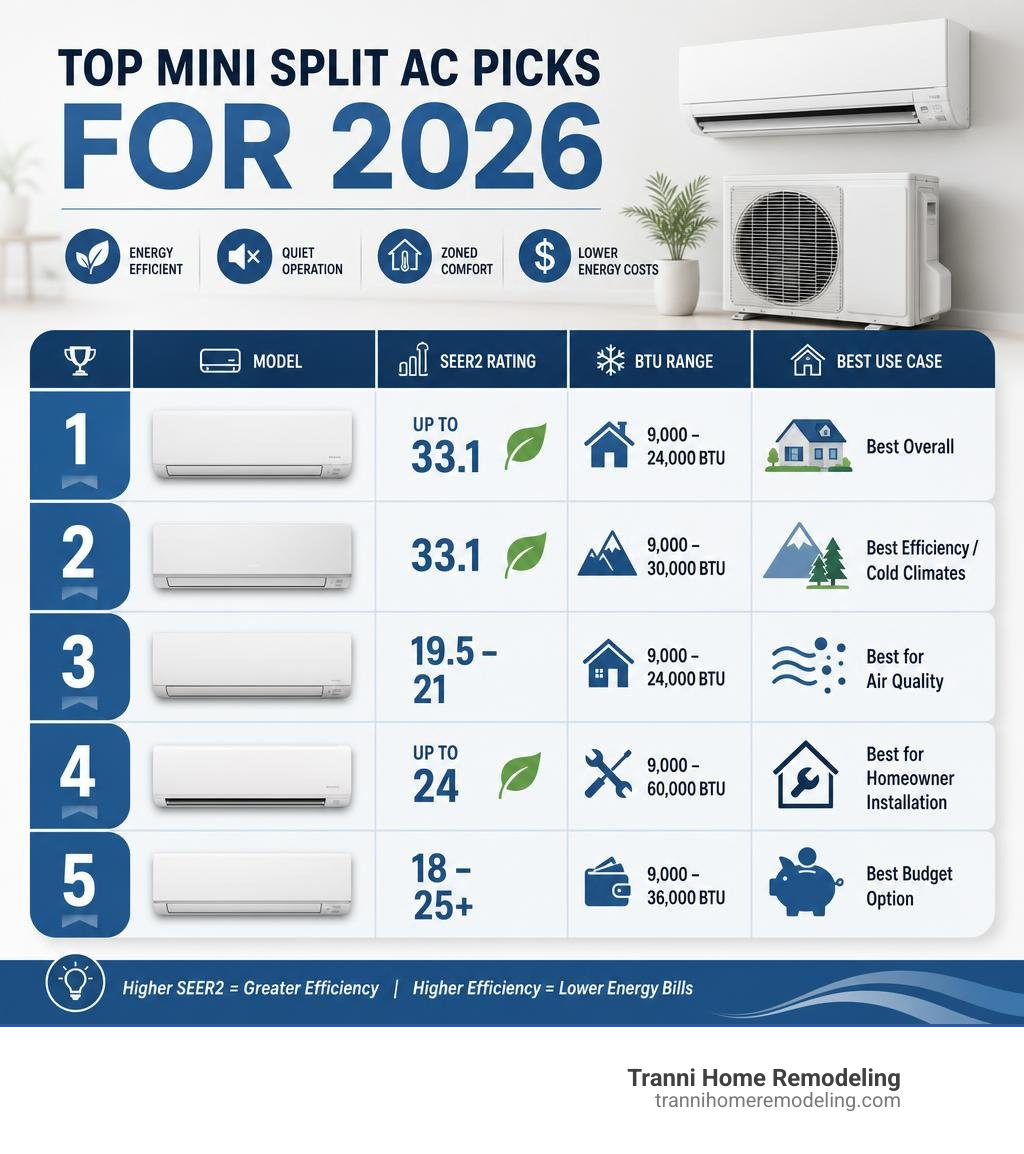
If you’re researching the best mini split ac units available in 2026, here are the top picks to consider right now:
| Rank | Model | Best For | SEER2 Rating |
|---|---|---|---|
| 1 | Mitsubishi MSZ-FS Deluxe | Best Overall | Up to 33.1 |
| 2 | Fujitsu Airstage LZAS1 | Best Efficiency / Cold Climates | 33.1 |
| 3 | Daikin LV Series | Best for Air Quality | 19.5–21 |
| 4 | MRCOOL DIY 5th Gen | Best for Homeowner Installation | Up to 24 |
| 5 | Senville LETO Series | Best Budget Option | 18–25+ |
Choosing the right residential cooling system is one of the most impactful home improvement decisions you can make. Ductless mini splits have become increasingly popular because they deliver zoned comfort without the energy losses that come with traditional ductwork — and the latest 2026 models are more efficient, quieter, and smarter than ever.
According to the U.S. Department of Energy, duct losses alone account for more than 30% of a central air system’s energy consumption, particularly when ducts run through unconditioned spaces like attics. That’s a significant amount of money leaving your home before conditioned air ever reaches you.
And yet, most homeowners still pick a unit based on price alone — without considering sizing, efficiency ratings, or installation quality. That’s where things go wrong.
I’m Tyler Tranni, owner of Tranni Home Remodeling in Billerica, MA. Through years of residential remodeling and HVAC work across Middlesex County, I’ve seen which mini split systems hold up, which ones underperform, and what separates a smart installation from a costly mistake. This guide cuts through the noise to help you find the best mini split ac units in 2026 for your specific home and budget.
Best mini split ac units 2026 helpful reading:
Understanding Ductless Mini Split Systems vs. Traditional HVAC
When we talk to homeowners in Billerica, Burlington, or Chelmsford about upgrading their heating and cooling, they often ask: “What actually makes a ductless mini split different from what I already have?” To understand why these systems have taken over the residential HVAC market, we have to look at how they compare to traditional central air and noisy window units.

A ductless mini split system consists of two primary components: an outdoor condenser unit and one or more indoor air handlers. These components are connected by a small conduit housing the power cable, communication lines, and copper refrigerant tubing. Unlike central air, which relies on a massive network of ducts to blow conditioned air through the entire house, mini splits deliver comfort directly into specific rooms or “zones.”
This direct delivery method is highly efficient and solves many common indoor air quality problems. Because there are no ducts to collect dust, pet dander, mold, or pollen, the air you breathe is significantly cleaner. In fact, concentrations of some indoor air pollutants are often 2 to 5 times higher than typical outdoor concentrations, and since we spend roughly 90% of our time indoors, clean air is essential.
To dive deeper into how these systems function, take a look at our Ductless Mini Split Complete Guide. However, while they are incredibly efficient, they might not be the perfect fit for every single home. To make an informed decision, it is wise to read about Why Some Homeowners Hate Mini Splits and What to Watch Out For before you invest.
How Ductless Systems Differ from Central Air
The most obvious difference between a mini split and central air is the ductwork. Central air systems force air through sheet metal or flexible ducts. Over time, these ducts sag, crack, and leak. As mentioned earlier, duct losses account for over 30% of a system’s energy consumption. By removing the ducts entirely, mini splits instantly reclaim that lost energy.
Furthermore, mini splits allow for precise zone control. With central air, your thermostat is usually in one central hallway. If your upstairs bedroom in Wilmington or Bedford gets baked by the afternoon sun while your basement remains freezing, central air cannot solve that problem without wasting energy. A mini split lets you set different temperatures for different rooms. If you want a detailed breakdown of how this zone-by-zone cooling operates, check out our Mini Split AC Unit Guide.
Mini Splits vs. Window Air Conditioners
If you are still dragging heavy, metal window units out of your garage every June, your back—and your wallet—are likely suffering.
- Noise Levels: Window units are notoriously loud, often rattling like a washing machine full of rocks at 2 AM. Indoor mini split units, on the other hand, operate at whisper-quiet levels between 19 and 28 decibels. That is quieter than a library.
- Aesthetics and Light: Window units block your view, ruin your home’s curb appeal, and rob you of natural sunlight. Mini splits mount high on the wall, completely out of the way of your windows.
- Security: A window AC unit is a security hazard, providing an easy entry point for intruders. Mini splits only require a small 3-inch hole through the exterior wall, keeping your home secure.
- Permanent Convenience: You never have to uninstall, clean, and store a mini split when New England winters arrive. They stay mounted year-round, ready to transition seamlessly from cooling to heating.
Choosing the Best Mini Split AC Units 2026: Sizing and Efficiency
Selecting the best mini split ac units 2026 requires understanding two critical metrics: efficiency ratings and thermal capacity (BTUs). Buying a system that is too small means your home will never reach a comfortable temperature. Buying one that is too large leads to “short-cycling,” where the unit turns on and off rapidly, failing to dehumidify the air and leaving your room feeling cold and clammy.

When comparing systems, you must look at the SEER2 (Seasonal Energy Efficiency Ratio 2) rating. In January 2023, federal standards transitioned from SEER to SEER2, which uses more demanding testing procedures that better reflect real-world static pressure. Because of this, SEER2 ratings typically run 5% to 7% lower than older SEER ratings, so make sure you are comparing apples to apples.
To learn more about how these efficiency ratings translate into real-world heating and cooling performance, read our A Comprehensive Guide to Comparing Mini Split Heating Units. You can also cross-reference performance benchmarks in the Best Mini Split Air Conditioners of 2026 | Expert-Tested Picks.
Top Features of the Best Mini Split AC Units 2026
The technology inside mini splits has advanced rapidly. The top models on the market in 2026 feature:
- Inverter-Driven Compressors: Traditional AC compressors are either 100% on or 100% off. Inverter compressors act more like a car’s gas pedal—they continuously adjust their speed to match the exact cooling load of the room, saving massive amounts of electricity.
- Smart Home Integration: Modern units feature built-in Wi-Fi, allowing you to control temperatures via smartphone apps, set geofencing parameters, or connect with smart assistants like Alexa and Google Home.
- Eco-Friendly Refrigerants: In compliance with updated EPA regulations, the industry is transitioning away from R-410A to low-GWP (Global Warming Potential) refrigerants like R-32 and R-454B.
- Low-Ambient Heating: Premium units can extract heat from outdoor air even when temperatures plunge well below zero, making them viable primary heat sources for Massachusetts winters.
To see how these features hold up under rigorous laboratory conditions, check out the 3 Best Mini-Splits of 2026, Lab-Tested and Reviewed.
How to Select the Best Mini Split AC Units 2026 for Your Home
While square footage is a great starting point, professional HVAC installers use a Manual J load calculation to size a system. This calculation factors in local climate zones, insulation quality, window placement, ceiling heights, and even the direction your home faces. For example, if you are cooling a poorly insulated garage or a room with vaulted ceilings, you will need to upsize your unit’s capacity by 20% to 30%.
Here is a general guideline for matching room size to BTU requirements:
| Room Size (Sq. Ft.) | Required Capacity (BTU) | Tons |
|---|---|---|
| 150 to 250 | 6,000 | 0.5 |
| 250 to 400 | 9,000 | 0.75 |
| 400 to 650 | 12,000 | 1.0 |
| 650 to 1,000 | 18,000 | 1.5 |
| 1,000 to 1,500 | 24,000 | 2.0 |
Residential Installation Costs and Professional vs. DIY Considerations
Let’s talk numbers. Upgrading your home’s comfort is an investment, and your budget needs to account for both equipment and labor.
When planning your project, it is essential to understand the difference between single-zone systems (one indoor head connected to one outdoor condenser) and multi-zone systems (multiple indoor heads connected to a single, larger outdoor condenser). For a comprehensive cost breakdown, read our Mini Split Installation Cost Guide.
Average Pricing for Single-Zone and Multi-Zone Systems
Please note: The price ranges listed below are average costs based on national internet data and do not represent actual installation quotes for Tranni Home Remodeling.
- Single-Zone Systems: Average equipment and installation costs typically range from $2,500 to $9,000+. The high end of this range accounts for premium cold-climate models, complex line set runs, and necessary electrical panel upgrades.
- Multi-Zone Systems: For homes requiring 2 to 5 zones, average costs run from $4,500 to $25,000+. The higher end of this spectrum reflects extensive carpentry, long refrigerant line runs, multi-stage outdoor condensers, and structural modifications.
For more details on equipment pricing and premium system configurations, you can read The 5 Best Ductless Mini Split Air Conditioners of 2026.
Why Professional Installation Outperforms DIY
While brands like MRCOOL offer “DIY-friendly” kits with pre-charged line sets, attempting to install a mini split yourself carries significant risks:
- Warranty Voiding: Premium manufacturers like Mitsubishi, Daikin, and Fujitsu explicitly state that their warranties are only valid if the system is installed by a licensed HVAC professional. If a DIY-installed system fails, you are entirely on your own.
- Refrigerant Handling: Handling and charging refrigerant lines requires EPA Section 608 certification. Releasing refrigerants into the atmosphere is illegal and carries heavy fines.
- Electrical and Building Permits: Mini splits require dedicated 115V or 230V circuits. Wiring these safely requires permitting and must comply with local building codes. In towns like Wilmington, Billerica, and Burlington, unpermitted electrical work can void your home insurance policy.
- System Longevity: A professional installer will pull a proper vacuum on the lines to remove all moisture and non-condensables. If moisture remains in the lines, it combines with the system’s oil to create acid, which will destroy the compressor within a few years.
To learn why premium systems require professional care, read more about the Mitsubishi Ductless AC System.
Frequently Asked Questions About Ductless AC
Are mini split heat pumps eligible for federal tax credits in 2026?
Yes! Under the federal Section 25C Energy Efficient Home Improvement Credit, qualifying residential mini split heat pump installations are eligible for a tax credit of 30% of the total cost, up to $2,000 per year.
To qualify for the credit in 2026, the system must meet strict efficiency guidelines set by the Consortium for Energy Efficiency (CEE)—typically requiring ENERGY STAR Most Efficient certification. Furthermore, starting in 2026, homeowners must obtain a Qualified Manufacturer Identification Number (QMIN) from the manufacturer to file with IRS Form 5695.
How often should mini split filters be cleaned and maintained?
To protect your indoor air quality and ensure system longevity, you should clean the reusable plastic pre-filters every 2 to 4 weeks during peak cooling and heating seasons.
To clean them, simply pop open the front panel of the indoor air handler, slide the filters out, rinse them with lukewarm water, let them air dry completely, and slide them back in. Neglecting this simple step is the number-one cause of airflow restriction, ice buildup on the coils, and premature compressor failure. Additionally, you should schedule a professional deep-cleaning and coil flush once a year.
Which mini split systems perform best in cold climates?
For homeowners in Middlesex County, cold-climate performance is non-negotiable. Traditional heat pumps lose efficiency as temperatures drop, but modern cold-climate models utilize advanced vapor injection and variable-speed inverter technology to deliver reliable heat in sub-zero conditions.
The Fujitsu Airstage with XLTH (Halcyon Cold Climate) technology and the Mitsubishi MSZ-FS with Hyper-Heating INVERTER (H2i) technology are the industry leaders. These systems can operate at 100% heating capacity down to 5°F and continue to provide efficient, reliable heat even when outdoor temperatures plunge to -15°F.
Conclusion
Investing in one of the best mini split ac units 2026 has to offer is a fantastic way to lower your energy bills, improve your home’s indoor air quality, and gain precise control over your indoor comfort. Whether you are adding a zone to a new home addition, finishing a basement, or retrofitting an older home that lacks ductwork, ductless technology is the smartest path forward.
At Tranni Home Remodeling, we have spent more than a decade helping homeowners in Billerica, Chelmsford, Bedford, and throughout Middlesex County transform their living spaces. We combine premium craftsmanship with high-quality residential HVAC services to ensure your home remodeling project is comfortable, beautiful, and energy-efficient.
Ready to upgrade your home’s heating and cooling? Contact us today to schedule a consultation and get a professional estimate tailored to your space: Tranni Home Remodeling HVAC Installation.